

Taboo topics in party games
The present is cruel and beautiful. It is as colourful as confetti swirling through the air at a party. It is as black as smudged kohl after a sexual assault. Books and films address all these colours, all this joy and suffering. Board games do not. They generally avoid anything that might cause irritation, including topics like death, homosexuality or depression. Why is that?
Note: This article first appeared in 2018 in the spielbox.
Let’s start with Ravensburger. The publisher only has feel-good products in its range and deliberately avoids controversial topics in games. The brand philosophy is based on joy, education and togetherness. “These values are naturally also reflected in our games. Ravensburger board games stand for high content and material quality as well as positive gaming fun. All our board games for children and families, dice, card and educational games are deliberately completely non-violent. After all, gaming sessions with all Ravensburger games should be great fun and convey positive experiences and moments. Games with negatively connoted themes cannot convey positive shared experiences,” says Katrin Hanger, the company’s spokesperson.
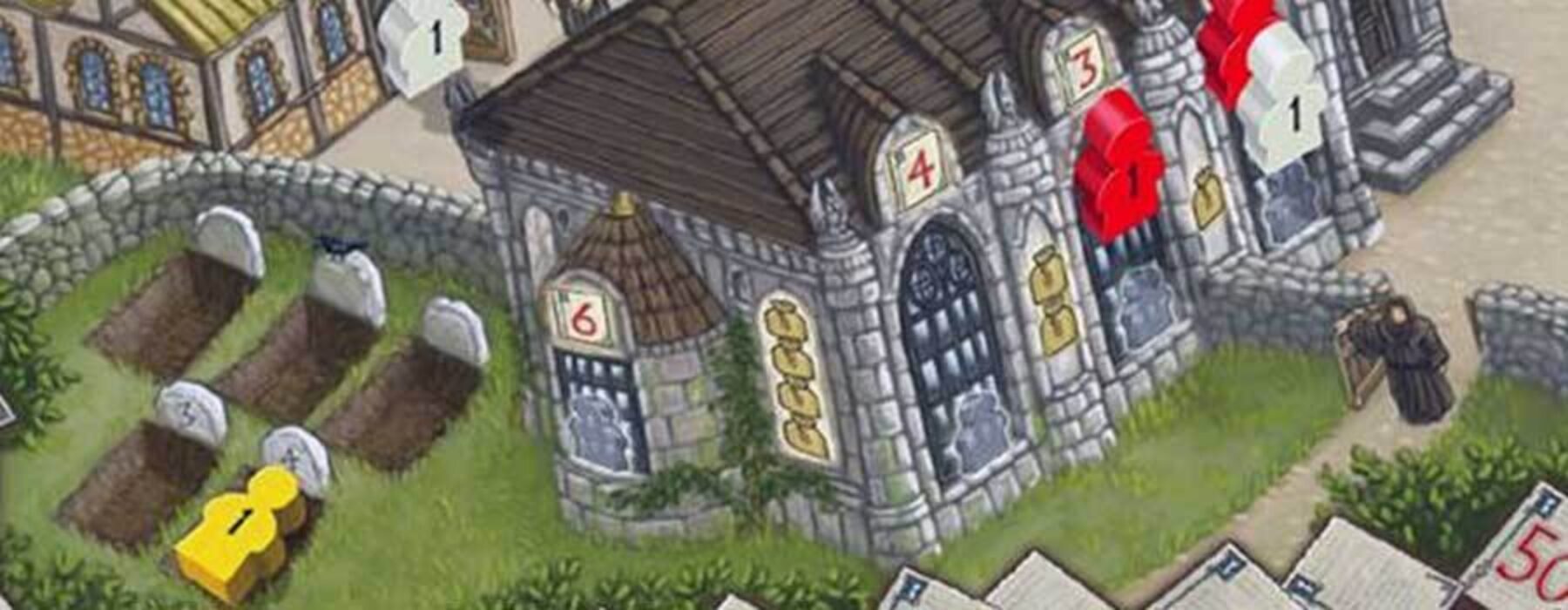
eggertspiele saw things differently in 2011. That year, the publisher released Village, in which death is ever-present. The authors Markus and Inka Brand wanted to develop a game that depicts life in a medieval village. They recall: “We quickly had the idea that several generations would live in the village. This led us to introduce time as a resource. As time passes, life passes – the playful representation of which we wanted to create. This is how death entered our game. Thematically embedding death in the game was never a problem for us. Our characters die a natural death, always in old age – that’s the way of things. On the one hand, there is the respectful handling of the topic of death, which we believe we have done well. Our deceased characters leave traces. They are mentioned in the chronicle and are generally not forgotten. On the other hand, there are game design tools that are necessary to make a good game.” In Village, death is closely intertwined with the game mechanics. The characters belong to different generations, are born and die. “Thanks to the logical time mechanism, the natural rhythm of life is as much a part of this coherently and clearly composed game as anything else,” the Spiel-des-Jahres jury praised when they named Village the Kennerspiel des Jahres.
Mostly feel-good scenarios and fictional worlds
However, death playing such an important role in a widely distributed game is the exception. Most of the time, instead of taboo topics, feel-good scenarios are offered, and the journey takes you to fictional worlds. This allows you to leave everyday life behind, relax and have carefree fun with other people. “Difficult, complex topics require more of a thematic engagement. This is offered, among other things, by books, such as those also found in Ravensburger’s book publishing division. Difficult social issues are also addressed there,” says Hanger. Nevertheless, there are board games with difficult topics. In Freedom – The Underground Railroad, participants support the abolition of slavery. In Manhattan Project, they build an atomic bomb, and in Black Orchestra, they want to assassinate Hitler.
One publisher that has several titles with unusual topics in its range is TerrorBull Games. In War on Terror, for example, players finance terrorists, encourage them to carry out suicide bombings or, as representatives of the opposing side, spread their idea of democracy around the world. The people behind TerrorBull Games, Tom Morgan-Jones and Andrew Sheerin, are about more than provocation; they are committed to the diverse representation of topics. Morgan-Jones and Sheerin often use satire, but not only. “Satire is perfect for criticism and speaking harsh truths. There is a long and honourable tradition of humour that goes back to court jesters. Humour can expose nonsense and reach people that serious sermons cannot. Ultimately, though, everything we do is a suggestive stage on which players can step into roles they want to take on. In War on Terror, no one has to pretend to be a deranged lunatic like Kissinger, capable of unspeakable things, but it can help. The real satire lies in the way the game is played, not in the way we present it. And that’s exactly why we love the medium.” Author Ulrich Blum is also fascinated by the medium of games. He too wants to tackle sensitive topics, but wishes for a serious engagement with them. “For me, this above all requires a role that makes the dilemmas of the actors tangible. Because this is where I see the exact opportunity of games: I am not just a spectator, but actively experience and decide.”
A. Sheerin: “Games don’t have to be fun”
Are there still topics that shouldn’t be addressed? “Sex, death, religion, war are part of life to varying degrees; they shouldn’t be taboo. If you approach these topics with the necessary respect, they can be wonderfully incorporated into games. Sexual abuse, rape, animal cruelty, maltreatment are, however, topics that we don’t even want to think about how to package into a game. We are grateful that publishers don’t bring these topics to the table,” say Markus and Inka Brand. Sheerin sees it differently. For him, games are a lens through which we learn something about life, “a legitimate creative form of expression and a valuable tool for exploring different topics”. In many cases, they are even better suited for dealing with difficult and taboo topics than linear media like films or books. “Games require interaction and decisions – decisions that have consequences.” Sheerin is aware that many people perceive games as something that should only distract from everyday life and entertain. In this context, topics like rape, child death or the Holocaust would be in poor taste for him. “But it doesn’t have to be that way. Games that interest me are rarely superficial or frivolous. Some aren’t even funny. I believe games don’t have to be fun. Games enable experiences. In my opinion, there’s no reason to restrict these experiences more than the experiences enabled by books, comedy, films, dances or whatever else.”
Comment: More courage
Most board games take us to sanitised pseudo-historical scenarios or fantasy worlds. The only thing participants think about is how they can exchange resources for victory points even more effectively. I think: this should change. Of course, there should still be fantasy worlds and sanitised pseudo-historical scenarios. But a bit more realism and engagement with critical topics in board games would be desirable and have several positive effects. Realistic-critical topics provide food for thought for players and thus help to question behavioural patterns and norms. That can never be a bad thing. Secondly, such games attract more attention outside the scene, especially journalists tend to prefer games that address current or unusual topics. Thirdly, more serious games would support all those who are committed to board games being recognised as a cultural asset. Child abuse, rape, xenophobia: should games really address such things? Yes. Books and films have been doing this for a long time. That’s a good thing, because anything that is addressed is also discussed. Keeping silent has never helped anyone; playing with, talking about and reflecting on these issues has.