
"Board Game Barometer": Interesting data, questionable conclusions
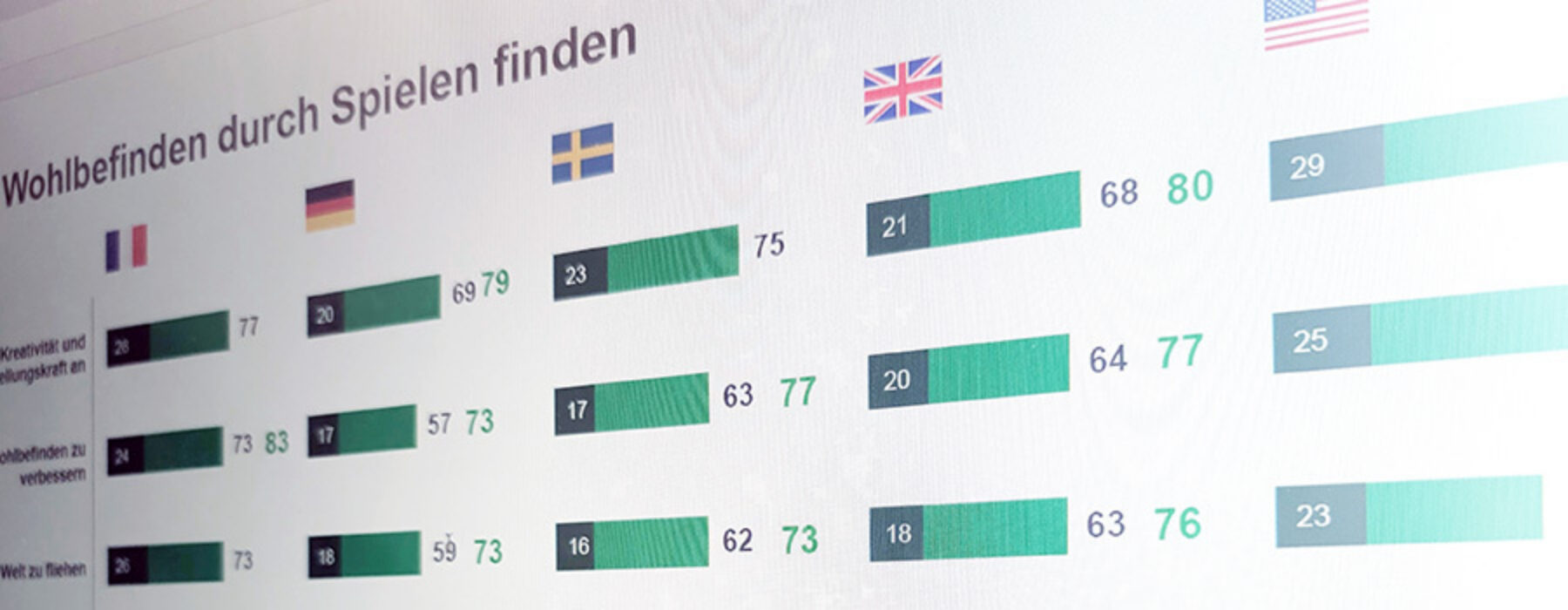
The “Board Game Barometer” is a new board game study. It provides interesting data, methodological weaknesses and questionable conclusions. We answer the most important questions about it.
Background: In June 2026, Asmodee and Kantar presented the “Tabletop Game Barometer” for the first time. The new annual study is intended to show how people in Europe and the USA use and experience games.
This article is a supplement to an approximately one-hour podcast with Dominik Zöllner. You can listen to the full conversation in the Podcast Brettspielgalaxie. We sent written questions to Asmodee about the “Board Game Barometer” on 22 August 2026. These have not been answered so far.
You are currently seeing placeholder content from Standard. To access the actual content, click the button below. Please note that data will be shared with third parties in the process.
More informationWhat studies and analyses on board games are there?
Only a few studies focus specifically on board games. Often, they only appear as a peripheral aspect or are grouped under collective terms such as “games and puzzles” or “toys” in the context of leisure behaviour.
Long-term studies on board games are even rarer. An exception is the market research institute Circana (formerly NPD Group), which collects market data. This is primarily used by publishers and industry associations.
The “Board Game Barometer” by Asmodee and Kantar aims to fill this gap. It is intended to appear annually and “compare board game practices, motivations and perceptions across markets to track their development over time”, writes Asmodee.
Why are different studies so difficult to compare?
Terms like survey, analysis or study are not protected and say nothing about the quality of the content. They are also completely different things. A survey is a method of collecting data, an analysis is a method of examining structures in data, and a study is a systematic scientific investigation.
Survey methods, questions and definitions also vary. Sometimes data is evaluated directly from retailers’ cash register systems, sometimes people are surveyed. Sometimes this survey is conducted online, sometimes by phone. Sometimes studies are representative, sometimes they are not.
How reliable are the results of the “Board Game Barometer”?
The “Board Game Barometer” was commissioned by Asmodee. It was designed and conducted by the market research company Kantar. In May 2026, Kantar surveyed 5,000 people aged 18 and over online, with 1,000 people each in Germany, France, Sweden, the UK and the USA. According to the study description, the survey was representative in terms of age, gender, region and socio-economic group.
“Online panels are by definition not representative of the population and are therefore only suitable to a limited extent for researching attitude distributions that are supposed to exist in the general population. In my opinion, this study is primarily a marketing tool and is by no means scientifically sound,” says Dr. Johannes Blumenberg, social scientist and operator of the blog brettspielministerium.de.
“A pure random selection is the only way to obtain a population-representative sample. At present, this can primarily be achieved through telephone or face-to-face surveys. In the future, this could certainly change. This requires that the entire population uses the internet. In addition, the online access panel used must be recruited offline via a random selection from the general population. Self-recruitment of respondents must be excluded,” write Dominik Hirndorf and Dr. Sabine Pokorny in their article Online, offline or both? Survey methods in the practical test. “For the scientific sector, such panels already exist, for example the GESIS Panel pop,” adds Dr. Blumenberg.
In the “Board Game Barometer”, some terms also remain unclear: What exactly counts as a board game? Are card games included? If so, which ones? In some questions, the study distinguishes between board games and collectible card games, in others it does not. Additionally, it differentiates between all respondents and fan players in some answers. What is meant by this term is not explained.
What improper conclusions are drawn in the “Board Game Barometer”?
In addition to the press release, Asmodee has published a presentation on the “Board Game Barometer”. One slide shows how often respondents engage in certain activities.
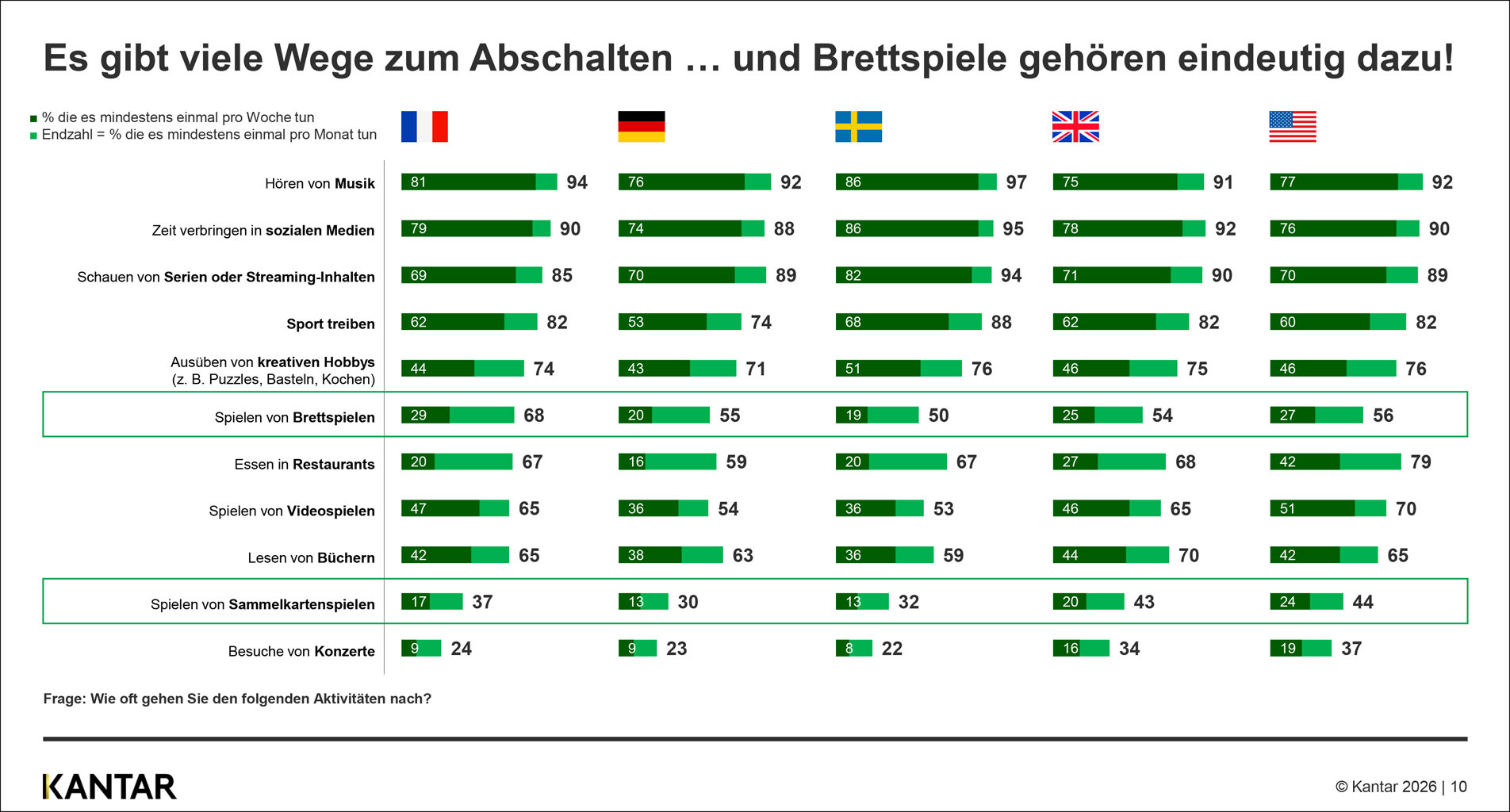
The headline suggests that all the activities mentioned are ways to unwind. This is not true. Just because 63 percent of respondents read books at least once a month does not mean they do so to unwind. They could also read books for school, university or work. For other activities, the equation between frequency and unwinding is also questionable, and this also applies to board and collectible card games.
Other slides show similar weaknesses.
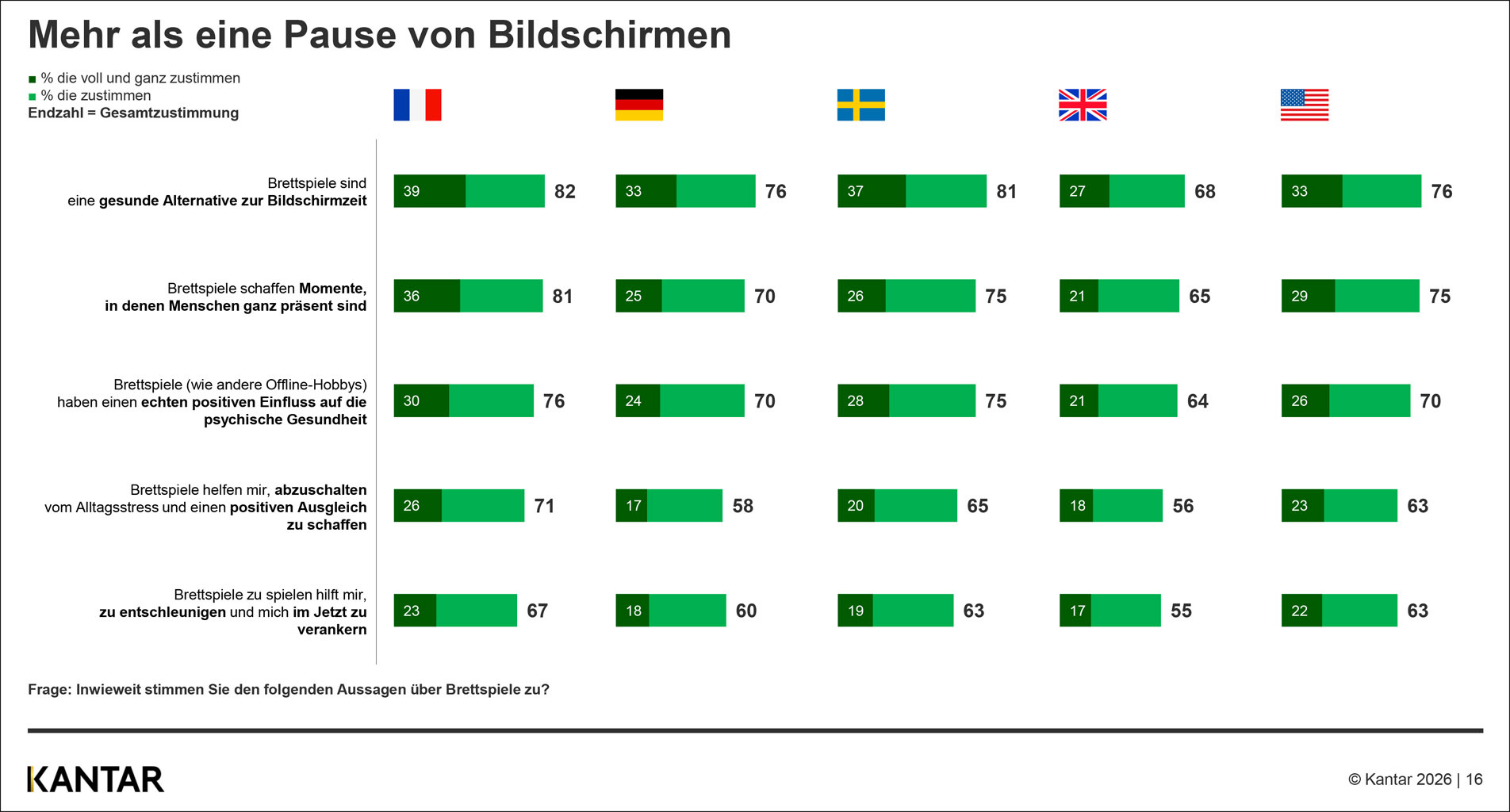
It is true that in Germany, 60 percent of respondents say that board games help them to slow down and stay in the moment. However, the data does not prove a cause-and-effect relationship. If someone states that a board game helps them unwind, it does not follow that board games actually promote mental health or reduce loneliness. The study primarily captures opinions and self-reports.
Asmodee writes: “Board games are no longer perceived as mere entertainment. They increasingly fulfil a broader societal need for balance, well-being and genuine connection. A quick game after dinner, a Sunday family ritual, a games night with friends or a deeper, immersive session all create the same thing: a protected moment in which people can be here, now and together.”
If studies are so problematic, why do they exist at all?
Studies are created for different reasons. On the one hand, they are intended to provide scientific insights. Often, however, they also serve market research and are later used in marketing. For example, Kosmos wrote in a press release in January 2026:
“The focus of the trade fair appearance […] is the tenth anniversary of Exit – Das Spiel, one of the most commercially successful board game brands worldwide. Since its market launch in 2016, around 30 million games have been sold in over 35 countries. Exit is now among the top 3 highest-grossing game brands on the market.”
This statement is based on data from Circana.
Studies often create news value – or at least aim to – and help to be perceived as an expert in board games.
This does not automatically make surveys like the “Board Game Barometer” worthless or unreliable. With a sample of 1,000 adults per country and a standardised survey, it provides interesting comparative data. The weaknesses lie in the interpretation: the respondents report their perceptions and assessments. Whether board games actually promote mental health, alleviate loneliness or strengthen relationships remains unmeasured.
What other insights does the “Board Game Barometer” provide?
More than half of Germans (54 per cent) spend their Saturday evening at home with a game rather than going out, according to the “Board Game Barometer”. At the same time, a majority (51 per cent) feel uncomfortable when a board game is brought to the table at a meetup.
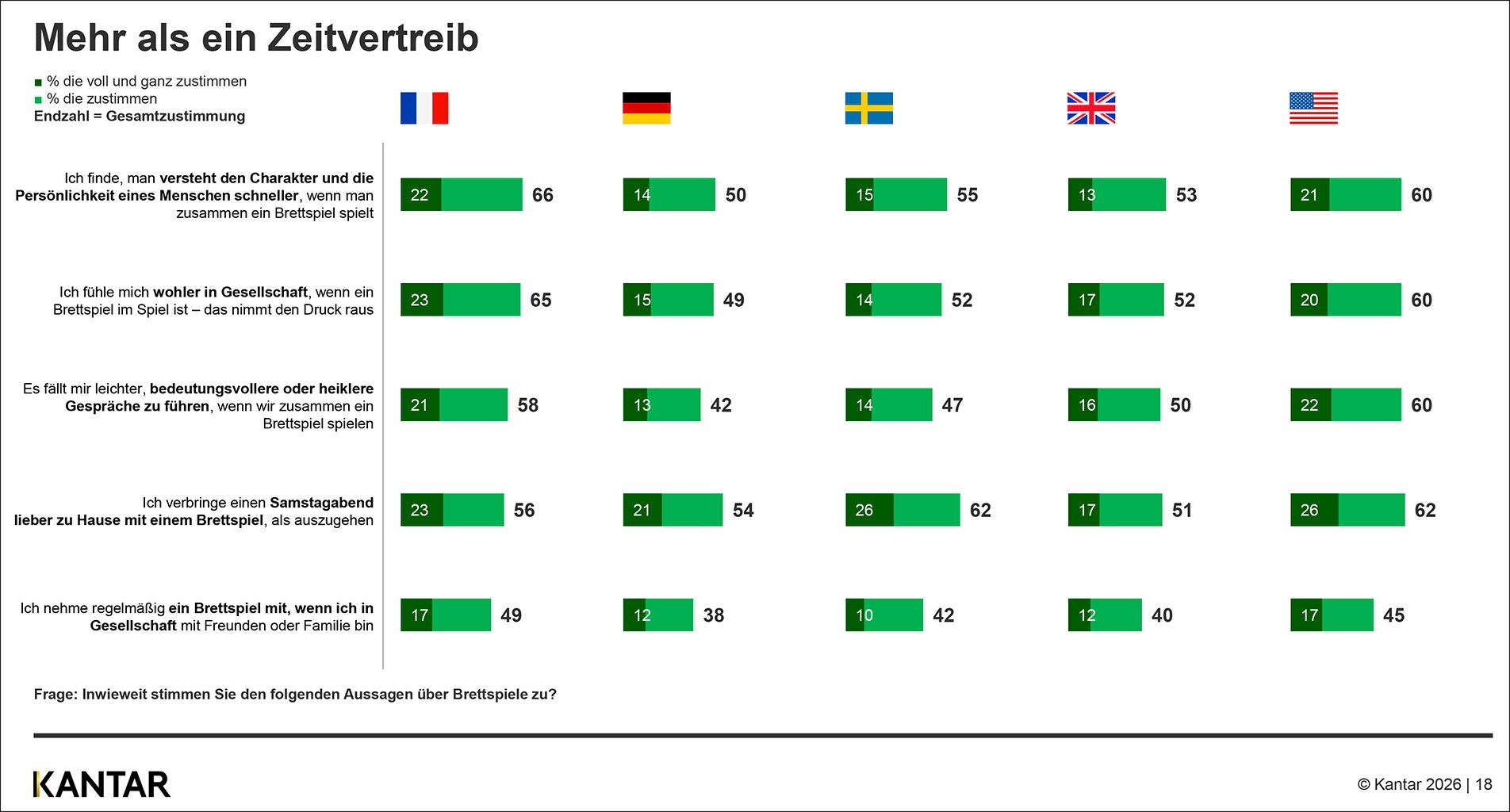
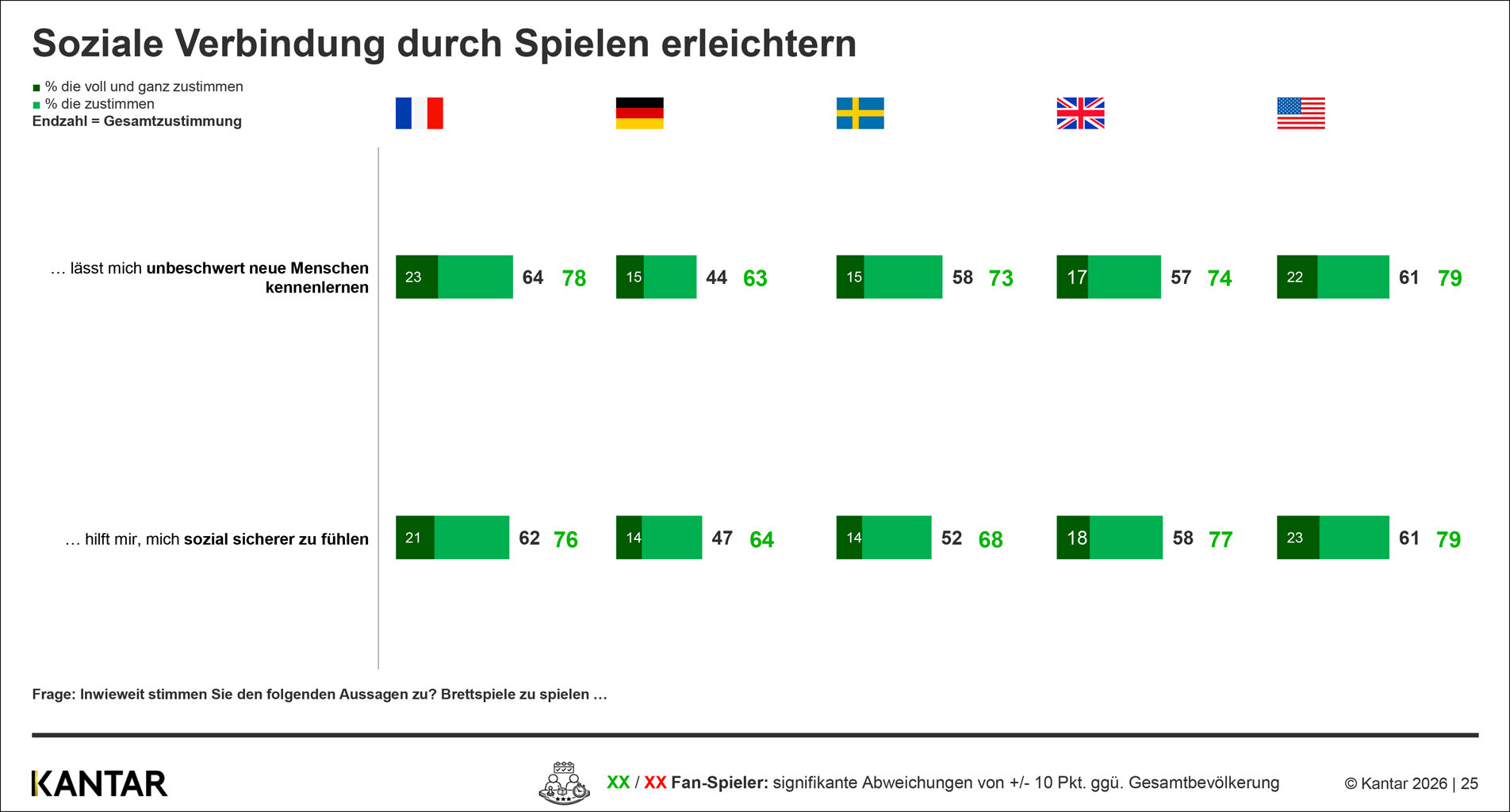
These findings align with another question: 47 per cent of respondents in Germany said that board games help them feel more socially confident. Conversely, this means that 53 per cent feel rather socially insecure because of board games.
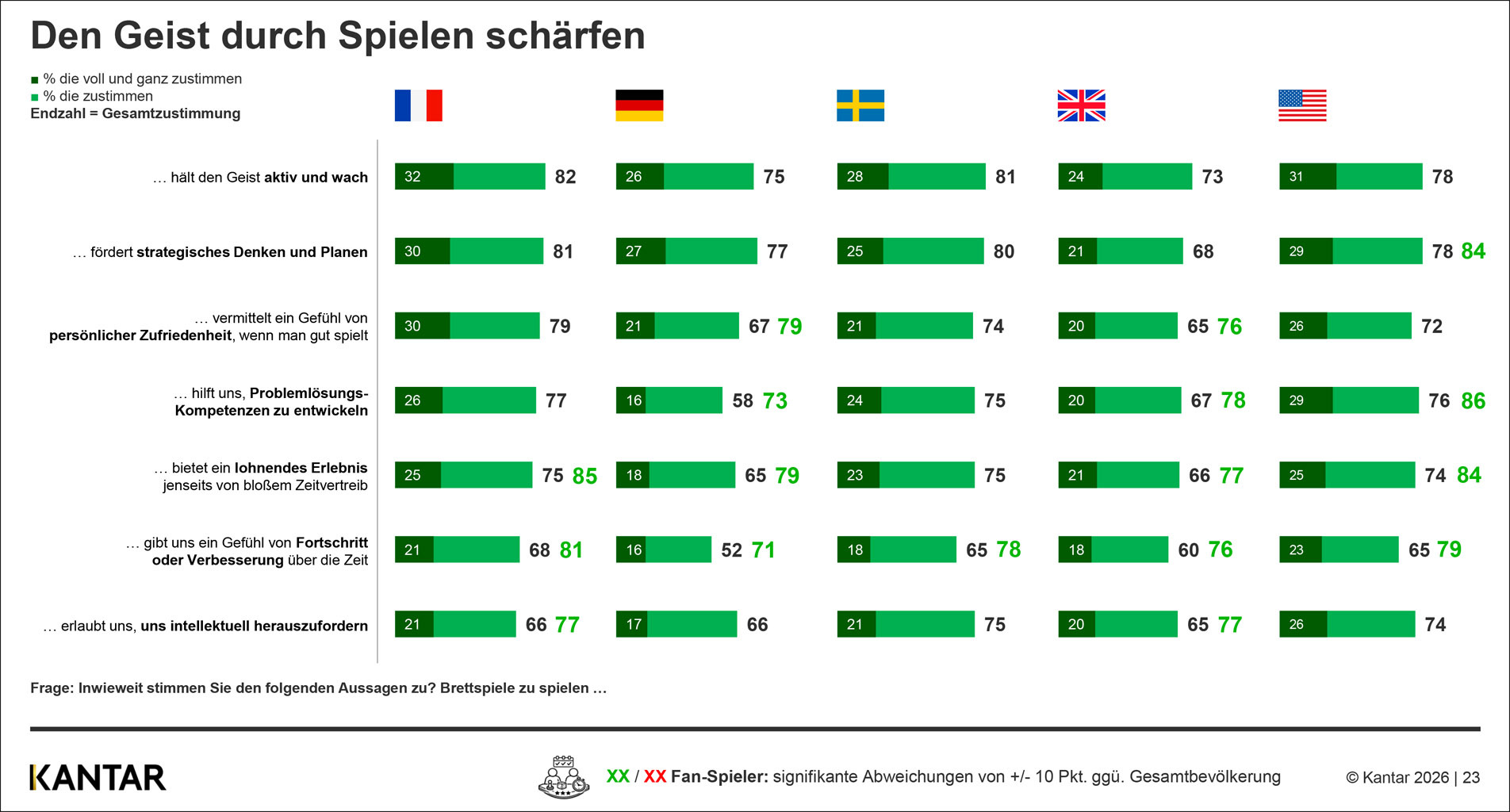
Board games are also seen by 75 per cent of respondents in Germany as something that keeps the mind active. They sharpen strategic thinking and offer an experience that is more than just a way to pass the time.
What question can the “Board Game Barometer” also not answer conclusively?
Do Germans play more board games or video games? Simple question, complicated answer. And this has been the case for years. As early as 2010, we pointed this out in our article Traue keiner Statistik. According to Asmodee, 54 per cent of respondents in Germany play video games at least once a month and 55 per cent play board games. This would mean: more people play board games than video games.
Market research company YouGov arrives at a similar result. It evaluated data in December 2025 and writes: “Around a quarter (23 per cent) of Germans list playing board games as one of their topics or hobbies of interest according to YouGov Profiles – meaning board games are now on a par with video games in the interest ranking of Germans.”
The Freizeitmonitor 2026 comes to a different conclusion. According to it, in 2026, out of every 100 respondents, 33 regularly played video games, but only 14 played board games.
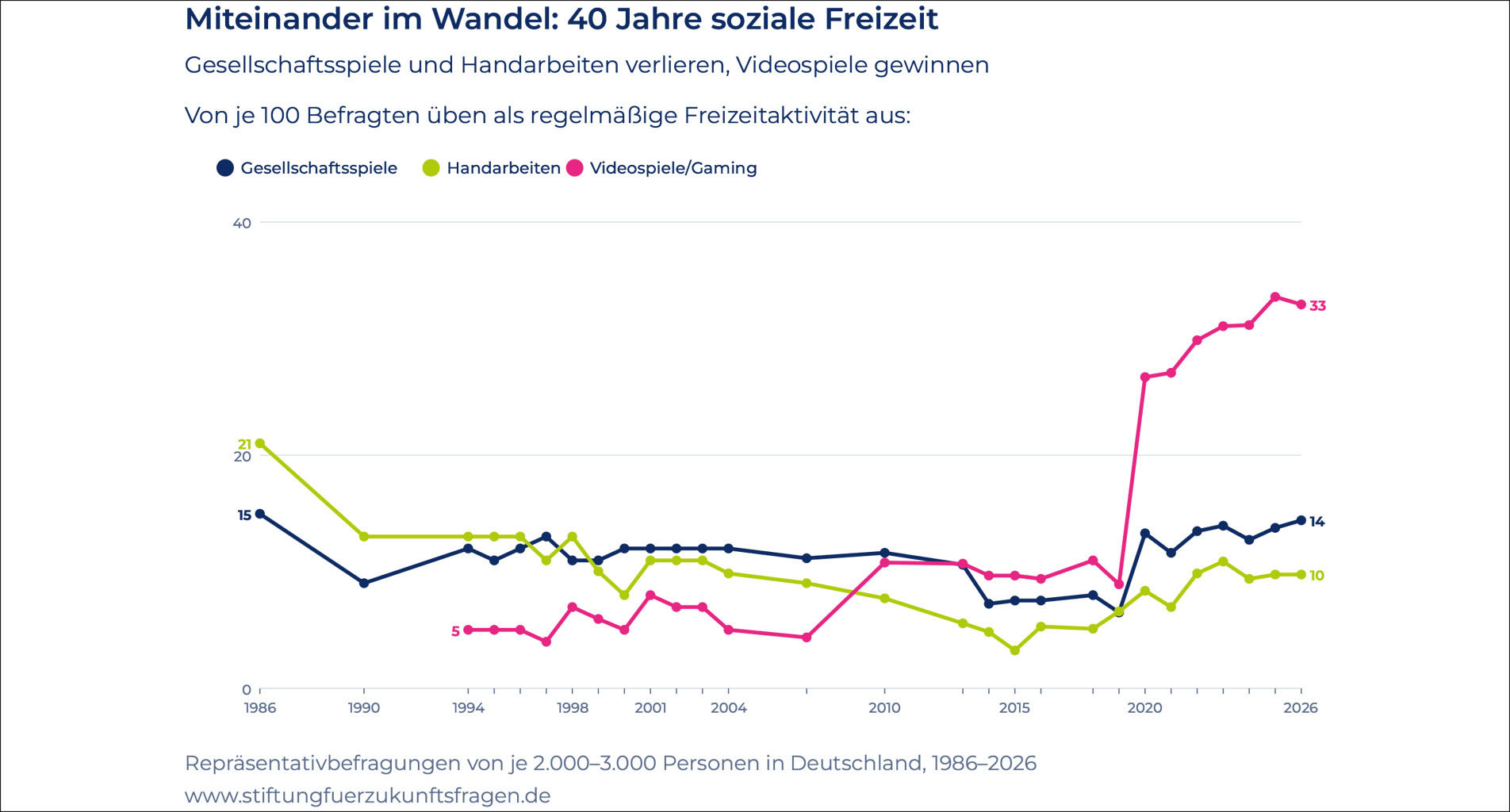
The Freizeitmonitor states: “Video games first appeared in the survey in 1994 with five per cent, hovered between four and eleven per cent until 2019 – and then rose sharply to 27 per cent (2020) and 33 per cent (2026). Gaming is now a weekly routine for every third person, long since no longer just alone in front of the screen, but networked and together. The desire to play has remained – its form has changed.”
The presentation on the “Board Game Barometer” can be downloaded at https://corporate.asmodee.com/news/game-night-is-the-new-night-out-more-than-half-prefer-playing-a-board-game-to-going-out.