
"Women prefer more communicative games"

Men dominate the games industry: as authors, illustrators, editors, publishers and critics. Women still enjoy playing. But they apparently prefer different games to men. And they’d rather talk than focus on winning. There are no studies to scientifically prove this – but there are numerous indications.
Note: This article first appeared in 2014 in spielbox.
August 2013: spielbox readers are outraged. They are lively discussing 25 words on spielbox.de. Some claim the words are discriminatory. Some want to cancel their spielbox subscription. Others don’t understand all the fuss. The 25 words stir people up. They heat tempers and electrify. The words were written by colleague L.U. Dikus in issue 03/2013, in a paragraph about “Ricochet Robots”. It says: “An additional black or, by now, silver robot is meant to provide relief and is therefore well suited as a balancing element in mixed groups with women and children.”
Is this sentence clumsily phrased, sexist, true or ironic? Those interested can and should continue to discuss this in the spielbox forum. Here, we provide some arguments for it, as well as numbers and facts about men, women and board games.
Do men really dominate the games industry?
The answer to this question, unlike the following ones, is simple: Yes. The Society of German Game Authors (SAZ) has about 430 members. Of these, 380 are men and 50 are women. That’s a female quota of about 12 percent. Most illustrators and editors are also male. Most publishing bosses too. The same applies to game journalists and bloggers. In the “Spiel des Jahres” jury, there are eight men and one woman, Sandra Lemberger. Interestingly, the ratio in the blue jury is reversed. Including the advisory board, six women and two men decide on the Kinderspiel des Jahres. The male dominance in games journalism is also evident in spielbox. The masthead lists only men as editorial staff.
Conclusion: Men dominate the board game industry. Why this is the case can only be speculated. In the video game industry, men are also in the majority. The German Games Industry Association (BIU) is therefore involved – like some board game publishers – in “Girls’ Day”. On this day, girls get to know traditionally male professions, such as game programmers, developers or designers.
Do men spend more time at the gaming table than women?
According to the Federal Statistical Office, around 39.4 million men and 41.1 million women live in Germany. Before we answer the question, let’s look beyond the game box. “The common stereotype that computer and video games are a male domain is a thing of the past,” says BIU managing director Dr. Maximilian Schenk. According to BIU, 16.2 million women in Germany play digital games. That’s 47 percent of all computer and video game players. Unfortunately, there are no such representative figures for board games. So we use three tricks. First trick: user data from Brettspielwelt. In June 2014, exactly 243,620 women and 266,684 men were registered on the online platform. That’s a female quota of about 48 percent. Sebastian Mellin trusts the numbers. The operator of Brettspielwelt assumes that only a few users provide a false gender. Second trick: a survey by the polling institute Ipsos. On behalf of deals.com, it asked a thousand Germans about their gaming preferences. According to this, 23 percent of the women surveyed and 20 percent of the men surveyed regularly meet up with friends, acquaintances and relatives to play. Third trick: a look at the visitor statistics of 30 weekly games meetups in Germany that we contacted. A total of 583 people play there every week. Of these, 201 are female, i.e. about 34 percent.
Conclusion: The numbers suggest that women enjoy playing just as much as men. While men also like to attend public games meetups, the majority of women apparently prefer private rounds or digital board game adaptations.
Do women prefer different games to men?
Anyone who considers traditional gender roles at the gaming table outdated needs to be strong now. At least as strong as Sylvester Stallone in his role as Rambo. “When I describe our data analysis to equality officers, they get goosebumps,” says Jens Junge. The Mediatrust managing director runs the portal spielen.de and can prove that women on spielen.de prefer different games to men [Editor’s note: Mediatrust cooperates with nostheide Verlag, which, among other things, publishes spielbox]. Junge’s data shows that women tend to love construction games. Often these are games where animals with big, round eyes run around. Men prefer to command armies in medieval strategy games. The preferences also differ by gender in Brettspielwelt. Imperial is played by 90 percent men, Puerto Rico and Power Grid by 78 percent each. Women prefer Bohnanza (80 percent of players are female), Bazaar (72 percent) and Ligretto (72 percent). Whether these findings from the digital world can be transferred to the analogue world is hard to say. However, publishing employees surprisingly often confirmed the supposed stereotypes. “Women tend to prefer communicative games rather than heavyweights. Of course, exceptions confirm the rule,” says Thorsten Gimmler, product manager for family and adult games at Schmidt. Silke Ruoff sees it similarly. The Kosmos spokesperson says: “In our experience, women particularly enjoy construction games and tend to avoid combat-focused games with destructive elements.”
Conclusion: There are no reliable studies on board game preferences between men and women. However, it seems the stereotype holds true, and women – speaking generally – tend to prefer communicative games. Among frequent players, this tendency is apparently less pronounced. In eleven of the thirty weekly games meetups we contacted, women prefer simpler or more communicative games. In the other 19 meetups, men and women play the same games.
Why do men play, why do women?
Men always want the same thing, especially when it comes to board games: to win. So goes the stereotype. According to the experiences of publishing staff, there’s some truth to the prejudice: “Fun and socialising are sometimes more important to women than winning. However, this isn’t necessarily the case for frequent female players,” says Ruoff. Andrea Meyer has had the same experience. The owner of Bewitched says: “If it has to be a communicative game, men, in my experience, prefer games like Times Up or Linq. In both, performance can be clearly attributed to an individual player.” Andrea Milke is also familiar with the phenomenon. The Amigo spokesperson has often observed that, in Bohnanza, men tend to focus more on successful trading with the highest possible profit. “Women place more value on interaction. They might even give away a bean to reach the goal, even if it helps their opponents.” Another indication that men are more competitive comes from the numbers of the German Board Game Championship. In 2014, 144 people competed in the final. 81 percent of them were men.
Conclusion: Once again, there are no reliable studies. However, almost everyone surveyed believes that communication, rather than winning, is the priority in many women’s game groups. For video games, this can even be proven. On spielen.de, women use the chat function significantly more often than men.
Why do female characters appear less often on game cards and boxes?
Tom Felber, the chair of the “Spiel des Jahres” jury, was surprised when he looked at the results. “When the jury, after completing their selection, looked at the covers of the fifteen recommended games on the red and anthracite lists, the unusually high number of women prominently featured on the covers immediately stood out: eight out of fifteen titles. That’s probably a record,” he writes. Female characters are also prominently represented inside the boxes. In Splendor, ten nobles visit the players – five men and five women. In Camel Up, three female and five male characters bet on camels. On the Kennerspiel des Jahres nomination list, however, women are less prominent. In Rokoko, there are male and female customers, but the apprentices, journeymen and masters are all male. In Istanbul and Concordia, men are also in the majority, even though a woman smiles from the Concordia box. Why is that? The short answer is: it’s due to the theme. The long answer comes from Pegasus spokesperson Michael Kränzle. He says: “In Noblemen, you can play as a woman or a man; all noble characters are available in both genders. Sometimes, though, it makes less sense, for example with market traders in Istanbul.” Illustrator Dennis Lohausen sees it similarly. “There simply weren’t any female legionaries in ancient Rome, and probably no female master builders in medieval Bavaria either. Still, I think it’s good when a woman appears in a traditionally male role, for example as a pirate, city guard or fighter. This works especially well in games that don’t place one hundred percent emphasis on historical accuracy. That’s why I drew a female explorer in Dominion Seaside.”
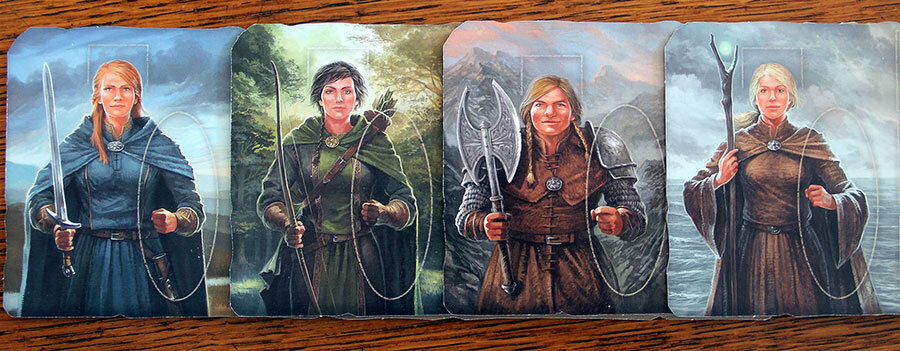
In Die Legenden von Andor, players can freely choose the gender of their heroes. Meyer is pleased about this. She says: “I now comment on games that don’t offer me attractive roles with ‘mathematically interesting’ or ‘I’m not the target audience’. I’m sure many people feel the same – especially those who don’t play often. No publisher has to integrate male and female characters into their games. But I think it would be smart to do so.” Especially since some publishers suspect that games are more often bought by women: “This applies above all to children’s games, but also to family games that end up as gifts under the Christmas tree or on the birthday table,” says Katrin Reil from Hutter Trade.
Conclusion: There are no reliable figures on whether more men than women appear in games. However, since many games are set in a historical context, this is likely the case. Current developments show: publishers and illustrators are now more aware of the issue and, where it makes thematic sense, aim for equality.
Why do many publishers avoid gender-neutral language?
The symbol shows, well, what exactly? A double triangle? A yoga pose? Or perhaps a mountain range? One thing seems certain: the sign is not self-explanatory.
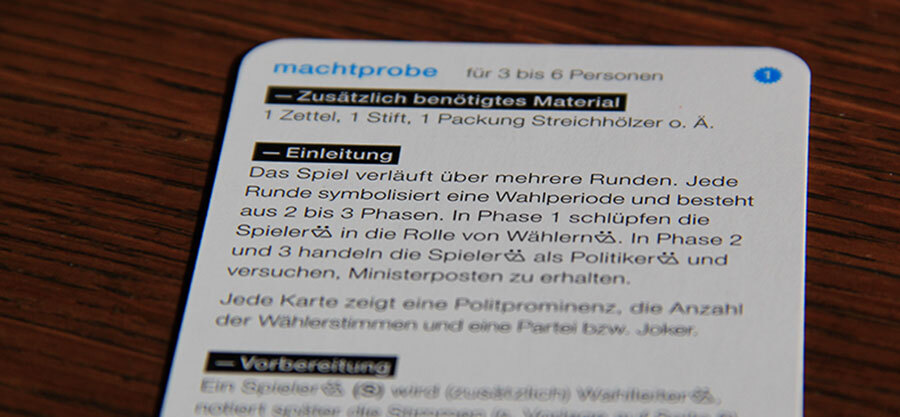
Yet the “Bundeszentrale für politische Bildung” (BPB) wanted to cater to all people and use gender-neutral language in the instructions for their card games. This takes all genders into account. There are two ways to do this: either make both genders visible, referring to players and female players, or use gender-neutral terms, such as “the players”. Almost all publishers avoid gender-neutral language. “This has nothing to do with not wanting to address women. It’s more due to space constraints and the desire for short, clear sentences. If every sentence included ‘players and female players’, instructions would be about a third longer, and sentences would be unnecessarily drawn out. Besides, the term ‘players’ has become established. Everyone knows who it refers to,” says Milke. Almost all the publishers’ representatives surveyed share this view. Meyer does not. She uses only the female form in her instructions. “I’m tired of always just being ‘included’ in most instructions. The authors make it too easy for themselves, in my opinion. But since both a capital I and a slash are hard to read, I simply include men when I use the female form.” Even this, however, isn’t one hundred percent politically correct. After all, there are also trans women, trans men and transgender people. Should these people be explicitly addressed in instructions? Meyer says: “I follow the discussion closely, but so far I haven’t come across a good, readable form of inclusion in written language. Currently, many people favour the underscore as a gender space. Editors therefore don’t write for their readers, but for their reader_innen. I currently prefer slashes. They’re also used elsewhere and might be easier to read – naturally, for the reader/inne/n.”
Conclusion: Almost all publishers avoid gender-neutral language. They justify this by saying it affects the readability of instructions.
What questions remain unanswered?
Many. Why do men dominate the games industry? Is it discriminatory that monsters, villains and rogues are usually male? Do female authors design different games than male ones? How sensual can an illustrator draw a female character’s lips, how revealing can their clothing be? Why do men usually win professional chess and Go tournaments? And where can interested people find more information on the topic? At least the last question is easy to answer. On this page, we publish interviews with men and women who, due to space constraints, were only briefly mentioned or not at all in this article. And in the spielbox forum next door, you’re welcome to continue the discussion. There will certainly be enough participants.
Comment: The wrong discussion
Women are different. Men are too. This is evident in shoe shops, in bed – and at the gaming table. It makes the world more colourful, interesting and loveable. The games world too. The generalisation there seems to be: women chat more while playing than men, winning isn’t as important to them, and they prefer communicative games. Numerous indications point to this. We shouldn’t get worked up about those who say this. There are more important things to get worked up about: for example, the portrayal of women in some board games.
In Vikings: Krieger des Nordens, players raid villages and abduct women as Vikings. Of course, games can and should tackle such atrocities – after all, there are also games about wars, even the Holocaust. However, games should approach such difficult topics with respect. Vikings: Krieger des Nordens does not. The female victims greet the attackers in unambiguously suggestive poses. The look and gestures of the red-haired woman on the yellow card signal: I can hardly wait to be properly taken by a Viking. What’s that about? And why does even the box for Strassbourg feature a woman whose décolletage is almost falling out of the window? Such illustrations are rare, but they do exist. Men and women alike should be outraged by them.