

Palestine-Watermelon: Scandal at Spiel des Jahres 2024 award ceremony
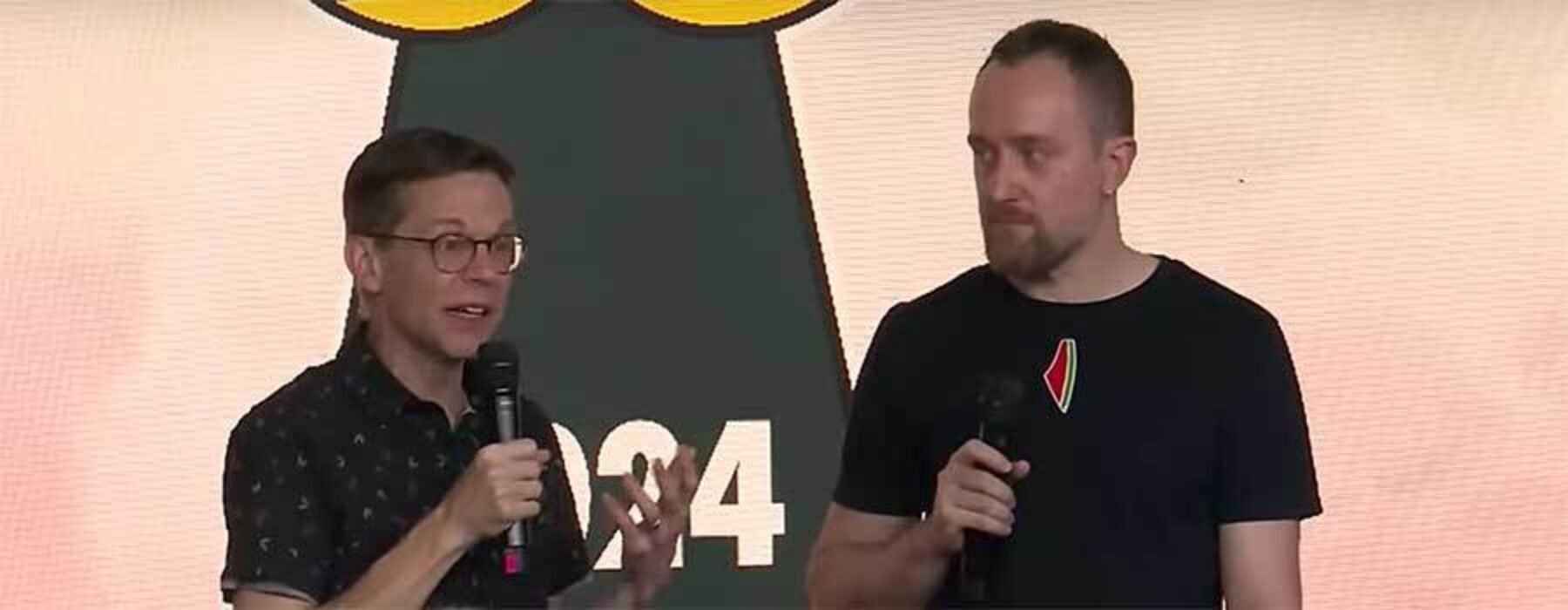
A scandal erupted at the Spiel des Jahres 2024 award ceremony. The cause was a melon sticker worn by game designer Matteo Menapace. We document the incident and the reactions to it.
At the Spiel des Jahres 2024 award ceremony, a melon caused trouble – more precisely, a melon sticker. It was displayed on Matteo Menapace’s T-shirt. Together with Matt Leacock, the designer won the Kennerspiel des Jahres 2024 award for E-Mission.
The sticker did not depict an ordinary melon, but a Palestinian one. Its colours reflect those of the Palestinian flag – red flesh, green and white rind, and black seeds. This became relevant in 1967, when Israel banned the Palestinian flag in the occupied territories after the Six-Day War. In response, Palestinians began using the watermelon as a symbol of resistance.
Antisemitic or just a sign of solidarity?
Menapace is aware of this. “By deciding to wear a watermelon sticker on stage at the Spiel des Jahres on Sunday, I wanted to show my solidarity with the Palestinian civilian population,” Menapace wrote in a statement published on medium.com on Friday, 26 July 2024, shortly after the award ceremony, which took place on Sunday, 21 July 2024.
The Spiel des Jahres association was not pleased with the sticker. “By wearing a sticker that shows the outline of a ‘Greater Palestine’, which denies the existence of the State of Israel, he [Menapace, editor’s note] has crossed the line of what can be accepted as legitimate political expression,” states a statement by the association, published on Monday, 22 July 2024. It continues: “The Spiel des Jahres association has supported the ‘Gaming for Tolerance’ initiative for years, thereby taking a clear stance against all forms of racism and antisemitism. We find it unbearable that a game designer invited by us wore a symbol on stage that must be perceived as antisemitic by Jewish people.”
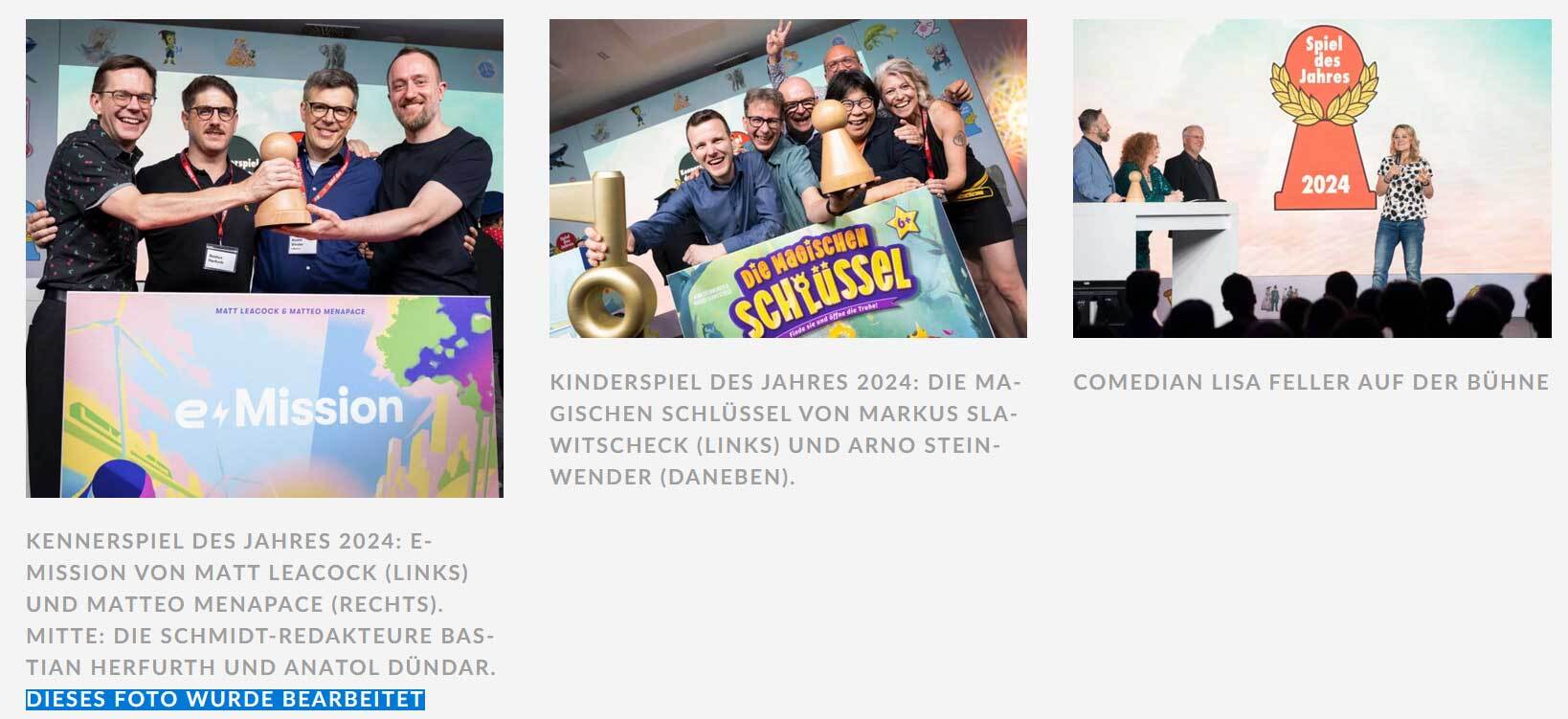
Photos: Spiel des Jahres
In his statement, Menapace wrote: “I acknowledge the current and historical context that has led to Spiel des Jahres, as a German institution, reacting with heightened sensitivity to accusations of antisemitism. I take these accusations very seriously. However, a debate about the design of the sticker and an antisemitic interpretation of it distracts from the real issue. Instead, I want to draw attention to the reality of thousands of Palestinian people who are being erased from the map and urgently need humanitarian and medical aid. No person or group of people should be erased because of their ethnic origin, religion or nationality. I hope we can all agree on that. All people deserve peace and justice. I believe this will only be possible when what the International Court of Justice recently defined as an unlawful occupation comes to an end. What we as citizens of Western nations can do is put pressure on our governments to take responsibility for their historical role in this injustice and end our complicity in financing and enabling war crimes.”
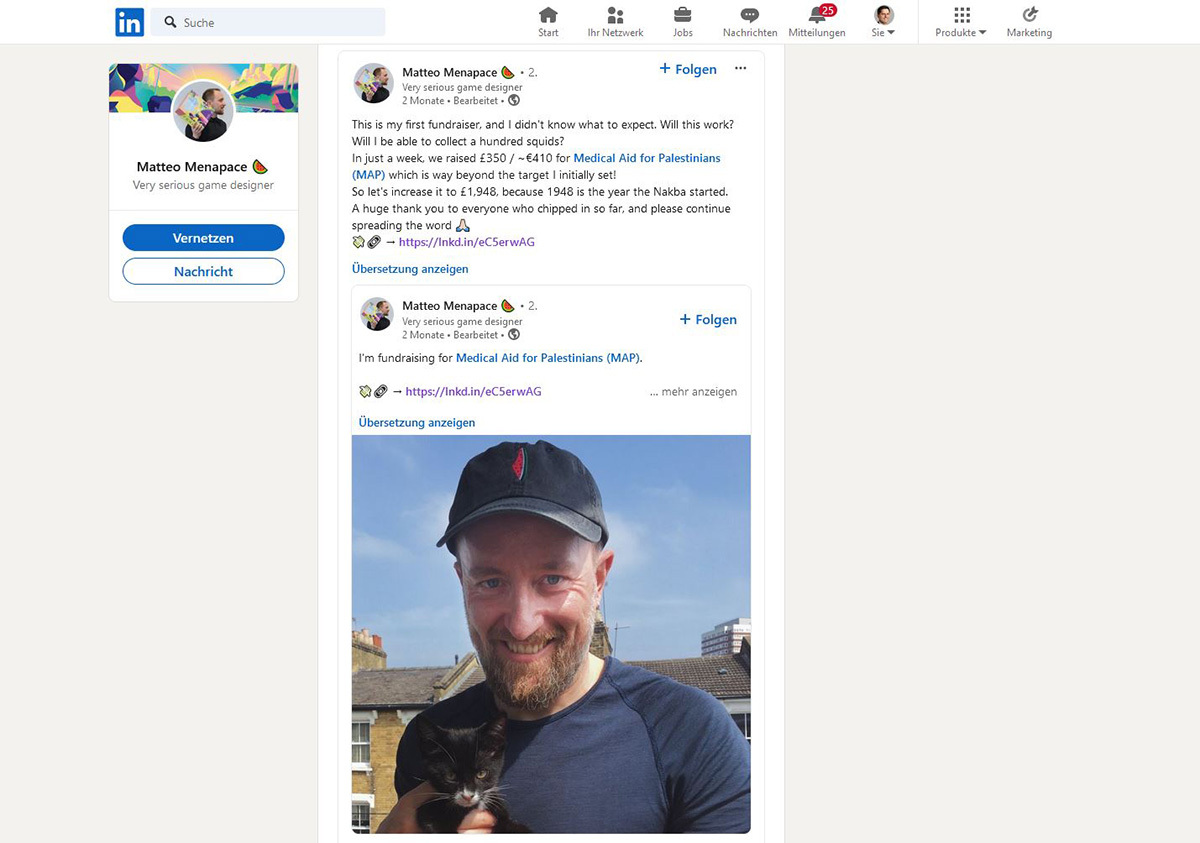
Menapace has also worn the watermelon symbol on other occasions. On his LinkedIn profile, there is a post featuring a photo of him. In it, he is wearing a cap with a watermelon in the form criticised by the jury. In the LinkedIn post, he talks about a fundraising campaign he ran in spring 2024. During this campaign, he collected money for medical aid for Palestinians. On the fundraising page, Menapace writes: “On 15 May, the Nakba (‘catastrophe’ in Arabic) marks its 76th anniversary. At that time, at least 750,000 Palestinians were expelled from their homes in historic Palestine during the violent events following the founding of the State of Israel. Many who did not want to leave were killed by Zionist militias, which later formed the Israeli Defense Forces (IDF). 76 years of military occupation, apartheid, displacement, expropriation and marginalisation have led to the best-documented, live-streamed genocide in history, with no end in sight.”
“Uncollegial behaviour”
Back to the award ceremony: during the event, neither the organisers nor those involved in the programme noticed the sticker or its meaning. However, viewers in the livestream did. Immediately after the ceremony, jury members Harald Schrapers and Christoph Schlewinski therefore asked Menapace to hand over the sticker. They prohibited him from displaying the symbol in the hall and in any photos taken there. Menapace is also no longer welcome at future events organised by the Spiel des Jahres association. “With his action, he also behaved extremely uncollegially towards the other people involved in his game (designer, editorial team, publisher),” the jury wrote.
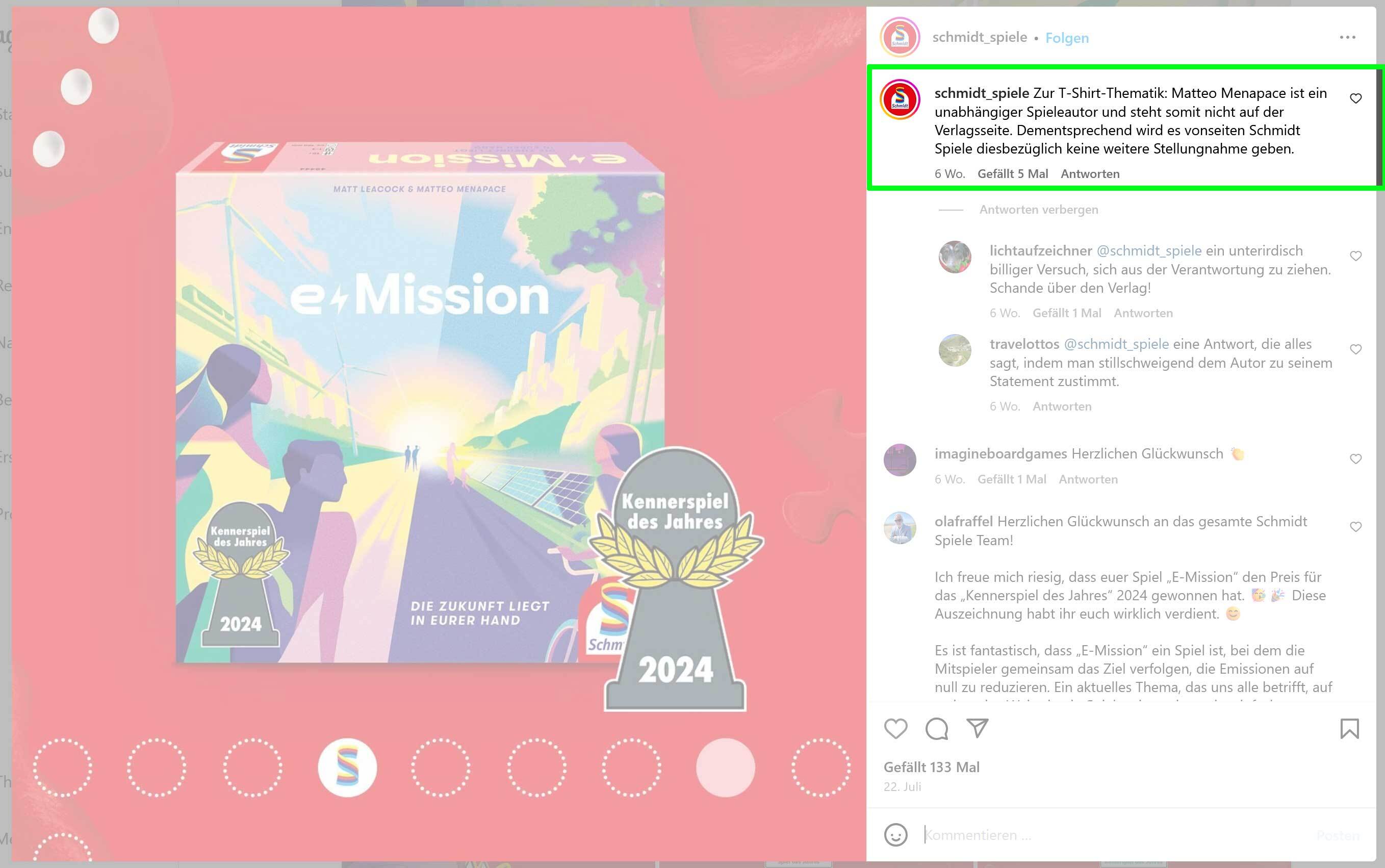
Menapace’s co-designer, Matt Leacock, has not yet commented on the incident. Schmidt Spiele, the German publisher of the game, pointed out that Menapace is an independent game designer and that the publisher would therefore not be issuing any further statements.
Reactions to the reactions
The incident, the jury’s response and Menapace’s statement have sparked a debate. Different views are clashing.
The website boardgamewire quoted German game designer Peer Sylvester. He said: “My [social media] timeline is now split. The first reaction from most [German board game] media people was an outcry over the supposedly antisemitic sticker, while the American side is outraged over the ‘violation of free speech’. I don’t think you can overestimate how widespread the first interpretation is here. […] Germany is very sensitive to antisemitism, which makes it difficult to have a nuanced debate, as people often take the extremist interpretation of symbols as the truth.”
The Brettspielnews page writes, among other things: “Why doesn’t he [Menapace] make it clear that he’s only talking about supporting civilian victims? Instead, he also politicises his statement with the accusation that Israel is committing genocide. For Menapace says: ‘I want to draw attention to the reality of thousands of Palestinian people who are being wiped off the map, and are in dire need of humanitarian and medical services’. From the Amadeu Antonio Foundation’s perspective, the accusations also have a clear direction – against the state of Israel. […] So it remains a vague political statement that pushes the real suffering into the background. There’s the lingering bad taste that an event was deliberately misused here to push political agendas.”
French game designer Bruno Faidutti writes in his blog: “I’m not German, but my immediate and spontaneous reaction when I saw the images of the ceremony was the same as that of the Spiel des Jahres jury. My generation, which grew up with memories of the war and stories of neighbours who disappeared, sees Israel above all as a refuge state for Jews who were expelled from everywhere, and that’s what it is. […] The younger generation, which grew up with memories of the 1960s and decolonisation, sees Israel above all as a colonial state, which it equally is. No one is wrong because everyone is right.”