
Are prejudices conjured in Magic: The Gathering?

Seven cards were banned from the Magic universe in 2020. With this, Wizards of the Coast, the company behind Magic: The Gathering, wanted to take a stand against racism. In her guest article, Dr. Juliane Lippok analyses the decision and explains how games can convey a global historical awareness.
This article by Dr. Juliane Lippok first appeared in the publication Mehr als nur Zeitvertreib? Wissenschaftliche Perspektiven auf analoge Spiele! of the project Boardgame Historian. The articles were published in the context of the Spiel 2021 trade fair. The contributions, which originally appeared on Boardgame Historian, were also published in 2022 as a collected volume by the University of Münster.
The first collectible card game Magic: The Gathering (Magic/MTG) was released in 1993 and has rarely been part of current news coverage since then. However, this changed in June 2020 when several print media such as Der Spiegel (2020) and the taz reported on the exclusion of seven cards from the Magic universe. The reason was racist content in the text and/or images. Controversial discussions arose in the gaming community both before and after. Below, I would like to highlight two aspects using this example:
- The processing of historical images in games and the impact of these game-mediated historical constructs on our perception of the world.
- The question of how a global historical awareness, also conveyed through games, can emerge.
My motivation for writing the following article is both personal and professional. Since the late 1990s, I have been playing, with interruptions, Magic the Gathering. As part of the gaming community, I follow podcasts, YouTube videos and forum posts about the latest editions, Wizards of the Coast (WOTC) company policy and similar topics. In addition, I am an archaeologist and work as a museum educator in the field of global learning. The following text is intended as a discussion contribution on the relevance of historical representations in games, without claiming to be exhaustive.
History of an event
On 10 June 2020, Wizards of the Coast published a brief statement under the headline Depictions of Racism, reporting that the card Invoke Prejudice with its associated Multiverse ID – simply put, the card’s identification number – and six other cards (Cleanse, Stone-Throwing Devils, Pradesh Gypsies, Jihad, Imprison, Crusade) had been banned. As a result, they would no longer be displayed on the official website and could not be played in official tournaments. It was also stated that racism has no place in Magic and that Black people should be better supported. However, the statement did not explain what led to this decision or why exactly these cards were banned.
Current reporting sheds light on the matter. It states that the racism allegations came from the gaming community itself and from circles close to the company, and were not only about cards with racist content but primarily about the treatment of Black players and the corporate culture at Wizards of the Coast. It also explains that the Multiverse ID 1488 of the card Invoke Prejudice (roughly translated as “Summon Prejudice”) is a known white supremacy code. Furthermore, the card itself depicts figures in hooded robes that strongly resemble members of the Ku Klux Klan. Combined with the card text, which disadvantages the opponent’s creatures that are a different colour from the player’s creatures, the reason for the racism allegations becomes clear. The banning of the cards was subsequently widely discussed in community forums.
It becomes clear that, particularly regarding the cards banned alongside Invoke Prejudice, it is often unclear why these cards are considered racist. Although the community here certainly makes an effort to clarify, it is frequently argued that the ban is an overreaction and that Magic is just a game.
Game mechanics of Magic the Gathering
To answer the question of whether individual cards or narratives are racist, a brief look at the game mechanics of Magic is useful. This also makes the community’s reaction more understandable.
In Magic, there are different types of cards that are cast using spells. To cast a spell, you must pay mana as a resource. Mana is produced by land cards in the colours red, blue, black, white and green. Each colour is associated with certain elements: red with fire, blue with water, white with air/sky, green with earth/nature and black with earth/death. There are various card types, such as creatures, which either correspond to one of the aforementioned colours, a mix of colours, or are colourless. Two or more players, so to speak as wizards, play against each other.
Each card has a name and consists, among other things, of an illustration and text that explains what the card does. The latter is sometimes supplemented by an anecdotal text set in the fantasy world of Magic. The image, text and game mechanics are meant to complement each other, as is the case, for example, with a flying white pegasus (such as Concordia Pegasus). This creates the so-called flavour, the consistency and atmosphere of the game that goes beyond pure functionality.
Magic has its own background story (lore), which is essentially typical of the fantasy genre, set in a kind of Middle Ages or early modern period. It creates a mix of historical fragments and largely established narrative patterns. However, Magic is also known for its creative use of these components. For example, white mana is used to summon genre-typical righteous and heavenly creatures like angels and knights, while black mana is used to summon demonic and shady creatures like zombies and vampires. Nevertheless, there are also black-green squirrels (Gefräßiges Eichhörnchen) and colourless gingerbread men (Lebkuchenrohling), and they can all go into battle together.

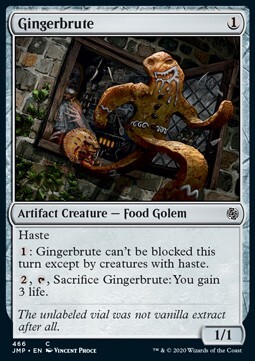
This means that Magic is not inherently a stereotypical or even racist game, but, like other games, it does provide the basis for such narratives. Of course, the players’ subjective interpretation and gameplay also play a role here.
Just a game?
There are numerous publications on the construction of fantasy worlds, their stereotypes and elements that romanticise the past. Since Magic is set in a fantasy world, these elements flow into the game. The fact that fantasy worlds are usually set in the Middle Ages or the early modern period already shows that established historical images are being drawn upon here. What is easily forgotten is that history is always a reconstruction:
“The past does not arise by itself, but is the result of a cultural construction and representation; it is always guided by specific motives, expectations, hopes, and goals.”
Jan Assmann, Von ritueller zu textueller Kohärenz. in: Stefan Kammer / Roger Lüdecke, Texte zur Theorie des Textes, Stuttgart 2005.
These also flow into games. In addition, the fantastical elements create historical fictions, which are then, sometimes unconsciously, projected onto reality. Colonial history has been critically examined in recent times. In the tradition of 19th-century historiography, early modern European expansionist policy is portrayed positively and valued as progressive. The perspective of those who were conquered is usually completely absent. A good example of how this historical image is processed in games is the computer game Anno 1800. Schott demonstrates very convincingly that Latin America and the people living there are seen in the game only as a resource. A similar mechanic can also be found in Magic, where the Conqueror’s Galleon becomes a land (Conqueror’s Stronghold) when it successfully attacks. A successful conquest therefore means that the player owns a land, i.e. another mana source.

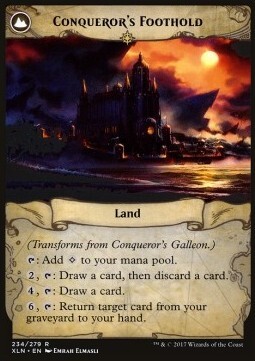
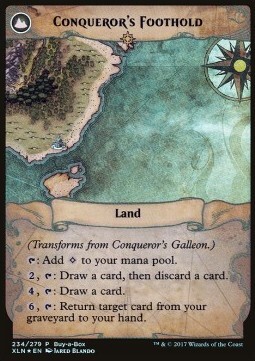
The ship type galleon is a Portuguese sailing ship; the card’s design is reminiscent of adventure films, so we are dealing with a positively connoted conqueror topos here. Stereotypes are naturally often used in games because they have such a high recognition value. This becomes problematic when the game does not offer any other perspectives, i.e. when no multiperspectivity is created. Exaggerating slightly, one might ask: where is the card Peasants’ Revolt that could be set against the Conqueror’s Galleon? This creates two problems. On the one hand, outdated and one-sided historical images are passed down as universally valid.
Here there is the danger of the single story. This aspect is particularly important because, as a rule, history is first conveyed to us through popular media such as games, films and comics. On the other hand, the question arises as to how people, for example Black players, react when they are confronted with one-sided and stereotypical depictions. One of the white cards removed from Magic is Cleanse (Purification/Cleansing). This card has the following text: “Destroy all black creatures.” This combination of card title and text evokes the image of ethnic cleansing, even though black creatures in Magic are not equated with Black people. The term ‘cleansing’ also draws on a discriminatory and long-widespread stereotype that associates black with dirt. This stereotype can be found in many places – from Struwwelpeter to soap advertisements. Imprison (roughly ‘to imprison’ in German) depicts an emaciated Black person and evokes images of slavery.
The green card Pradesh Gypsies (Riotous Gypsies) is already problematic due to the term ‘Gypsy’, which is often used in a derogatory way or associated with romanticising stereotypes. The white card Crusade (Crusade) is illustrated with crusaders and gives all white creatures a bonus. The white card Jihad also gives white creatures a bonus if the opponent controls cards of a certain other colour. Both cards convey a historical image that asserts European-Christian superiority. It is not difficult to understand that people who are often confronted with such stereotypes in their daily lives do not want to encounter them again in their favourite games. Consequently, the racism debate was initiated by the Black player community. In my view, playing together means taking these perspectives seriously, a path that Magic seems to want to take with the banning of the cards, as one must assume.
Magic was accused in the aforementioned open letters of using such measures merely as tokenism. Wizards of the Coast appears to want to counter these accusations. For Black History Month 2021, the Secret Lair series released Black is Magic, with Black artists designing artworks for Magic cards. Of course, the examples mentioned are just individual cards. But individual cards condense into narratives, and as the protest from the Black community shows, the marginalisation and discrimination of Black people is not limited to the game but is part of the company culture. This seems to have a longer history, as the following example shows. The creator of the card game, Richard Garfield, was already aware in 1995 that a card, which was actually based on an episode from 1001 Nights, could be discriminatory: Stone Throwing Devils can be understood as a derogatory term for Palestinians, even if this was presumably not intended. Initially, there were no consequences – the card was only banned in 2020.
Die Entwicklung eines Globalen Geschichtsbewusstseins – How to?
If you look at the discussions surrounding the banning of the cards, you notice entrenched positions that often characterise debates on racism. One side declares racism without further explanation, while the other considers the respective products, statements, etc. harmless and the accusations exaggerated. As I work in the field of Global Learning, I am familiar with these positions first-hand. However, anti-racist education can only succeed if people enter into dialogue with one another. This includes people from the Global North and South alike. First, it is important to raise awareness that games convey historical images which players then project back onto the world. It is important to explain which discriminatory stereotypes exist, as this makes it understandable that people who are confronted with stereotypes on a daily basis are hurt by them. After that, you can discuss together what needs to change. The lack of understanding prevalent in large parts of the Magic community regarding the ban also stemmed from the fact that Wizards of the Coast did not justify its decision and did not disclose where the accusations came from. Otherwise, there might have been more understanding of the underlying issue, even if there was no agreement on sufficient reasons for banning the cards.
Another reason for the rejection within the community, in my experience, is that people react with resistance when beloved and 100% positively associated, seemingly harmless songs, games and sweets from childhood and youth become the subject of anti-racist debates. People then feel attacked and accused. Although it is essential to take clear stands against racism, it is also important to understand the development of a Global Historical Consciousness as a process. A critical look at one’s own past often documents a changed attitude towards carnival photos with blackfacing or one’s own reporting.
For example, the taz itself critically notes that in its first article about the release of Magic in 1993, it used Pradesh Gypsies (Prassenden Zigeuner), one of the now-banned cards, as an illustration. In Global Learning, in my view, it is about initiating such processes in people, accompanying them and enabling dialogue. This way, one-sided perspectives can be expanded and new images and attitudes developed. Magic seems to offer perfect conditions for this. Doug Beyer, for instance, described the flavour of Magic as a “constructive simulation”. According to this, Magic on the one hand adheres to the conventions of the fantasy genre, but on the other breaks with expectations to create something new. These are ideal conditions for truly beautiful new fantasy worlds.
Bibliography
For technical reasons, you will only find the bibliography and ludography here. All footnotes can be found in the original article on Boardgame Historian. Suggested citation: Juliane Lippok, Are prejudices conjured in Magic: The Gathering?, Boardgame Historian 2021, URL: bghistorian.hypotheses.org/1446
- Assmann 2005: Jan Assmann, From Ritual to Textual Cohesion, in: Stefan Kammer / Roger Lüdecke, Texts on the Theory of Text, Stuttgart 2005.
- Boch / Falke 2020: Lukas Boch / Anna Klara Falke, Vikings in Modern Board Games, in: Mittelalter Digital 1, Issue 2 (2020), pp. 95-117. DOI: https://doi.org/10.17879/mittelalterdigi-2020-3289 [accessed: 11.10.2021].
- Chimamanda 2009: Adichie Chimamanda, The Danger of a Single Story [22.05.2010] https://www.ted.com/talks/chimamanda_ngozi_adichie_the_danger_of_a_single_story?language=de [accessed: 13.09.2021].
- Der Spiegel 2020: Magic The Gathering Removes Racist Cards [25.06.2020], URL: https://www.spiegel.de/netzwelt/games/magic-the-gathering-entfernt-rassistische-spielkarten-a-155a7795-dcfa-4721-bfd9-2323b5e321ff [accessed: 13.09.2021].
- Beyer 2010: Doug Beyer, What is flavor? [25.05.2010], URL: https://magic.wizards.com/en/articles/archive/savor-flavor/what-flavor-2010-05-25 [accessed: 13.09.2021].
- Freund 1999: Winfried Freund, Deutsche Phantastik, Munich 1999.
- Harmon 2020: Lawrence Harmon, To Whom it May Concern [03.06.2020], URL: https://docs.google.com/document/u/0/d/1tKsYkdEEfU9u_27ZvVWu8Wkm2bThe3lfov24f2brjM/mobilebasic [accessed: 13.09.2021].
- Heuer 2012: Andreas Heuer, Global Historical Consciousness, Münster 2012.
- Hoffmann 1844: Heinrich Hoffmann, Der Struwelpeter, n.p. 1844.
- Kirsch 1988: Peter Kirsch, Die Galeonen: große Segelschiffe um 1600, Koblenz 1988.
- Koopmann 2020: Jean-Paul Koopmann, Nazi-Hexer on the Index [19.07.2020], URL: https://taz.de/Sammelkartenspiel-Magic/!5695141/ [13.09.2021].
- Nowak 2020: Michael Nowak, Too Racist! Seven “Magic” Cards Are Now Banned [11.06.2020], URL: https://www.heute.at/s/kartenspiel-magic-laesst-rassistische-karten-entfernen-100086579 [accessed: 13.09.2021].
- Meteling 2015: Arno Meteling, War and Cartography. Introduction to Epic Fantasy, in: Michael Dellwing / Martin Harbusch, Community Formation in Times of the Zombie Apocalypse, Wiesbaden 2021, pp. 37-68.
- Schott 2019: Dominik Schott, Anno 1800 Rewrites History [07.09.2019], URL: https://www.golem.de/news/sklavenhandel-und-kolonialismus-anno-1800-schreibt-die-geschichte-um-1905-140996-2.html [accessed: 13.09.2021].
- Toggweiler 2021: Michael Toggweiler, You can’t tame a wild thing: Ethnographic Notes on the Wild People in Game of Thrones, in: Michael Dellwing / Martin Harbusch, Community Formation in Times of the Zombie Apocalypse, Wiesbaden 2021, pp. 125-149.
- Varney 1995: Allen Varney, Words of Magic [1995], URL: http://www.allenvarney.com/av_mgcwords.html [accessed: 13.09.2021].
- Volkmann 2021: André Volkmann, STEREOTYPE BOARD GAMES? TUKDATU SPARKS RACISM DISCUSSION [17.01.2021], URL: https://spielpunkt.net/stereotype-brettspiele-tukdatu-loest-rassismus-diskussion-aus/ [accessed: 13.09.2021].
- Wallner 2017: Marina Wallner, “You know nothing” [2017], URL: http://othes.univie.ac.at/46707/ [accessed: 13.09.2021].
- Wendt 2016: Reinhard Wendt, From Colonialism to Globalisation, Paderborn 22016.
- WOTC 2021a: Wizards of the Coast, Depictions of Racism in Magic [01.06.2020], URL: https://magic.wizards.com/de/articles/archive/news/darstellungen-von-rassismus-magic-2020-06-10 [accessed: 13.09.2021].
- WOTC 2021b: Wizards of the Coast, Story, URL: https://magic.wizards.com/de/story [accessed: 13.09.2021].
- Zaiem 2020: Beg Zaiem, The Wizards I Know [08.06.2020], https://docs.google.com/document/u/0/d/1RDhVZ4x_Zf1abOpGfEGMI4xtYMA7AghCN5uWIfJRa6c/mobilebasic# [accessed: 13.09.2021].
- Zeller 2010: Joachim Zeller, Weiße Blicke, Schwarze Körper, Erfurt 2010.
- Zimmermann 2018: Felix Zimmermann, “It’s the atmosphere, stupid!” – Past Atmospheres: Definition and Method [02.08.2018], URL: https://gespielt.hypotheses.org/2175 [accessed: 13.09.2021].
Ludography
- Magic: The Gathering: Richard Garfield, Magic: The Gathering, (Wizards of the Coast 1993).
Individual Magic Cards (Card name eng. / ger.: / Set / Year)
- Jihad / – / Arabian Nights / 1993
- Stone Throwing Devils / – / Arabian Nights / 1993
- Cleanse / – / Legends / 1994
- Imprison / – / Legends / 1994
- Invoke Prejudice / – / Legends / 1994
- Crusade / – / Fourth Edition / 1995
- Pradesh Gypsies / Prassende Zigeuner / Fourth Edition / 1995
- Conqueror’s Galleon, Conqueror’s Foothold / Galeone der Eroberer, Bollwerk der Eroberer / Ixalan / 2017
- Gingerbrute / Lebkuchenrohling / Throne of Eldraine / 2019
- Ravenous Squirrel / Gefräßiges Eichhörnchen / Modern Horizons 2 / 2021