
Visual Babylon: The iconography of board games
The visual language of analogue games is constantly caught in a contradiction: it is cognitively complex, yet it should be as simple as possible to access. It is newly developed for each game in some way. In doing so, designers delve deep into the bag of tricks of human perception. And back to established visual codes. To find a way out of the maze of many spoken visual languages somewhere between recognition, understanding and seeing.
This article is from “Null Ouvert – Magazin für analoge Spielkultur”. You can find more information about the magazine in this post.
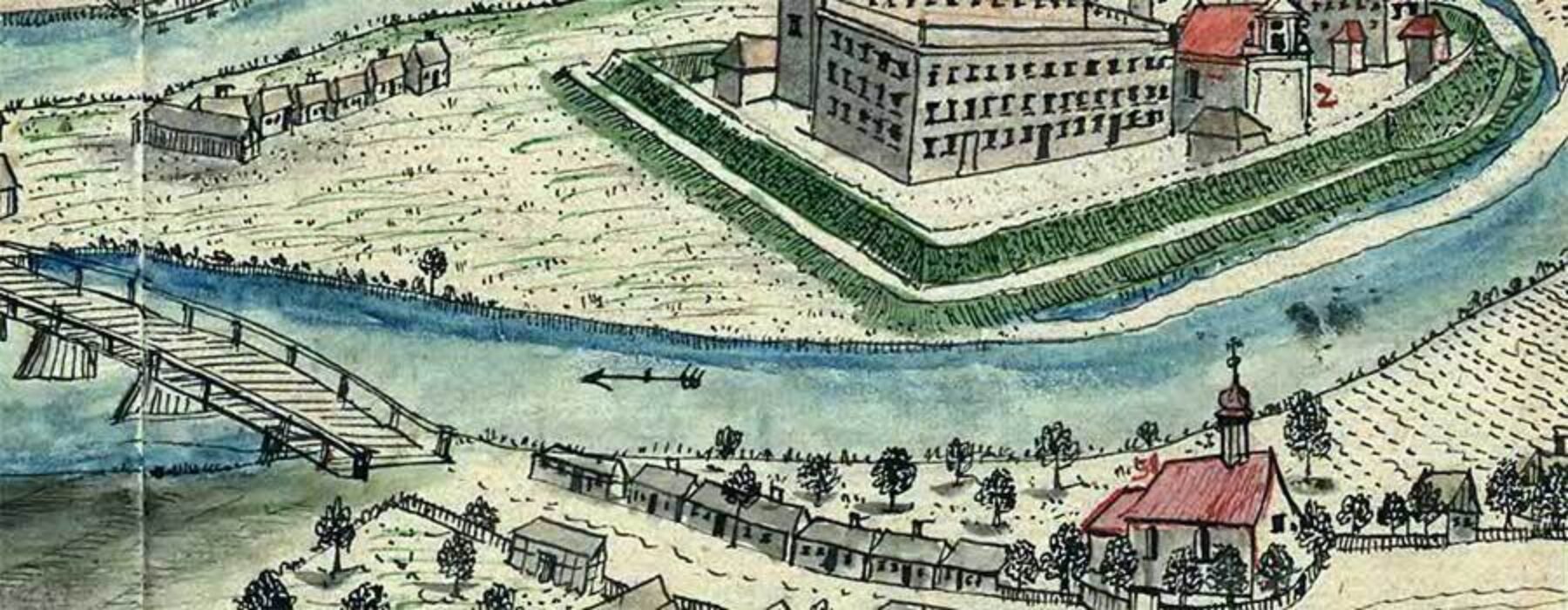
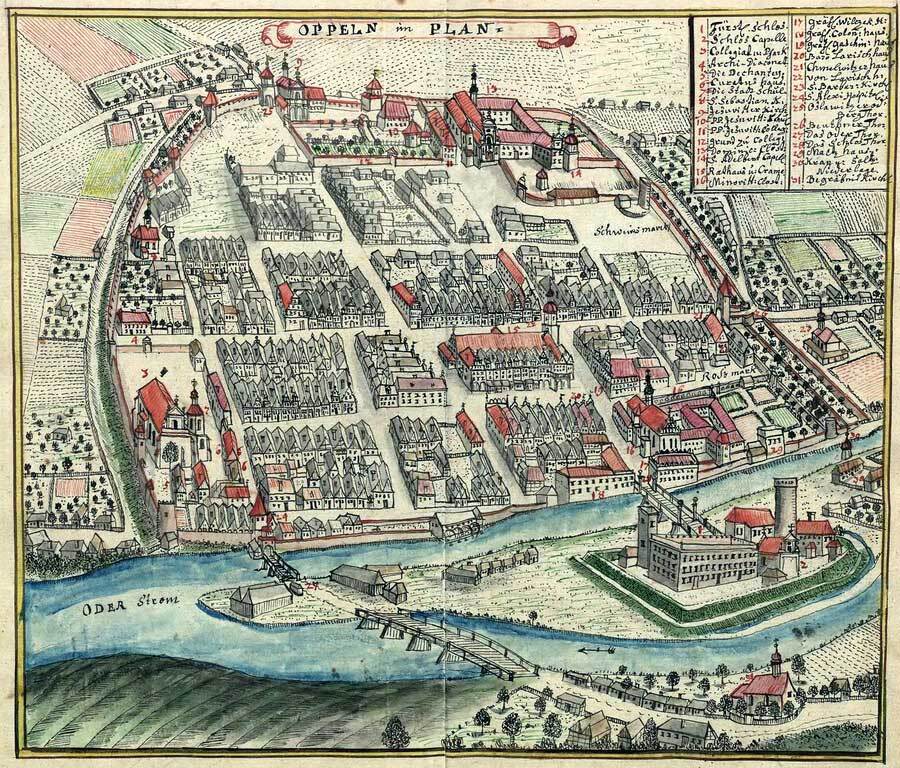
If you play board games often, you’ll eventually start seeing game components everywhere. It’s unavoidable: maps, lines in the sandbox, underground maps, abstract paintings. If a structure is recognisable that reminds us of a game, we recognise it and start interpreting it as such. In a moment, you’ll see a plan of the Polish city of Oppeln from the 18th century. However, the city plan isn’t here because of the clear structure of the blocks of houses, which invites us to place little wooden figures in them to gain majorities. We also have to resist the urge to cover the city’s streets with wooden sticks to demarcate areas. And we’ll leave jumping from intersection to intersection with our meeple for now. The plan is here because it also depicts an arrow – but more on that later.
Patterns, symbols and shapes in games
In research, there are different approaches that attempt to explain this phenomenon. Not the compulsive urge to see board game plans everywhere, but rather our ability to recognise patterns, meaningfully connect visual structures, perceive things that aren’t actually there. And, almost incidentally, experience something like joy in the process. So is it about understanding how a symbol finds meaning in our minds and is related – both to a real object and to a kind of abstract category (semiotics)? Or about the mysterious composition and recognition of shapes that don’t actually exist (Gestalt psychology)? Or, more fundamentally, about how our brain can recognise and connect recurring structures at all (pattern recognition)?
Of course. But that all sounds extremely abstract. There are also many approaches that work very concretely with the context of everyday perception. Signage (wayfinding) helps us understand how we orient ourselves in space – or fail to. Comic research allows us to understand why we can arrange static images into a meaningful sequence, and the broad field of usability shifts the problem into the digital realm. But we don’t want to go that far. We’ll stay seated. At the table. In front of our plan of Oppeln.
And please don’t think about why the symbols in this article turn into words, sentences and images in your head. We’re asking ourselves how this works with board games. And there’s little that’s special, a lot that’s traditional and little that’s documented. But at its core, it’s about the question of why and what we recognise in a game, why we fill this recognition with meaning and perhaps even rules, and how visual language in analogue games has developed.
Arrows as powerful symbols
And for the approach of a possible answer, let’s look at a few very different examples.
Symbols help us grasp things quickly. Without text-based language. But they remain ambiguous and dependent on personal experience. And it helps to know their (cultural) history.
The arrow is an old and powerful symbol. It left its archaic meaning as a sign of war behind long ago. In the mid-18th century, map and blueprint draughtsmen began using the arrow as a symbol for the direction of flow. With increasing industrialisation, it eventually replaced the pointing hand as a directional symbol on and for signposts. Today, the arrow is omnipresent and guides us through a visually incredibly complex world. Arrows are also used in board games: sometimes as a reminder of the direction a game piece should move. Other times as so-called conversion arrows. Three crystals are magically turned into two victory points. Two sheep become food for four person tokens. And of course, it also always shows us what we should pay attention to: rarely on the game board and cards, but mainly in the rules. Curved, long, with a loop if something needs to be flipped. The arrow has become deeply embedded in our visual understanding – it has stuck.
And that brings us back to Oppeln. In the city view, the arrow indicates the direction of the water flow. One of the earliest examples of the symbol’s non-military use. So when designing analogue games, we move within a tension field of perception-psychological observations and the cultural-historical collective of the visual.
Visual codes based on experience
The arrow is just one example among many. Similarly fascinating are frames and boundaries (walls, illuminated manuscripts) or character portraits (ID, wanted poster). Literature on the subject may not immediately build a bridge to analogue games, but those who are aware of the cultural history of our perception can work visually with metaphors. Just as we understand the folder as a container for various files in the digital world, we naturally understand these in non-digital form too. The depicted game piece, the coin to be handed in, the open hand that symbolises our income.

Over the past forty years, something like a grown visual code has developed, especially for more complex games. Not always consistent, but based on gaming experiences.
Attention, now it’s interactive. Please draw a church on a piece of paper with just a few strokes. Of course, you’re influenced by the churches depicted on the map of Oppeln. And of course, you’ve already seen the image below.
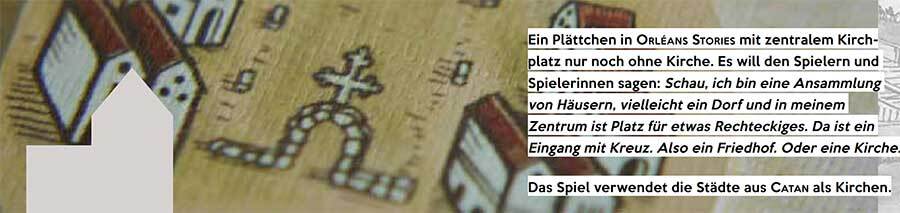
Even so. Each and every one of us will draw the church slightly differently, but most of us will still recognise it as such. And that’s quite an impressive mental achievement. We know various visual attributes of a church, so we break down the artistically abstracted church into further small parts. And if there’s even a cross on a pointed roof, everything is clear anyway. But there’s also the problem that these experiences can overlap and shift. Board game enthusiasts read the grey shape standing at the bottom left as “city from Catan”. The rest of the population sees it more as a church.
If we can’t clearly identify a symbol, the next step is to look at the context and search for further clues. So if we want to turn a Catan city into a church, we need some additional hint. A symbol. For example, a cross.
Interacting with seemingly old media
How can we use something as static as paper to help people through the highly interactive system of board games? The term ‘interactivity’ has been used rather inflationarily in the context of digital media over the past few decades. It’s now hard to draw a clear line. What matters is whether we’re talking about interaction with another person via a medium, or interaction with the medium itself. In this respect, analogue games with their underlying materials – wood, cardboard, paper, plastic – seem rather passive. Passive media only allow information to flow in one direction. For example, from the book into the mind. But as soon as the book has an index, a reciprocal effect arises. We’re no longer bound by the linear sequence and can jump around in the book.
It’s precisely these little tricks that make interacting with seemingly old media so exciting. What can you do with paper? Always something new. An escape room game breaks the fourth wall and suddenly we have to take out the box bottom, we’re asked to stick things to or even destroy game components, and sometimes we even have to turn off the light. This play with the medium isn’t an end in itself and isn’t just an interesting experience – it also creates opportunities to make many interactions intuitive and fluid.
And this is something that isn’t just needed in analogue games, but in any form of interaction, whether with maps, underground timetables or paintings. After all, it’s fundamentally about how we as humans interact with the physical world and give meaning to the things we see. When playing, we do this only at the table and within a very small, very manageable framework, but that’s exactly where the potential lies.
Impressive tricks of the visual language in analogue games


