

Reinhold Wittig died: A life for games, art and Göttingen

Reinhold Wittig has died. He passed away on 11 April 2026 in Göttingen. With him, the gaming scene loses one of its most creative minds. An obituary for an artist, publisher, author and his guineafowl.
Neither a hippopotamus on a rollercoaster nor snakes on ladders can compete with the guineafowl. No other animal has shaped the German gaming landscape like it has, thanks to Reinhold Wittig.
Like a guineafowl, Wittig picked up everything he encountered. Beer mats inspired him just as much as dice. Scrap became art, ideas became events. He invented hundreds of games. In 1976, he founded the publisher Edition Perlhuhn, in 1983 the game authors’ meetup in Göttingen, and in 1988 he laid the foundation for the establishment of the Spiele-Autoren-Zunft (SAZ). Wittig was a doer, a jack of all trades.
“Everything I took on in my life, I pursued professionally – teaching and research in geology, art, astronomy, puppet-making, theatre and, of course, inventing games. I was always fully committed – but not to everything all at once.”
Reinhold Wittig
Göttingen and Wittig: a mutual influence
Wittig’s publisher Edition Perlhuhn was based in the street “Am Goldgraben”, on the edge of Göttingen’s city centre. The city shaped Wittig, and he shaped it. He was born in Göttingen in 1937. There he worked, played and created art. Since 1974, Wittig’s bronze game locomotive has stood in the pedestrian zone. In 2003, Wittig created the Göttingen Planetenweg, a scale model of our solar system. Two billion space kilometres correspond to one Göttingen kilometre. Wittig and his wife Karin designed the sun and planets as bronze steles.

In 1964, Wittig founded the puppet theatre “Collegium magicum” in Göttingen. With its idiosyncratic figures and experimental performances, it soon gained recognition beyond the region.
The audience had never seen anything like it before. They quickly became the talk of the town, and with each new performance, there were a few more spectators. Perhaps precisely because they barely matched the common idea of puppet theatre. Not a single spoken word, rather abstract plots devoid of scenery, accompanied only by experimental sounds and contemporary and baroque compositions.
Matthias Wittig
Wittig built over 200 puppets himself from metal, wood and plastic.
Göttingen was also Wittig’s professional home. As a doctor of geology, he worked at the University of Göttingen’s Geological Institute until his retirement in 2002.
Breakthrough as a game author: a game without rules
At the same time, he began developing games like Wikingerschach and Piratenbilliard in the late 1950s – initially without any commercial ambition. His gaming career took off in 1974 when the Göttingen Art Association asked him to publish a playable graphic.
“Back then, he did what he had already done many times with his puppets: he used everyday materials, in this case, nuts. The honeycomb shape inspired him to come up with the title Wabanti. There was no box yet; the nuts and dice were in a bag. There were 24 numbered copies, and the reactions were so positive that two years later, together with his friend Hubertus Porada, he founded a games publisher, namely Edition Perlhuhn,” recalls Hilko Drude on his blog “Du bist dran!”.
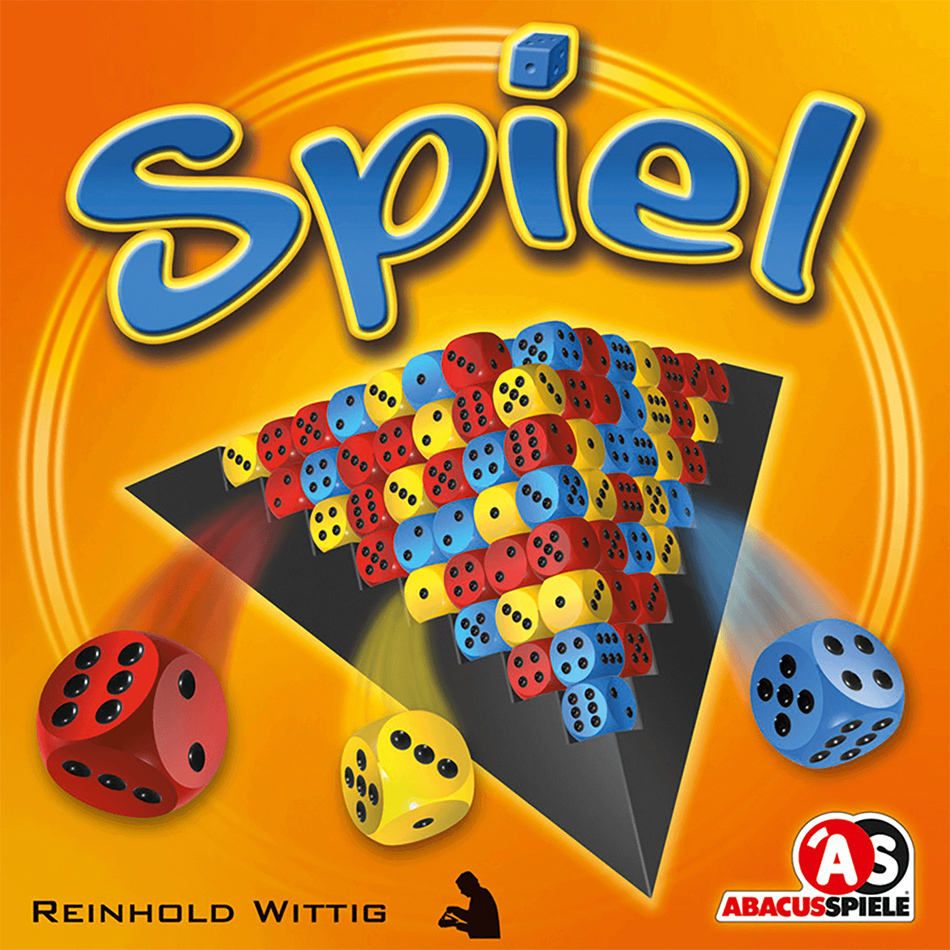
The breakthrough came in 1979 with the dice pyramid Das Spiel. But was it even a game? Johan Huizinga wrote in his 1938 book “Homo Ludens” that a game absolutely requires binding rules. Wittig disagreed: his first edition contained none. The box only held 281 coloured dice and a platform for stacking them. Wittig encouraged players to be creative themselves, to experiment with numbers, colours and chance. Former Ravensburger games programme manager Erwin Glonnegger was enthusiastic.
“This game is a milestone on the path that led to a culture of board games in late 20th-century Germany, the likes of which have been unique ever since.”
Erwin Glonnegger
Das Spiel is still available today. Since 2004, it has been part of Abacusspiele’s range, and a revised edition is set to appear in 2026.
Another success: with Piratenbilliard , Wittig reached a million-strong audience in 2013. It was the tenth game on the TV show “Schlag den Raab”. Challenger André defeated Stefan Raab 7:2.
Edition Perlhuhn: a creative games publisher
In 1970, Wittig began geological research into prehistoric earthquakes in what is now Namibia. In collaboration with his colleague Hubertus Porada, he also designed large-format calendars there, which were very successful. But what should the publisher that sold them be called?
“We were looking for a name that highlighted the African roots and was neutral in terms of ‘social form’, while also hinting at art: ‘Edition’ fit perfectly. We struggled more with the animal name. Edition Lion? Edition Vulture? Impossible. Guineafowl? The range from ‘a blind hen finds a grain of corn’ to ‘casting pearls before swine’ tipped the scales in 1976: Edition Perlhuhn.”
Reinhold Wittig

Most of the roughly one hundred games from Edition Perlhuhn were published in small print runs, often unusually packaged in cardboard tubes. The connection between games and art remained a concern for Wittig – five of his games received the special prize for the most beautiful game from the Spiel des Jahres jury. Several of his works also made it onto the recommendation list. In 2020, he was inducted into the Hall of Fame of the Academy of Adventure Gaming Arts & Design (GAMA), one of the highest honours in the international tabletop sector. In 2003, the city of Göttingen awarded him its honorary medal.
In 2002, Wittig founded “Namibian Games” in collaboration with the company Driehoek – a games production where local craftsmen and craftswomen worked with regional materials. Here, his geological research in Africa and his passion for games came together.
“My dream of the perfect game is anything that advances society – a big claim, I know. But you should keep it in mind, and you must even pursue it.”
Reinhold Wittig
Joe Nikisch preserves the playful legacy of Wittig. The founder of Abacusspiele was a close friend. In his online shop Nikisch bundles remaining stocks of Edition Perlhuhn and supplements them for small reprints. “Wittig proved that a game can be more than just a pastime: it is aesthetics, community and inspiration. His passion, his love of detail and his unique view of the world will be missed,” reads an obituary on the Instagram channel of Abacuspiele
Game designers’ meetup in Göttingen
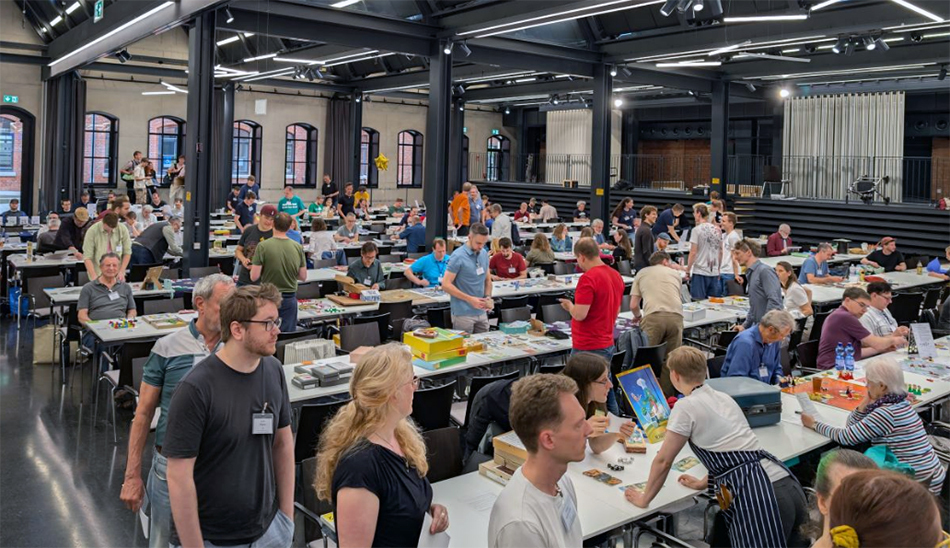
There’s strength in numbers: this applies to guinea fowl just as much as to game designers. Guinea fowl live in social groups outside the breeding season. The game designers’ meetup also created and continues to create social connections. Designers exchange ideas there and present their prototypes. Wittig initiated the event.
The annual gathering of friendly players, game designers and game critics in Göttingen, held at the home of the artistically ambitious small publishers Karin and Reinhold Wittig, grew into an event that soon outgrew the private setting. The Wittigs transformed the private get-together into the annual Göttingen game designers’ meetup.
Tom Werneck
The first meetup took place over two days in January 1983 at the Künstlerhaus in Göttingen. Around 50 people attended. Later, the event moved to the Stadthalle, where it has been held annually in early June ever since. When Wittig turned 80, he handed over the organisation to the Spiele-Autoren-Zunft (SAZ) in 2017, which has since continued to run the event together with the city.
From the brief descriptions of the games presented, the magazine Spiel & Autor emerged. The publication, primarily aimed at publishers, also provided a platform for game designers. The last print edition to date was published in 2018.
Founding of the Spiele-Autoren-Zunft (SAZ)
Five years later, in February 1988, on the Perlhuhn evening on the fringes of the Spielwarenmesse in Nuremberg, twelve male authors and one female author signed a proclamation on a beer mat at Wittig’s initiative. It read: “None of us will submit a game to a publisher if our name is not on the top of the box.”
Among the signatories, alongside Wittig, were Erwin Glonnegger, Knut Michael Wolf, Wolfgang Kramer, Joe Nikisch, Gilbert Obermeier, Alex Randolph, Johann Rüttinger and Ilse Dreher-Plonka.
The beer mat laid the foundation for the founding of the Spiele-Autoren-Zunft (SAZ). At a games festival in Graz, Bücken, Kramer and Randolph met again. They decided to push the founding forward. Their goal was to make game designers more visible, to place their names on boxes, to promote fair contracts with publishers and to strengthen the cultural asset of games. In 1991, the SAZ was officially founded at the Spiel fair in Essen.
“A resolution of the first general meeting was the appointment of Reinhold Wittig as an honorary member of the SAZ. Everyone agreed that Wittig had deserved this honour to the highest degree. His Göttingen game designers’ meetup had been the breeding ground in which game designers found their identity and self-awareness, which ultimately led to the founding of the Spieleautoren-Zunft.”
Klaus Teuber
Wittig was also politically engaged. “As early as 1985, he wrote to numerous state and federal ministries to achieve political recognition for board game culture in Germany,” writes Jens Junge on his blog. At the time without success, today “playing board games” is intangible cultural heritage in Germany.
Living legacy
In the 1980s, the German games scene took shape. The “Spiel des Jahres” jury has been awarding prizes since 1979. The first issue of Spielbox was published in 1981, the first Internationalen Spieltage took place in Essen in 1983. In the same year, Karin and Reinhold Wittig initiated the first game designers’ meetup in Göttingen. These pillars still form the foundation of board game culture in Germany today.
Reinhold Wittig shaped German games culture on three levels: as a prolific author with timeless titles such as Spiel, Volta and Piratenbillard; as a publisher who consistently treated games as works of art; and as an activist who, with a beer mat, ensured that game designers’ names now appear on the boxes.
Christoph Post, Brettspielbox
Without Wittig and his work, the games scene would look different. Perhaps that’s why the guinea fowl suited him so well: a vigilant, headstrong animal, always on the move, always searching.
Update on 16 April 2026
The Spiele-Autoren-Zunft (SAZ) is also mourning Wittig. On their homepage, they have published an obituary. It states, among other things:
“When the Spiele-Autoren-Zunft was founded in 1991, Reinhold was indeed not among the founding members – but his then-wife Karin was. A Spiele-Autoren-Zunft without Reinhold was apparently inconceivable, so he was appointed an honorary member in the founding year. Were there even game designers before Reinhold Wittig? Of course there were, but before Reinhold’s work, they largely led an anonymous shadow existence and were barely recognised by players and publishers as the creators of their works. Reinhold emphasised the cultural and artistic claim of creating games with the term ‘Spieleautor’ and gave game designers a confident self-awareness.”
The Haus des Spiels writes on Facebook among other things:
“The famous Thursday proclamation was recorded on a beer mat at his initiative: ‘None of us will submit a game to a publisher if our name is not on the top of the box.’ The Deutsches Spielearchiv is still very honoured to be able to preserve this valuable founding document. Reinhold Wittig sent this beer mat (signed during the Nuremberg Spielwarenmesse) to Marburg at the time for safekeeping with Bernward Thole – with a wink, asking him not to use it as a beer mat.”
Update on 21 April 2026
Jochen Corts remembers Wittig on spiel-des-jahres.de. He writes, among other things:
“To paint a credible overall picture of the person and his work and to avoid the impression of mere flattery, it must not be omitted that Reinhold Wittig was a confirmed egocentric who demanded a great deal of forbearance from those around him. However, he usually managed this through charm, humour and generosity. He once even described himself as ‘uncompromising’ with noticeable pleasure. […] The biological name of the guinea fowl (Numida meleagris) is derived from Meleager, a figure from Greek mythology. When his sisters could not stop mourning his death, they are said to have been transformed by the goddess Artemis into these very birds to ease their grief. A species of bird whose plumage pattern looks not only like pearls but also like tears. More than one of these may now have been added in quiet remembrance of Reinhold Wittig.”