
Minecraft: From computer game to board game
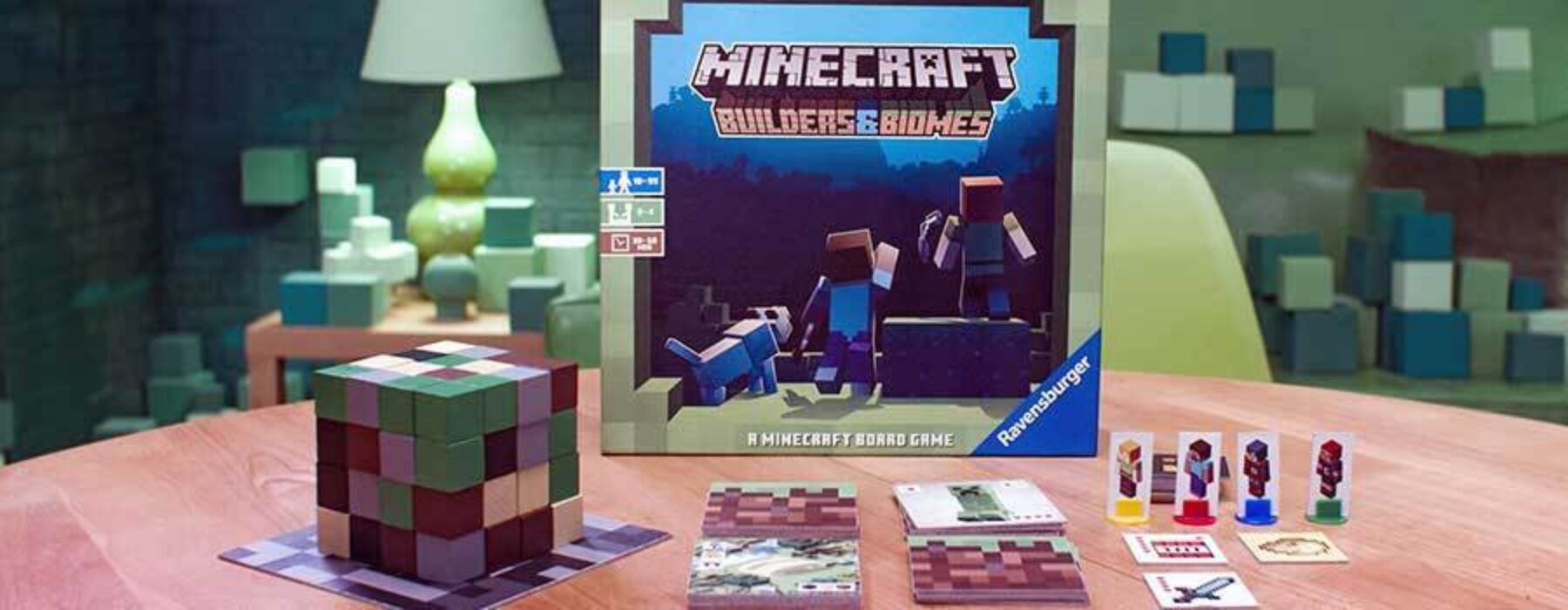
Ulrich Blum has developed the board game Minecraft Builders & Biomes by focusing on the strengths of the analogue medium, seeking out Minecraft’s–core principles and the emotions they evoke. A developer’s diary.
This article is a guest post by Ulrich Blum. Do you also want to publish articles on kulturgutspiel.de? Great! We’re always happy to hear from guest authors. If you’re not yet familiar with the board game, we recommend starting with the rules overview from 1Minute1BoardGame.

To explain how “Minecraft Builders & Biomes” came about, I need to go back a bit: Normally, the development process of a game has some parallels with writing a novel. The author works on a project alone for a long time. At some point, they feel the game is “finished”. Here, “finished” doesn’t refer to graphics or components, but primarily to mechanics and other elements the author is responsible for. With this prototype, the author then approaches publishers, presents the game to them and hopes for a publishing deal. If such a deal is made, work on the game continues together with the publisher. This does involve changes to the game system, but it’s mostly about turning the prototype into a finished, printed game with beautiful illustrations and great components.
Special case: Minecraft licence
When it comes to developing a game based on a licensed theme, this process makes little sense. The chance that an author will randomly knock on a publisher’s door at just the right moment with a game that fits the licence is extremely low. So Ravensburger asked several authors, including me, to submit initial game concepts for Minecraft. Now, processes where multiple colleagues are approached always carry the risk of putting in work without being able to make the game in the end. So I’m usually cautious and try to keep my effort low beforehand, especially for economic reasons, as I make a living from game design. But when I heard it was about Minecraft, all economic sense quickly went out the window. I knew Minecraft and had spent many enjoyable hours playing it. Not nearly as many as the real fans, but enough to know that I was very eager to take on this challenge. In other words: I was simply too excited about the project not to go all in.
First, I spent about a week doing little else but playing Minecraft. At first just to get reacquainted with the game, then more analytically. Minecraft is a sandbox game. This means the game makes very few demands on how you play it. There’s an incredible variety of things you can do, without any of them being better than the others. Instead, you decide for yourself what you feel like doing and what you want to achieve. This was my main focus in the analysis: What exactly am I doing? What goals am I setting myself? And why? Which experiences interest me and which don’t? And most importantly: How do I feel about all of this?
From mining instead of building to the second round
One thing became clear to me relatively quickly: the game had to include dice. Physical, large blocks that I could touch and stack, that I could play around with. Lots of them. And what should we do with them? Build things, of course, right? Unfortunately not. After a conversation with Daniel Greiner, the editor who would be handling the game at Ravensburger, I had to abandon this idea. Daniel’s rough estimate was that we could fit about a hundred wooden cubes into the game without ending up with a retail price that no one would be willing to pay. The larger the blocks, the fewer there would be. The idea of four players building three-dimensional things with just a few dozen blocks wasn’t very exciting. Only the simplest structures would be possible. Plus, real wooden cubes have the annoying habit of obeying the laws of physics, unlike the digital Minecraft blocks. I had to come up with something else.
I’d bought a bag full of large wooden blocks and was playing around with them to get ideas. At some point, this block made up of 4x4x4 cubes was in front of me. What followed was one of those rare moments in the creative process where everything suddenly comes together and makes sense. If the building aspect of Minecraft couldn’t be represented three-dimensionally, then at least the mining, i.e. the extraction of raw materials, could. Around this, I built a system that represented as many aspects of Minecraft as possible. I submitted this design for the first round of evaluations at Ravensburger.
In fact, my design made it to the next round. But the feedback for the next revision was: We really like the block with the raw materials, but everything around it is far too complicated for the target audience. It’s best to scrap all of that and build something new.
That might sound a bit harsh, but I wanted to get the contract and be allowed to make the game. Feedback that would have tempted me to just simplify the existing system a little would have been much worse. Sometimes it’s better to quickly accept that you’re on the wrong track and try something else.
Hidden market as an interesting cost-benefit consideration
The next design was radically simplified. There was the resource cube, from which you collected building materials, and a market with buildings. You built these in a personal 3×3 grid, trying to achieve certain combinations.
With this design, I got the contract. I was overjoyed. I now knew that my work hadn’t been in vain. But it was also clear that the real work was only just beginning. It was mid-February, and by the end of May, the game had to be far enough along for production preparations to begin. The schedule was extremely tight. For comparison: Normally, as described above, you go to the publisher with a game that’s been thoroughly tested. From signing the contract to publication, it usually takes another full year.
First, my simplified prototype had to become more complex again. Buying buildings from an open market didn’t feel very Minecraft-like. I sat down for a day and played the computer game, looking for elements I could use. I noticed that I found it very satisfying to explore my surroundings and discover new things.
So I tried out a few variations of a hidden market in my prototype, where you had to discover what you wanted to build later. At the same time, this introduced an interesting cost-benefit consideration: Do I build this half-suitable building? Or should I keep looking for something better? Relatively quickly, I settled on the display that can still be found in the finished game. I noticed that this display was almost a mirror of the resource cube. It also consisted of 4x4x4 elements, just tiles instead of cubes. I knew I was on the right track and that the core elements of the game system were in place.
Extremely fast iteration cycles
But there was still a lot to do: From now on, everything revolved around the question of what should be on the 64 market cards. We began with extremely fast iteration cycles. Almost every day, there was a new version of the prototype, which was immediately recreated and tested in Ravensburg and Stockholm (the headquarters of Mojang, the developer studio behind Minecraft). During this time, we tried to adapt almost every element of Minecraft: caves, farming, villages, crafting, and so on. The more we tested, the more we cut. It was always amazing to see how much we could remove, even though we’d previously thought that element was central to the gaming experience.
What remained were buildings and monsters. The game didn’t need anything else to appeal to a surprisingly broad audience. The most important thing was to reach the (often young) Minecraft fans. But it was wonderful to see that parents were fully on board too. The icing on the cake was that even seasoned gamers found it entertaining and had plenty of interesting decisions to make. Everything pointed to us having created a great gateway game – a game with a simple entry point but lasting fun for a wide audience.
The work on the board game Minecraft Builders & Biomes was a very stressful and intense period, but it also brought some incredibly satisfying moments. The close collaboration with Daniel Greiner at Ravensburger and some of the game designers at Mojang was particularly inspiring and positive. You could tell that everyone wanted to develop the best possible game. I’d like to take this opportunity to thank everyone involved for their work. Without the fantastic teamwork, the game would never have turned out so well.
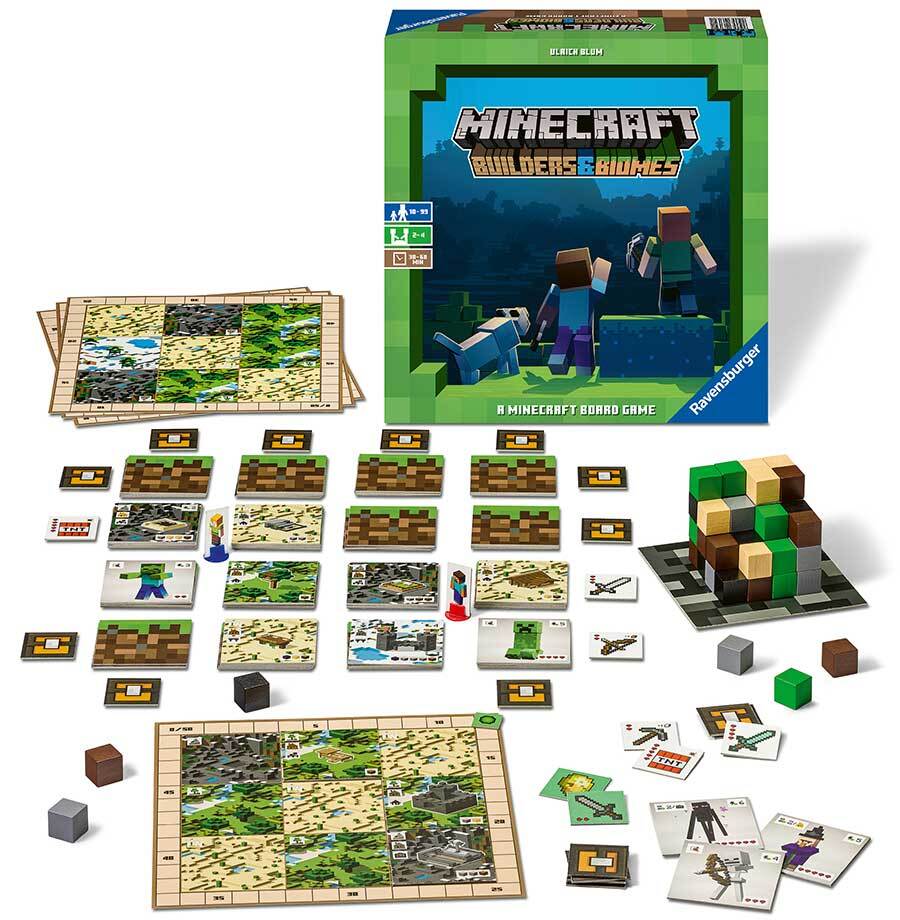
Minecraft Builders & Biomes
Minecraft: Builders & Biomes is a game for two to four players aged ten and up. It was designed by Ulrich Blum and published by Ravensburger. The game lasts 30 to 60 minutes and costs around €40. Just like on the computer, players explore the Overworld, construct buildings and mine resources. They collect experience points for completed buildings and defeated monsters. The player with the most experience points wins.
Two to four players find themselves in an unexplored part of the Overworld, made up of a grid of card stacks. Next to it is a large die made of 64 randomly arranged resource blocks. Each turn, players always perform two of five possible actions. At the start of the game, they first explore the card stacks in their vicinity and mine blocks from the resource die. What buildings are hidden in the card stacks? A stone house in the snowy tundra? A llama stable in the mountains? A wooden bridge in the desert? Players try to create the largest possible contiguous area of forest, desert, mountains or snowy tundra on their game board. The larger the area, the more points they get. The types of buildings and building materials also affect the score. Monsters bring bonuses and extra turns. Hidden in the stacks are Endermen, Creepers and other monsters that can be defeated with weapons. To fight a monster, players flip over three weapon tiles. A diamond sword – a good start! A poisonous potato – bad luck. All eyes are fixed on the last tile: another potato, another dud! Although this battle wasn’t victorious, those who defeat their monsters receive rewards like extra turns or bonus points. The points are counted when the layers of the resource die are mined. As soon as the third layer is removed, the game ends.