
Andreas Becker: “There’s an exciting story behind almost every game”

Since January 2021, Andreas Becker has been editor-in-chief of spielbox, the world’s highest-circulation board game magazine. An interview about game reviews, jazz, good journalism and paid-for cover pages.
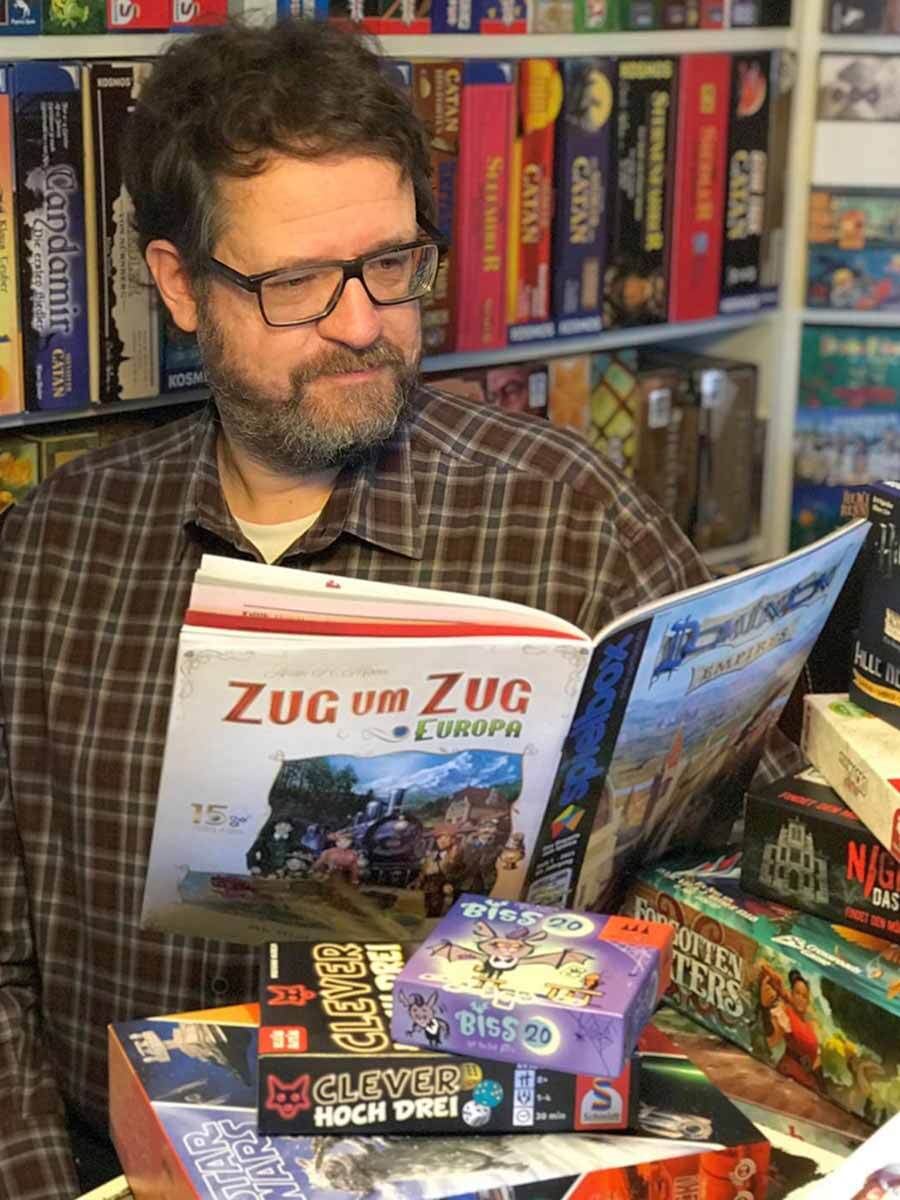
The spielbox is a consumer magazine about board games. It has been published since 1981, and since 1992 by w. nostheide Verlag – currently seven times a year with a circulation of 13,000 copies per issue. From 2002 to 2020, Matthias Hardel was editor-in-chief; since 2021, it has been Andreas Becker. Becker was born in Delmenhorst in 1975. After studying history with minors in German and political science, he did a traineeship at Weser-Kurier. From October 2009, he worked in Delmenhorst as an editor for the Bremer Weser-Kurier, most recently heading the editorial team. Becker enjoys playing with Orange. His current favourite game is the Pandemic Trilogy because it can always create fascinating immersion and great tension for him. His three all-time classics are Carcassonne, 7 Wonders and The Castles of Burgundy.
On a scale of one to ten: How much have you enjoyed spielbox so far?
Five.
Five stands for absolute mediocrity.
The rating is mainly due to the design. Compared to other magazines, spielbox has seemed outdated to me for a long time. The text flow was often too restless for my taste. There was too much floating text. Then there were pages that were too dense, where I felt overwhelmed by the text. I want clearer structures and calmer text flows in the magazine. I believe readers will feel more comfortable in a tidier environment and may spend more time with the magazine. We’ve made a start, but we’ll keep experimenting with one thing or another in every issue.
What else bothered you?
I wasn’t getting enough in-depth content. I felt that the scene’s key figures were given too little of a voice. Yet almost every game has a fascinating story behind it, which is only natural given how long development can take. Sometimes the writing was too dry; you had to really slog through it. We won’t change everything overnight, but these are points I want to work on. So far, I’ve had the impression that everyone on the team is keen to go down this path with me.

w. nostheide Verlag also publishes Spiel Doch! alongside spielbox. How will the magazines differ in future if spielbox becomes more magazine-like?
The core of the spielbox brand is its more extensive reviews, which Spiel Doch! will never offer to this extent. We will also continue to provide more in-depth, deeper – or, to put it bluntly, slightly nerdier – coverage in spielbox than Spiel Doch! aims for. Since Udo Bartsch, editor-in-chief of Spiel Doch!, and I get on well, we’ll be exchanging ideas intensively about which topics fit better in which magazine, especially as Udo will continue to write for spielbox and I for Spiel Doch!. Looking at what Udo has achieved with Spiel Doch!, I don’t think it’s a bad idea to move closer to his magazine: well-crafted games journalism is not a bad role model.
At the 2020 Day of Board Game Criticism, you said: “The most important currency for a critic is their own relevance.” There are now over 150 German-language board game blogs, vlogs and podcasts. Some reach more than 100,000 people with their content. The circulation of spielbox is 13,000 copies. How relevant is the world’s highest-circulation board game magazine still?
I believe spielbox still plays an important role, even if, as a print medium, it takes on the role of the grey eminence among all the YouTube channels, podcasts and blogs. Print has a hard time, even in this niche. We won’t be able to reverse this trend. Believing we can would be naive. But spielbox still plays an important role, in my opinion, first and foremost because of the team. No one can match this level of expertise in board games, especially not in this unique mix of experienced colleagues – real dinosaurs of the scene – and the younger people I want to bring on board gradually. That’s an asset we can capitalise on. This team is fantastic. I also believe that fans of analogue games still appreciate an analogue medium. And if only to maintain cherished rituals: Is the new spielbox out? Then I grab it, get comfortable, flick through the magazine and check the ratings first. Right now, we’re discussing with everyone involved how we can enhance the enjoyment of reading it. What are the relevant topics? Which stories from the scene do we want to tell? We need to try to write them in a way that makes them a pleasure to read. If we manage to do that seven times a year, if readers smile seven times a year when they take spielbox out of their letterbox, we’ll stay relevant.
Which pages and channels does the new spielbox editor-in-chief like to read, watch or listen to?
When it comes to daily newspapers, I’ve always particularly liked Süddeutsche Zeitung. Simply because I enjoy well-written stories. The SZ has some fantastic authors who really make you want to read. As someone who enjoys reading and watching for pleasure, I also love mare, a fantastic magazine. In the gaming scene, I’d like to follow more media, but I don’t have the time. I do have a few favourites: I’m one of those who would love to read a new text every day on rezensionen-fuer-millionen.de by Udo Bartsch. Precisely because that doesn’t happen, it’s all the more exciting when something new appears. In my eyes, Udo remains a stylistic reference. I find sites that reflect on the goings-on in the gaming world very appealing, where journalism doesn’t just stop at reviews: I find what Peer Sylvester and Georgios Panagiotidis do on spielbar.com fascinating. I also think kulturgutspiel.de is very good because you cover board games from a journalistic angle. I believe this is probably the only way to take the topic out of its own media bubble and give it a different kind of attention in large, high-reach media formats. A format that focuses solely on presenting or playing new releases as quickly as possible probably can’t achieve this effect. I don’t watch many videos, but I do like how professionally Julia and Stephan Zerlik from Spiel doch mal! approach their reports and don’t just do reviews. When it comes to video, TableTop with Will Wheaton will remain the gold standard. Of the many excellent podcasts, I particularly enjoy listening to the Brettagogen.
You also said at the Tag der Brettspielkritik: “Only the reader matters.” Who reads spielbox? If only I knew exactly. The most recent reader survey dates back to 2014. Back then, it turned out that the average spielbox reader was an academically educated man with a high income, in the middle of life. Around seven years later, this has probably changed. The fact that the entire scene has become younger, more colourful and more diverse also affects spielbox. In recent years, we have seen increases in subscription numbers. So it is unlikely that our reader base has not also changed. We are considering launching a new survey to find out who reads us and whether the demands on the magazine have changed.
What does it mean for future magazine content that only the reader matters?
A fundamental problem that journalism has struggled with in recent years is its self-image. In the past, metaphorically speaking, people ate what was put on the table. The journalist decided what was relevant and what was read. This has changed with the internet. Today, journalism must see itself more as a service provider. We have to offer our readers what they want. The last survey clearly showed that readers want reviews. It’s quite possible that this has changed somewhat since then. That’s why I’m really hoping for reader feedback to get a good sense of what is truly desired. Until then, we also have to be guided by what we as authors would like to read ourselves. At least for me, I don’t just want reviews, but also other stories. Maybe I’m just a weird oddball who’s alone in this view. That’s what we need to find out.
Are the ratings staying?
Yes, the ratings will stay in their current form. This is something we keep hearing: readers want ratings. They particularly appreciate it when each rating is justified. We will work on meeting this demand even better. From now on, every game reviewed in spielbox will be rated on a scale of one to ten, including those on the Spielwiese and expansions. I’ve never fully understood why there were three different rating systems. The only exception will remain children’s games, which is due to the fact that most of our authors, myself included, don’t engage with that segment.
The spielbox ratings
In spielbox, the Spielreiz ratings range from 1 to 10, with 1 being the worst and 10 the best rating. The ratings 1, 2, 3 represent the gradations of poor, the ratings 4, 5, 6 represent the gradations of mediocre, and the ratings 7, 8, 9 represent the gradations of good games. The 10 is reserved for exceptional games that stand out even among very good games.
In the past, average games often received a seven rather than a five. Will the rating scale be used more fully in the future?
How much the scale is used depends on the individual critic, not the scale itself. The fact that ratings often settle at a uniform level is more due to the quality of the games. A title that is fun and offers a lot of variety is, depending on the interpretation of the scale, rated a six or seven, not a five. The five stands for absolute mediocrity. Many games today are above that, without really exciting. That’s at least how I perceive a large part of the new releases. Truly terrible games have become rare. Even when they do exist, we as the editorial team have to ask ourselves whether we want to dedicate any of our limited space to them – and which colleague has the masochistic desire to bring such a game to the table again and again in different setups. However, it does make sense to include a less exciting game in the magazine if a prominent author is behind it or if there’s a hype around the title. In that case, it should get a thorough pan. Here too, the journalism’s value and service mindset applies: many readers would rather have a recommendation on what’s worth buying than a verbose warning about what they should avoid.
Due to Corona, public games meetups are currently impossible, as are private rounds with people from multiple households. What impact does this have on spielbox reviews?
It becomes more laborious to get games to the table often enough. Games that thrive on being played in larger groups are currently falling by the wayside. There are also colleagues who currently cannot gather enough playing experience and therefore appear less in the magazine. I think all reviewers, regardless of which media they produce content for, suffer most from the fact that there are no public meetups. They cannot get opinions from other players. They also cannot experience the effect of certain games on specific groups, which is probably the most serious impact for the members of the “Spiel des Jahres” jury. Public meetups always provide refreshing, sometimes eye-opening impressions. With regard to the experience of the colleagues who write for spielbox, I am sure that they can still get a very good overview; even if games could only be played by four instead of five. Since the entire review scene nationwide has not collapsed, it seems that this problem does not affect others so severely that they would have to pause.
Speaking of colleagues: will the editorial team change?
There isn’t a classic editorial team at spielbox. Unfortunately, we’re too small for that. But who knows what the future holds. With regard to the authors, I do want to make some changes. Above all, though, I want to expand the team: I’ve already brought some younger colleagues on board, and there are also more women authors.
How do you become a spielbox contributor?
We’re always looking for new authors and, together with several people, we consider who might be suitable. If I think I like someone’s approach and style, I’ll reach out to them. The basic requirement is that they have already reported on games in some form, so I can get a good impression of their work.
And how do you become editor-in-chief of the world’s highest-circulation board game magazine?
I was asked and I agreed. That was all there was to it. Sometimes it can be that simple. However, the request came at a time when I was already toying with the idea of changing my career. Since October 2009, I had been an editor for the Bremer Weser-Kurier in my hometown of Delmenhorst, and most recently I had been heading the editorial team. Delmenhorst, contrary to what outsiders might say, is mega-exciting from a journalistic perspective. Nevertheless, I increasingly found myself thinking that I had already written down, at least once, all the stories the city had to offer me, sometimes in dozens of repeating variations. In October 2018, the second major trial against former nurse Niels Högel began. He is believed to have murdered well over eighty patients in hospitals in Oldenburg and Delmenhorst. This trial, the largest murder trial in the history of the Federal Republic, was one I wanted to cover. Just before the first day of the trial, the offer to take over the world’s highest-circulation board game magazine landed in my lap at SPIEL Essen. It was very tempting to turn my hobby into my profession. Just the thought of reporting on an industry whose purpose is to bring people joy and fun made me eager to take on the role. It’s an industry where the density of incredibly nice people is as high as I’ve experienced anywhere else. So, there are worse fates.
What makes a good journalist in your eyes?
They are driven by curiosity and free from prejudice, fearless even in the face of opposition. Good journalists have strong opinions, demonstrate integrity and feel committed to the constitution. They also enjoy telling good stories and treat their main tool – language – with care.
If a publisher wants to appear in spielbox, they only need to place an ad on the cover. This also gets them an article in the magazine. How does this align with journalistic independence?
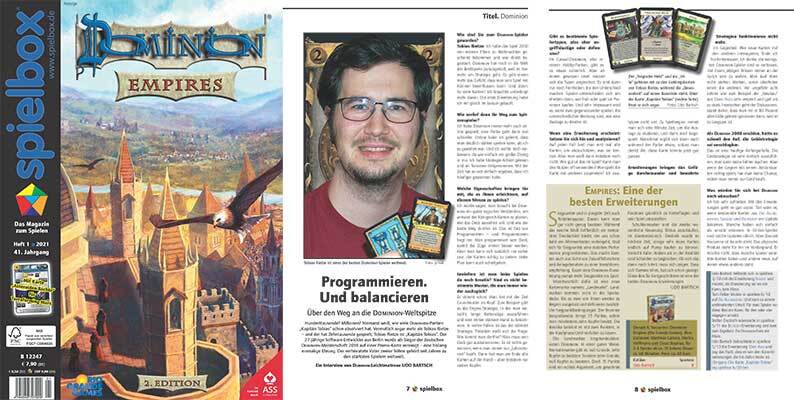
The connection is actually the opposite. No one can buy an article in the magazine. But it’s true: the cover page in spielbox is an ad page. This has grown historically. From a journalistic perspective, I’m not happy about it. I would change it immediately if I could, because I think it’s unfortunate. But this is a publisher’s decision, and at nostheide-Verlag, the editorial team and the publisher are strictly separate. So I have no choice but to make the best of the situation. We respond to reader requests with the article in the magazine. In the past, it wasn’t necessarily the case that a cover feature also had an article. This confused many readers, as other magazines don’t work that way. Readers have learned it differently. We’ve developed the ambition to create journalistic content for a cover feature, which isn’t a problem. As I said: you can tell an interesting story about almost any game. One thing I can definitely rule out: there is no automatic assumption that an advertiser on the cover also buys a favourable review. This didn’t happen under Matthias Hardel, and it won’t happen under me.
Are there any other guidelines from the publisher?
Apart from the indirect guideline regarding the cover story, there are no editorial guidelines at all. Of course, we exchange information about what’s happening in the industry. But this mainly concerns economic developments at game publishers. It would also be silly if we didn’t share information and missed a story as a result. The internal relationship is the same as in any German publisher. The publisher and the editorial team are separate. Compared to many other board game media in Germany, this may not always be as clear. There, you mainly have very dedicated individuals or more or less large collectives who simply enjoy reporting on their hobby. Such structures aren’t necessary there because they aren’t companies pursuing economic interests. But for us, as I said: the publisher and the editorial team are separate. So far, I’ve had complete freedom. This may not be very meaningful given my short time as editor-in-chief. But I know from Matthias Hardel that it was never any different during his 19 years.
spielbox doesn’t use gender-neutral language. Why?
That has indeed been the case so far. At this point, we simply haven’t yet agreed on a binding approach for spielbox. But this will also happen in the foreseeable future.
What’s important to you in games?
I need to have fun and be well entertained. There are many ways to achieve this. I like cooperative games because they create special moments when you achieve something together. It can also be a group solitaire where I competitively puzzle away. It’s always great when the timing of my decision matters, for example because I can slow down other players – but always with the risk that I might miss out on something elsewhere. So a good mix of dilemmas excites me. Otherwise: tile-laying or worker placement, and I’m in.
And who inspires you?
True inspiration for me usually comes from art, especially from the works rather than the people. I love authors whose writing clearly shows that language has been carefully crafted. I like authors who convey a message that goes beyond solving a murder, but who also enjoy entertaining. I like reading Daniel Kehlmann. Exhibitions are always good, preferably classical modern, but even better contemporary art. With many contemporary authors and artists, you encounter very thought-provoking positions. Often, it’s also the aesthetic dimension that draws me in. I can be captivated by virtuosity, by craftsmanship. Maybe that’s why I enjoy listening to jazz.
Transparency note: The questions were asked by Sebastian Wenzel. From 2012 to 2019, Sebastian worked as a freelance contributor writing articles for spielbox. Sebastian also administers and moderates the joint forum of SpieLama, spielen.de and spielbox.