
Collab: board game for interdisciplinary research
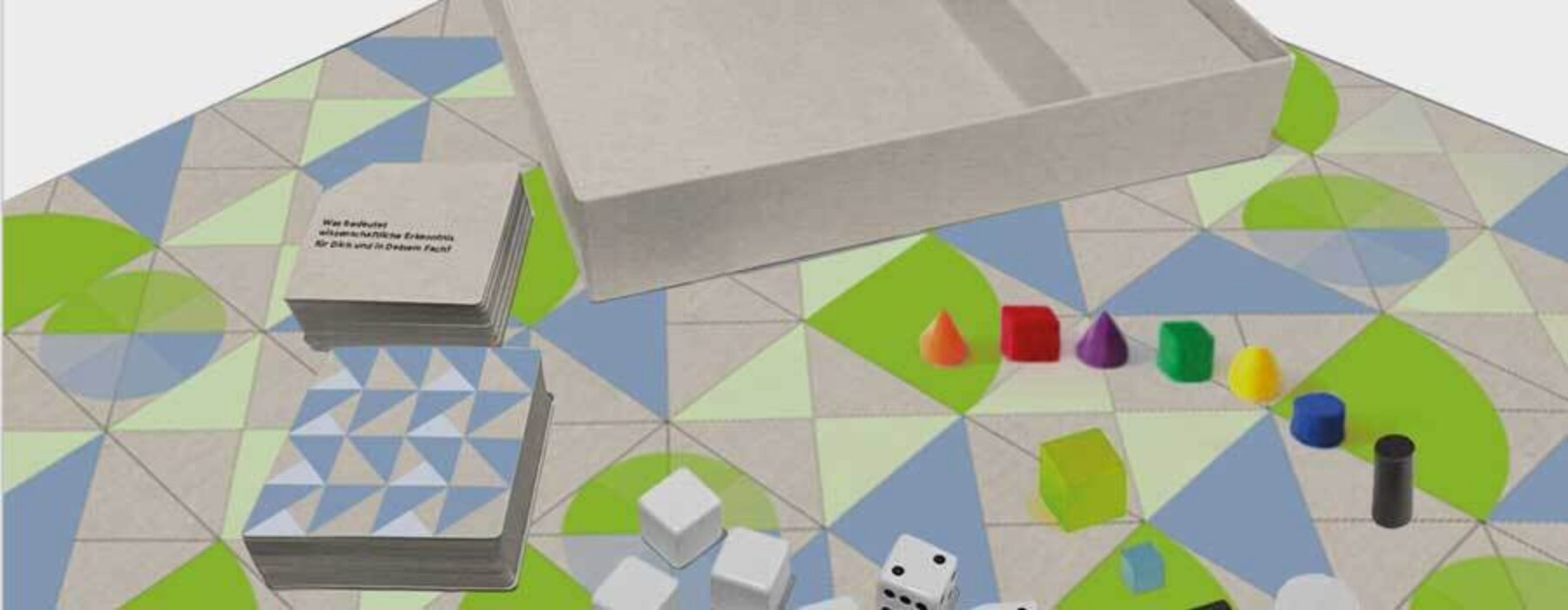
The game Collab aims to improve communication and cooperation between researchers from different disciplines. It is more reminiscent of a method for activating conversation than a classic board game.
Even the Dutch cultural historian Johan Huizinga knew: “A game is a voluntary act or occupation […], which has its aim within itself […].” In other words: playing is purpose-free. Purpose-oriented games, on the other hand, instrumentalise the game for interests that lie outside the game itself. This also applies to Collab. The instructions state: “The aim of the game is to exchange ideas about disciplinary foundations in a playful context.”
“Especially at the start of an interdisciplinary project or application, we should take the time to get to know the other disciplines and their different ways of doing science. It’s fun, enables better collaboration and prevents many misunderstandings later on. And we also learn a lot about our own academic cultures,” says Silja Klepp. She developed the game together with Johanna Barnbeck. Klepp is a professor of human geography at Christian-Albrechts-Universität zu Kiel (CAU), and Barnbeck is an artistic researcher from Berlin. The project was implemented with support from CAU, the DenkRaum initiative, the Berlin agency Spread the Nerd and the CAU research focus Kiel Marine Science (KMS).
Reflection, discussion and event cards
In Collab we move figures across the board and draw reflection, discussion and event cards. Reflection cards pose questions such as: What is the purpose of your scientific work for you? How do you identify your blind spots in research? If you could change something in your discipline, what would it be? The player whose turn it is shares their professional or personal opinion in a maximum of one minute. The other players note down important or surprising points and questions during this time. If a discussion card is drawn, everyone at the table discusses one of the “five big questions” for ten minutes – quote from the instructions: “For example: How is the role of science in society discussed in your field? What categories or pigeonholes do you work with? How is your academic world divided up?” Event cards change the position of the figures on the board.
Visually, the game is inspired by Bauhaus aesthetics, a design school that traditionally works across disciplines. “During the game, a visual representation of the gameplay is created, which later reminds the players of the exchange. This looks different after every game – just like interdisciplinary research always looks different,” says Barnbeck.
Free printable version
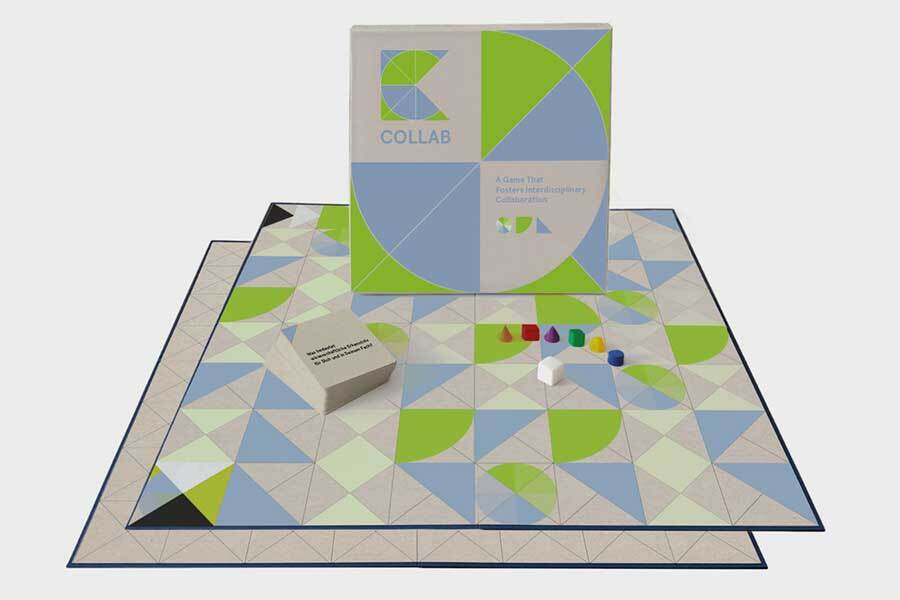
Collab is available in German and English, either to print or as an online version. A climate-neutral, coloured cardboard version can be pre-ordered on the project website de.interdisciplinarygames.net.
The creators’ wish is for Collab to also inspire a paradigm shift in interdisciplinary research. For this reason, Klepp and Barnbeck have prefaced the game with a manifesto for good interdisciplinary collaboration. It states, among other things: “Interdisciplinary collaboration requires courage because it initially creates more uncertainty than disciplinary research.” But also: “Interdisciplinary artistic and scientific collaboration on an equal footing is possible.” The aim is also to make work and project groups a discrimination-free space. Klepp says: “Interdisciplinary work can be annoying or a lot of fun. Collab helps to start the conversation and advance the joint reflection on structures and disciplines. This is central to successful and exciting collaboration.” This is sensible and correct, but it has very little to do with a classic board game.