
Archaeology meets algorithm: AI deciphers Roman board game
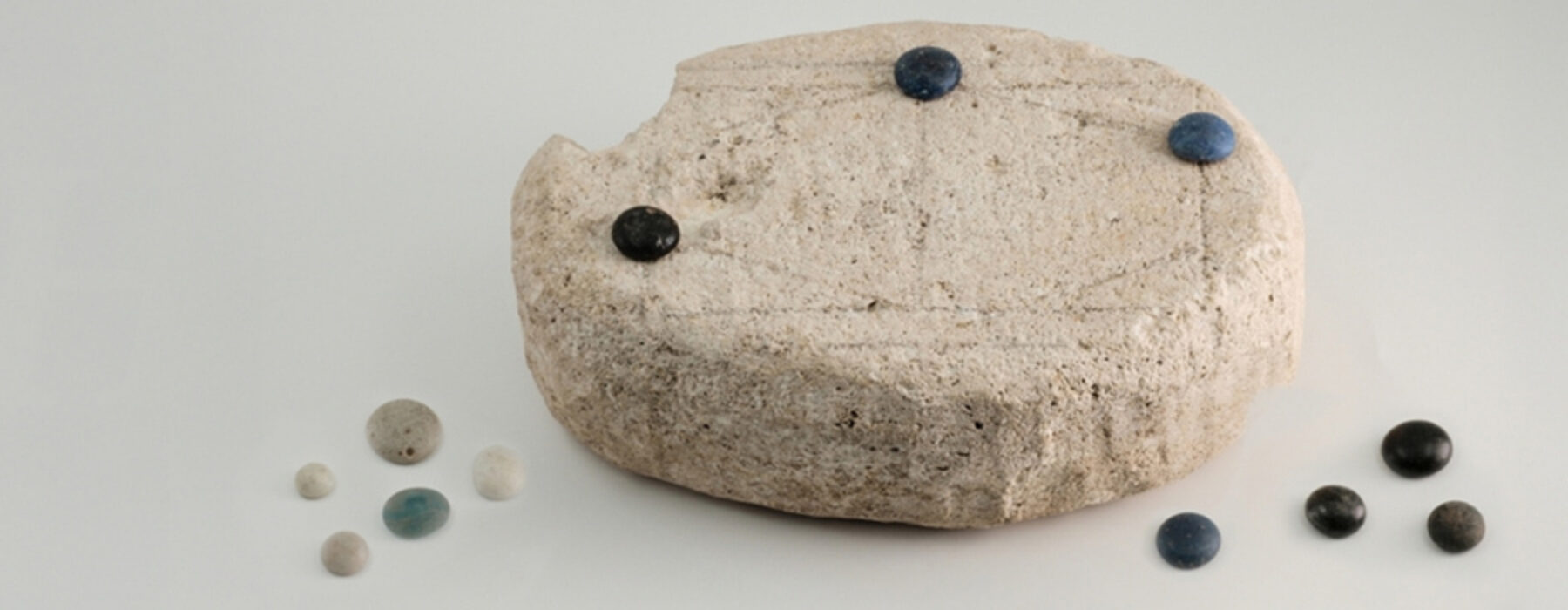
A Roman limestone once puzzled archaeologists for a long time. Now, an artificial intelligence has deciphered the presumed rules of the ancient board game.
It all started with a white limestone from the Roman settlement of Coriovallum, present-day Heerlen in the Netherlands. Archaeologist Walter Crist discovered it in 2020 in the collection of the Thermenmuseum. The stone slab, measuring about 21 by 14.5 centimetres, features a geometric line diagram and was worked on around 1,500 to 1,700 years ago. “The appearance and wear suggested a game, but I didn’t recognise the pattern from other ancient games,” Crist said, according to the University of Leiden.
Under the microscope, he examined the stone’s lines and discovered wear marks. A 3D scan revealed the scratches in detail. “Some traces are a fraction of a millimetre deeper than others, which means they were used more intensively,” Crist said. Presumably, game pieces were pushed along there. But according to which rules?
Simulated move paths match real scratch marks
The team used artificial intelligence and the Ludii database from Maastricht University to determine the rules. In the journal Antiquity, they report on two AI agents that played thousands of games on virtual replicas of the stone. They drew on more than 130 rule sets of historical European board games. The AI varied starting positions, move options and winning conditions, and compared the simulated move paths with the real scratch marks.

The most likely interpretation: the game was an asymmetrical blocking game. The aim was not to capture pieces but to prevent the opponent from moving. According to the AI, players took turns placing stones in the grooves, with one side having four pieces and the other two. The winner was the one who managed to avoid being immobilised the longest.
Such games were previously known mainly from the Middle Ages and modern times, for example Haretavl from Scandinavia or Gioco dell’Orso from Italy. If the AI analyses are correct, blocking games are several centuries older than assumed. “This makes the discovery particularly remarkable,” says Crist. The reconstructed game dates back to the Roman Imperial period and is called Ludus Coriovalli. It is now considered the oldest known European example of this kind. Anyone who wants to can play it on a Ludii project page.
“New tool for deciphering games”
The AI approach could enable further discoveries. “For the first time, AI-driven simulated gaming has been combined with archaeological methods to identify a board game,” says Crist. “This research provides archaeologists with new tools to decipher games from ancient cultures.”
Yet the exact reconstruction remains difficult. Archaeological finds are often incomplete: a board may survive, but the associated pieces, dice or inscriptions may not. Even with well-preserved boards, it remains unclear whether the discovered pattern represents a single rule set or just one of several variants. Ulrich Schädler, among others, points this out in his article Vergessene Spiele: Für immer verloren oder noch zu retten?.
Moreover, ambiguous wear marks complicate the analysis: different rule sets can produce similar scratch patterns. AI also only combines known rule types from other regions and eras. Unknown game ideas, hybrid forms or culturally specific house rules remain invisible because they are missing from the training catalogue.
Therefore, the AI does not provide an absolute truth about the gameplay, but merely the most plausible scenarios.