
Ten years of Exit: puzzling with a system

What began in 2016 with three games is now one of the most successful board game brands in the world. Behind the success of Exit – Das Spiel are the author duo Inka and Markus Brand. In the interview, the two talk about good puzzles, the secret of their success and parcel centres that influence their work.
Since 2016, over 80 Exit products have been published by Kosmos – not just games, but also Advent calendars, books and puzzles. Exit thus ranks alongside brands like Catan, Ubongo, Andor or Die drei ??? as one of Kosmos’s most important revenue generators.
You’ve been developing Exit games for ten years. Do you still enjoy it?
Yes, we do. We’ll keep developing as long as we have fun and creative ideas. If the quality of the puzzles were to drop, we’d take a break.
The subtitle of Exit is “Das Spiel”. Is solving puzzles even a game?
Of course it’s a game, a cooperative one at that. But more than that, it’s a group experience – a game with an event-like character. We like to compare it to murder mystery dinner games. You can only play it once because you’ll know the solution afterwards, but in return you usually get several hours of fun and experience an exciting adventure together.
What makes a good puzzle?
It has to be logical. The solution has to be in the game itself. If players say “Ah, I see” at the end, it was a good puzzle.
And what makes a good Exit game?
A good Exit game is like a movie night. The story has to build tension, surprise and touch you. What matters is a consistent theme, creative puzzles, a certain dynamism and the famous aha moment when the group finds the solution together.
In 2014, Kosmos editors Ralph Querfurth and Sandra Dochtermann had the idea during a lunch break to bring live escape rooms into people’s homes as a game. The games were to be small, affordable and card-based, possibly with a decoder wheel. Inka and Markus Brand developed a game system based on these specifications.
How did you approach the development?
Our task was to create a system that lets you play an escape game without a game master. This led to the puzzle and help cards as well as the decoder wheel. You enter a code on the wheel, and the result directs you to a puzzle card. There you find out whether the code was wrong or if you can proceed. This double-checking system is the real innovation.

The system also convinced critics. In 2016, three Exit games were awarded the Kennerspiel des Jahres. The jury wrote at the time: “The perfect game principle and the remarkable quality of the cooperative adventures in the ‘Exit – Das Spiel’ series are so convincing that all three titles of the premiere season deserve to be highlighted. The often innovative puzzles make it a pleasure to search for the by no means trivial and often ingenious solutions. These games are a must for all escape room fans and those who want to become one.”
How is new Exit content created today?
From the first idea to the finished product usually takes up to two years. Often we start with an image, a place or an atmosphere in mind, like an abandoned castle or a deep-sea expedition. From there, the story develops. Then we think about which puzzles fit. The connection between the story and the mechanics is crucial. The puzzles have to match the story. The order of the puzzles is also crucial. Subsequent changes can throw off the entire system, especially because of the decoder wheel. It only has holes in certain places so that all codes fit.
In Exit games, players have to bend, tear or colour in cards, packaging and other materials. This allows for a wide variety of puzzles. In addition to the brain teasers, there are often surprises. For example, you might have to call a phone number to get the next clue.
How do you come up with your puzzles?
We’re always in puzzle mode. We jot down ideas in a book. When we develop a new game, we look in it to see which puzzles might fit. Some ideas come from the materials, others are based on well-known puzzle types that we develop further or adapt. Some come to us spontaneously, like a flash of inspiration. Often a puzzle also emerges from the storyline.
Exit games are available for beginners, advanced players and experts. How do you determine the difficulty level?
A puzzle for experts isn’t necessarily harder. The difference lies in the number of clues. Beginners are guided more. For example, they usually have all the materials they need right in front of them. Experts have to think more outside the box.
Which puzzles are you particularly proud of?
Markus: I especially like the final puzzle in The Conspiracy of Venice. Something happens there that had never happened in an Exit game before.
Inka: My favourite puzzle is a simple one. Players just have to read the inscription on a gravestone out loud. I don’t want to spoil it, but our playtest sessions were incredibly funny. I laughed so much that this puzzle will always stay in my memory. Otherwise, I really like it when players have to get musical to solve the Advent calendar.
Are such puzzles particularly difficult to develop?
Puzzles with paper, cardboard or straws are easy to develop and test. It gets more complicated with special printing techniques or materials like scratch-off ink. Whether these puzzles work can only be tested in later production stages. For example, if a pin has to be guided precisely through the cardboard at a specific point, that’s very complex in production.
Shipping the products also plays a role. With one Advent calendar, we had built in a maze that had to be solved by tilting the box. Our prototype worked without any problems, but it wasn’t sent by post. In parcel centres, however, a box is often moved and turned. The editorial team had to find a solution that could withstand that.
The Exit games cost €14.99 or less. How does the price influence development?
Most puzzles work with a pen, scissors, paper and a few other inexpensive materials. That’s a challenge we’re happy to take on. But we also keep trying out new ideas. Besides costs, safety regulations and production requirements set limits. With our latest prototype, there’s an element where it’s unclear whether it can be technically implemented.
Exit games can only be played once. Solving the puzzles requires writing on, folding and cutting up the game materials.
It was initially heavily criticised that Exit games can only be played once.
Modifying the materials enables an exciting and surprising gaming experience. The games consist almost entirely of paper and cardboard, which are recyclable. This makes Exit games more sustainable than many other games. Besides, it’s in the nature of things that a solved puzzle can’t be solved again. There’s no reason to play the game a second time.
The first three Exit games were released in Germany in 2016: The Abandoned Cabin, The Secret Lab and The Pharaoh’s Tomb. Today, Exit is available in 35 countries and 24 languages. Over 30 million Exit products have been sold worldwide. The games are especially popular in France, Italy, Spain and the Netherlands.
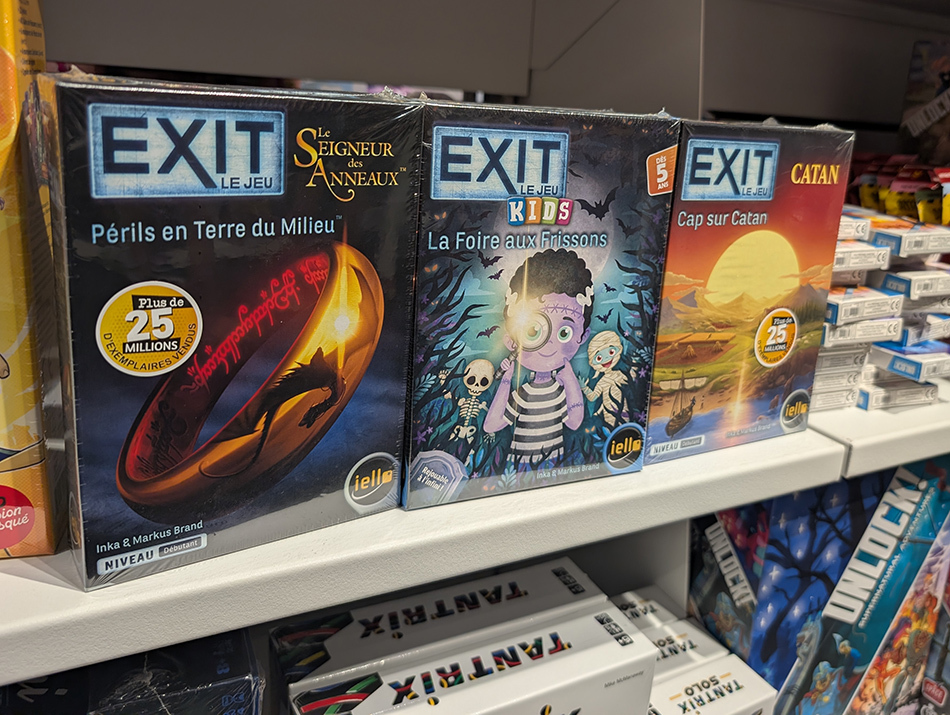
Do the French solve puzzles differently from the Germans?
That’s hard for us to judge, as our test groups are mostly from Germany. Games are only translated into other languages after publication. But the feedback from different countries is surprisingly similar. I remember a Swedish stag party: the guys called in the middle of the night because they were stuck in The Pharaoh’s Tomb. Just like many German players.
How do you translate German puns into other languages?
The license partners handle the translations. We make sure to identify linguistically tricky puzzles. If a pun doesn’t work, we look for alternatives together or develop a replacement puzzle for the international version.
Initially, you developed the games alone. Now your daughter Emily helps you. What has changed as a result?
Emily brings fresh ideas and new perspectives. Her spatial awareness is a huge help, as many puzzles are now very complex.
Other publishers also offer puzzle games. Asmodee, for example, distributes Unlock, which is developed by various authors. Unlock! Kids Detective Stories won the Kinderspiel des Jahres special award in 2023. Unlock! Game Adventures won the Kennerspiel des Jahres special award in 2023.
Which escape games do you enjoy besides Exit?
We really enjoy playing other escape games and are always excited to discover a new series or concept. There are many great games on the market, and we also draw inspiration from them for our own work.
What final tip do you have for anyone struggling with an Exit puzzle?
The most important tip is: look very carefully. Everything in the game has a meaning. Everything can be important for the solution: even the box or the instructions. It’s worth reading texts attentively and paying attention to highlighted or underlined parts – they’re never marked without reason.
You never need to search for solutions online. Every puzzle contains all the necessary clues. Also, you should listen to all players. In test rounds, we often see that the quietest person already has the right idea, but no one pays attention to them. Good teamwork is often the key to success.
Hidden Easter eggs
Every Exit title contains references and homages. The opponent “Dr. Arthur Funbeq” is an anagram of Kosmos editor Ralph Querfurth. In The Abandoned Cabin, there’s a painting signed IMBRAND, a nod to Inka and Markus Brand. Birthdays also appear, such as dates in diary entries. Most of the animals also have real-life counterparts. They live at the homes of Kosmos employees.
Many Exit games also reference well-known films and series. In The Secret Lab, there’s a reference to Breaking Bad, complete with chicken association. In The Forgotten Island, black smoke moves through the jungle, reminding you of the series Lost. In The Forbidden Castle, a throne forged from shields creates a “Game of Thrones” feel.
Homages can also be found in the images: The circus director from The Last Performance is a tribute to Heiko Windfelder, the long-time programme manager at Kosmos and co-creator of the Exit success story. In the advent calendar The Intergalactic Race, you discover your own spaceship in a scrapyard. If you look closely, you’ll find a caravan with a partially obscured nameplate: “T. Jon…”, a reference to Die drei ???.