
Reiner Knizia: “Expect publishers to make beautiful games out of what I have created”

One author, three awards: Reiner Knizia is the first person to have won the Spiel, Kennerspiel and Kinderspiel des Jahres. In a triple interview, he reveals that he steals cutlery from planes, reads joke books to fall asleep and gets annoyed by unprofessional publishers.
Reiner Knizia is the first author to have won the three most important awards in the board game industry: the Spiel, Kennerspiel and Kinderspiel des Jahres. In 2008, he achieved the double. Back then, he won the Spiel des Jahres with Keltis and the Kinderspiel des Jahres with Wer war’s?. Almost twenty years later, he completed the triple. The Kennerspiel des Jahres 2026 was Rebirth. To mark the occasion, we put three questions to him in a triple interview: three questions on three main topics, each with three answers per question.
You are currently viewing a placeholder content from Standard. To access the actual content, click the button below. Please note that this will pass data to third-party providers.
More informationThis interview is a supplement to an approximately one-hour interview with Reiner Knizia. You can listen to the full conversation in the podcast Boardcast by Frederik Malsy.
1. Reiner Knizia as an author

Today you are a game author. In the past, you ran a construction finance company with 300 employees and 2.5 billion euros in new business per year. Which three skills from back then help you today?
It’s a valuable experience to have worked in a large company. It helps me understand why processes in international publishers work in a certain way.
Secondly: organisation. In large companies, it’s important to design processes so they stay simple. The bigger the company, the greater the risk that bureaucracy grows. Of course, with our small company Knizia Games, we also try to conquer the world. But we make sure to keep things as simple as possible. We prioritise and want to achieve a lot with few people without burning out.
Thirdly: cultural differences. In England, I worked in an international environment. English and German culture may not seem far apart, but there are huge differences. The British improvise and make progress. Germans get lost in bureaucracy. Everything is correct, but in the end they don’t get anything done because they’re too busy with themselves. This experience helps me because my games are international and I work with publishers from many cultures.
What three things annoy you when working with publishers?
I deliberately didn’t start my own publishing company. Producing and marketing games is a different business from designing them. When I build a prototype, I want it to go out into the world. For that, I need a publisher to take over the prototype, implement it, produce it and sell it. I work hard to do a professional job and deliver a perfect game design. I expect the same professionalism from the publisher, whether it’s big or small. I expect the publisher to turn what I’ve created into a beautiful game. Our industry thrives on the fact that we all got into it out of love for games. Unfortunately, love for games alone isn’t enough to be a successful author or publisher. And unfortunately, there are an awful lot of chaotic people in the industry.
What particularly annoys me is when publishers don’t formulate the rules clearly. This leads to mistakes, inconsistencies, differences in terminology and contradictions.
Another annoying thing is when publishers license a game and then say: This doesn’t fit, we want to completely redesign it. Then I ask myself: Why was the game licensed in the first place? I don’t tell publishers how to do their job either, like saying they have to do marketing or production in this or that way. Everyone should do their part of the job professionally.
Now I’ve named two things. I’d like to leave it at that. It’s enough if two things annoy me.
What three pieces of advice should someone follow if they want to become a full-time board game author?
In my view, a love for games is essential. Why else would you become a game author? It’s important to know the industry. You should know what games exist so you don’t end up inventing Monopoly or Mensch ärgere Dich nicht for the hundredth time. If you’re afraid someone might steal your idea, even though it’s not new, you haven’t done enough research. It’s part of the process to attend trade fairs, look at other games and study publishers’ catalogues to find your way step by step.
That’s my first piece of advice: take it step by step. Don’t aim for the world record or big success right away. It’s better to work with a small publisher that’s just as passionate about the game as you are. That way, you can learn on an equal footing. If an unknown author approaches an international publisher, it’s unlikely to work on an equal footing, if they even get through at all.
If you want to become an author, you shouldn’t also become a publisher. Self-publishing is a dangerous path. You’re missing the second pair of eyes that can look at things, spot issues and improve them. In the end, your garage is full of self-produced games and your car has to stay outside in winter.
Thirdly: maintain your own style and direction. Don’t follow others. In the long run, that won’t get you anywhere. You have to find your own style. You should start with games that bring you joy and stay true to yourself.
2. Reiner Knizia as a person
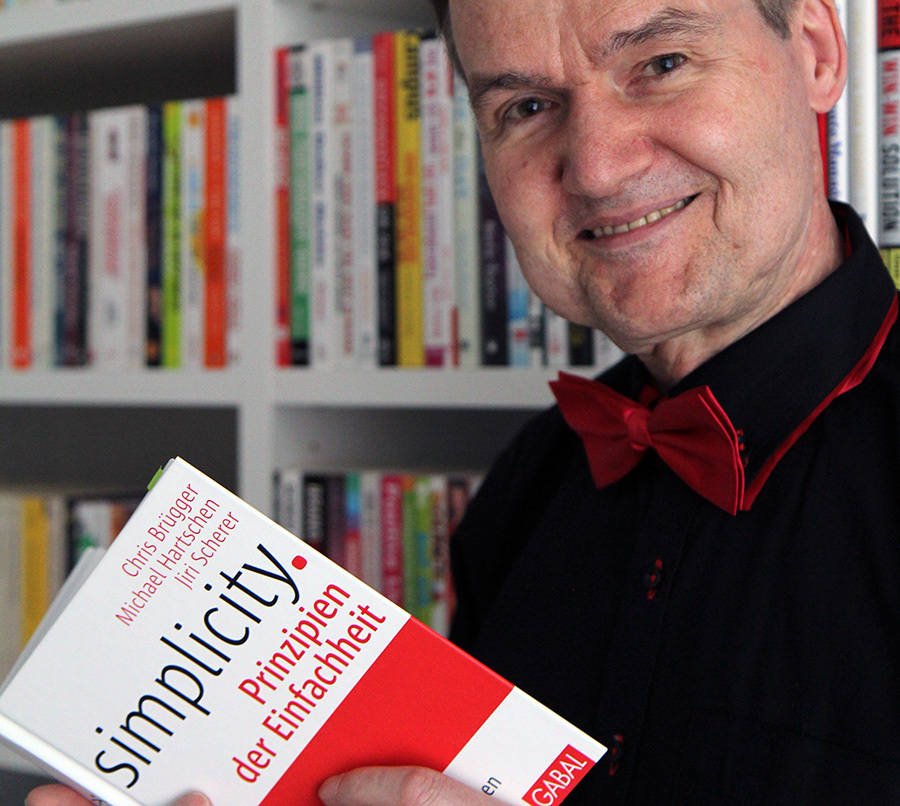
Which three books have you read most recently and what did you learn from them?
When I get up at four in the morning and test until ten in the evening, I don’t have much capacity left to read a lot in the evening. So I like to read critical and humorous quotes, and sometimes a joke book. That suits my attention span. After each joke or quote, I can fall asleep. I’m so lazy that I lie on one side and only read the left-hand pages. The next evening, I switch sides to read the right-hand pages.
Still, there are books I keep coming back to. One of my absolute favourite books is The Time Machine by H. G. Wells. Time, time travel and what changes over time fascinate me. Wells delves deep into the theory. He even describes how to build a time machine. It’s brilliant. When I see how our society is developing, increasingly resembling the Eloi from the book, I think: H. G. Wells saw it all coming.
Secondly, there’s a fantastic book by Jean-Louis Servan-Schreiber. It has a terrible, sensationalist title: The 90-Minute Hour. I’ve read a lot of literature on organisation, time management and self-organisation. Often, people just copy each other. Servan-Schreiber thought for himself. Why do I need to have time? Why do I need to synchronise it? For example, because trains run. So we need to ensure that time matches across different villages. Servan-Schreiber shows how time became relevant to us. He thinks from the subject itself, not from abstract derivations. That fascinates me.
Recently, thirdly, I read The Victorian Internet by Tom Standage. It’s about the invention of the telegraph. It’s remarkable how this form of communication changed the world. Suddenly, you knew the prices in the neighbouring village. Arbitrage became possible. I’m fascinated by how much of what we experience through digitalisation and is hailed as new often existed before in a different form. This is also reflected in my games. It’s exciting to place the present in a historical context and realise: many things existed before, just differently.
You have lived in the USA, England and Austria. Today you live in Munich. Which three things from those countries do you miss the most?
My favourite city is still Vienna, where I also lived. But this longing isn’t so bad. Every summer I go to a design retreat in Vienna and pack all the games that are finished or almost finished. There I have two intensive weeks in which I work. Every day I’m allowed one hour out to see the city. Usually I visit a bookshop to research the next topic. That way I combine the pleasant with the useful.
From England, I miss friends the most. I lived there for 23 years. You leave those friends behind. You can’t kid yourself about that, even if they all visit us in Munich every one or two years. Places I’ve grown fond of, I miss less. The people are more important.
From the USA, I miss the old America that I experienced during my studies there. Today’s America doesn’t appeal to me.
Which three facts that have nothing to do with games does almost nobody know about you?
I used to be an ambitious athlete. I had it in my head that I could achieve success with hard training. On a small scale, it worked. I was Swabian champion over 400 metres. Later I switched to football. There I was terribly fast as a defender, could catch up with opponents and take the ball off them. But I wasn’t skilful enough with ball control. Nothing came of the career. Still, I do as much sport as I can today.
Another secret I would never admit publicly: I’m active in a ring of organised crime. I “collect” cutlery from aeroplanes, so spoons, forks and knives. I have a huge collection. Sometimes I ask politely, sometimes a spoon just disappears into my pocket. This hobby started because I used to fly a lot and found the different cutlery designs fascinating. It turned into a passion or a quirk. I’ve even persuaded friends to join in. Unfortunately, many airlines now use plastic cutlery, for various reasons, but certainly also because the metal cutlery often went missing.
What else is there to know about me as a boring person? I have a great passion for quotes. My bookshelves are full of them. I’m constantly buying new books, even though many quotes repeat. But every now and then I discover a real gem. Quotes contain truth and wisdom. They reflect the culture of their countries of origin. One of my favourite quotes is attributed to Einstein, though many quotes are attributed to Einstein. It goes: “The main cause of stress is daily interaction with idiots.”
3. Reiner Knizia as a player

Which three games would you have liked to have invented yourself?
I rarely play other people’s games. So I don’t know which ones I would have liked to invent. Of course, I could say the collectible card game, i.e. trading card games. They created a huge new industry. Everyone wishes for such global successes. However, I have to admit: I visited Richard Garfield in Seattle before Magic: The Gathering was published. Clever as I was, I said to Richard: “This won’t work. It’s far too complicated.” That shows: you can wish for such innovations, but then be too stupid to recognise them.
With Wettlauf nach El Dorado I tried to open up the deck-building game to a broad audience. The underlying innovation was a wonderful achievement by Donald X. Vaccarino: creating something completely new in card games, which have existed forever, namely deck-building. A fascinating twist. Such surprises excite me.
And thirdly, legacy games. At first, with these, just like with cooperative games, people shook their heads and were confused: am I supposed to tear up the card? That’s nonsense, pure gimmickry. But then you recognise the depth behind it.
I often misjudge such big trends, at least at first. Then I ask myself: what can I contribute? That’s how My City came about. The game tries to make the complex legacy games accessible as a simple family game where everyone plays at the same time and a game is finished in half an hour.
Which three qualities should people have if you enjoy playing with them?
I meet up every week with one to two dozen people to play and test. My best testers are the ones I’d most like to strangle. That’s not a quality, but they should be critical. I pack my entertainment into boxes. At some point the box is opened, then the entertainment should come out. So you have to test it beforehand. So: critical testers. Tough on the game, but not on the people.
I like to play with pleasant people I want to be around. That’s the first and most important thing. We seek human community. The game brings us together. I want to be with nice, pleasant people. That’s the most important thing of all.
Secondly, it’s useful if someone isn’t obsessed with winning and doesn’t react badly to a loss. It’s unpleasant if you constantly have to consider that someone can’t lose. However, I believe this has largely been eliminated by our gaming culture.
When I was in England, we had an expression: hopefully there’s no Chris at the table. I had several friends all called Chris, and they were all terribly slow players. Thirdly, it’s part of respecting the community to play at a reasonable pace, to keep the game moving and not act as a solo player while the others wait for it to continue.
Are there three themes that should have more board games about them?
There are many themes that are overused. We don’t need any more games set somewhere in the Renaissance in Italy or repeating this or that theme. I’d like something new, something appealing. I have new themes I’m working on. But I’m not revealing them.
This is a challenge of game development: finding new themes. You have to keep your eyes open. Are there new characters? New films? Or new developments in the world? Games are a mirror of our time and our world.
Bonus question
You have published more than 800 games. Which three are you particularly proud of?
I refer to my games as my children. Now I’m being asked: which three children are my favourites? If I only name three titles, the others will be upset. I have the ambition with every game that it brings something special with it. That’s why I’m proud of all my games.
For example, with Euphrat & Tigris. The game was released in 1997 and was number one on BoardGameGeek for many years. That still makes me happy. The elegance of the game continues to impress me, even though it’s one of my most complex games. And then there’s its longevity. A Kickstarter has just finished, bringing out the game in a new, even more beautiful version.
A turning point in my career as a game designer was also Wettlauf nach El Dorado. It was the first game where I, as the designer, invested in the artwork myself. I hired Vincent Dutrait. As a deck-building game with many cards, it required a lot of investment. That’s why I knew I had to support individual publishers. I also wanted a consistent look for the compatibility of the different editions. That paid off. The game has now been published by twenty different publishers.
The third game might be Modern Art, because it was the first time I won an award as a designer. It might be L.A.M.A., because it showed that even simple, non-simplistic games can achieve great success. It might be Durch die Wüste, because it expresses my philosophy. I want players to bite their nails and say: So much to do, and I don’t have enough turns. I love that in life. And I love that in games. That comes across especially strongly in Durch die Wüste.