
Corona is also a board game
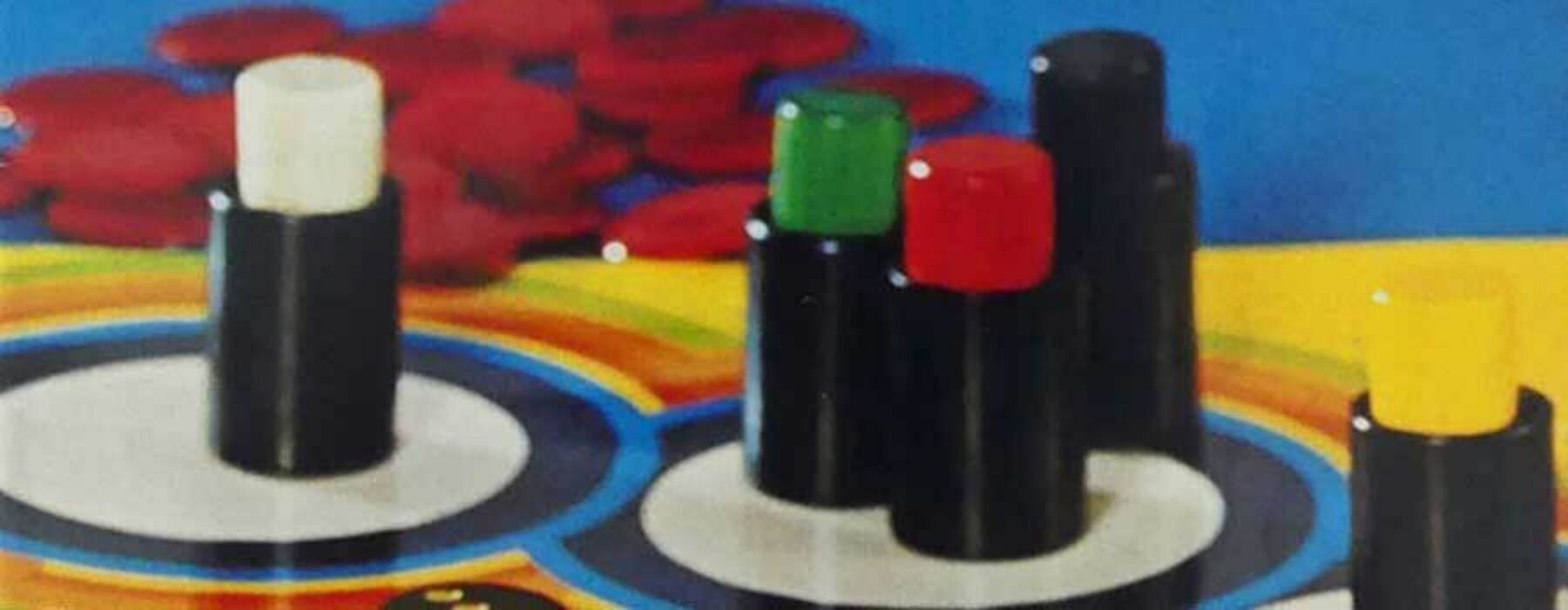
Corona isn’t just the name of a Mexican beer and a city in California – it’s also a board game. To win, you should behave very differently than during the current Covid-19 pandemic.
Alex Randolph created classics like Sagaland, Tempo kleine Schnecke and Inkognito, but also the game Corona. The Latin word means crown or wreath. The Corona board game was first published in 1974 by Ravensburger in the Casino series. The instructions at the time stated: “Corona is a dice game with a completely new game principle, where chance is excluded – or rather, chance neither helps nor hinders. The dice only determine the starting situation. Then each player can do something with it – or not.”
If you keep your distance, you lose
During the Covid-19 pandemic, many politicians also faced a starting situation and had to make decisions and take action. What to do? What not to do? Most decided to shut down public life and impose contact restrictions. In the Corona board game, if you keep your distance, you’ll probably lose.
Six figures stand on spaces of a circle. A player rolls six coloured dice. The results dictate how far the corresponding coloured figure must move. The twist: at the start of a round, the figures are not colour-coded. The players assign the colours after a short thinking phase. During this, each must consider which colour to assign to which figure and in which order to move the figures. The more figures on the space where the currently moved figure stops, the better – the more points you get. The author’s tip: “In any case, you should try to bring as many game pieces together on one space as possible.”

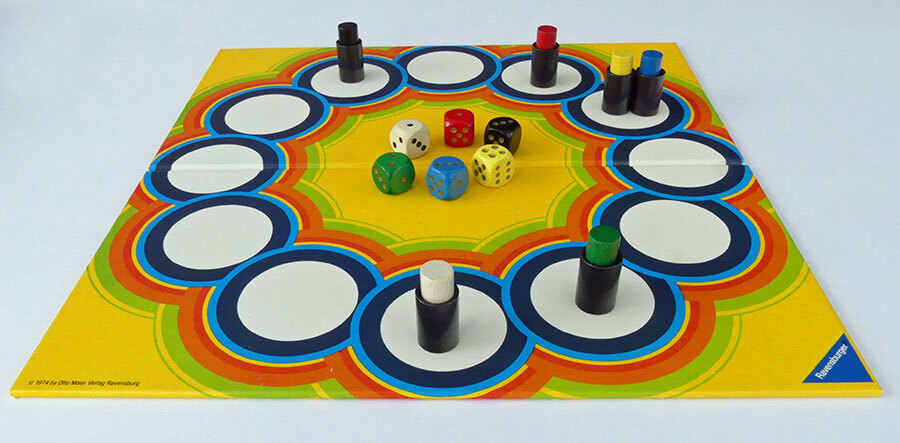
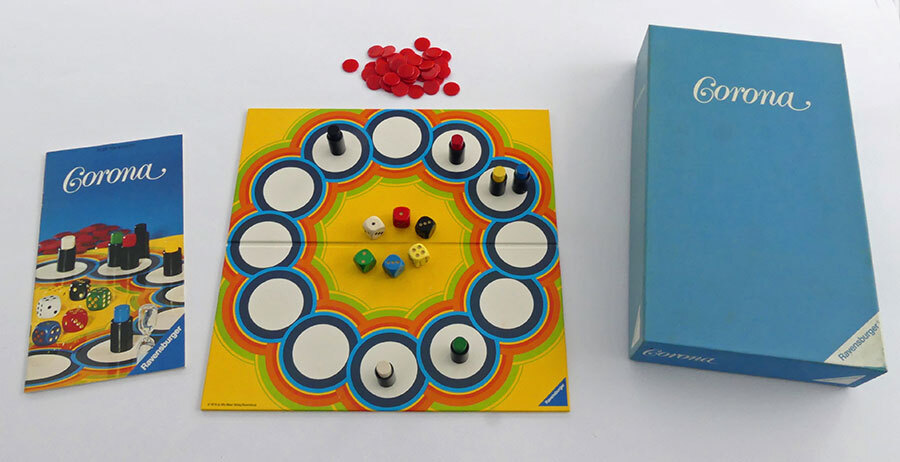
Corona was a hit and was re-released time and again, under different names and with slightly modified rules: in 1982 as Moonstar by Avalon Hill, in 1984 as Harun by Edition Perlhuhn, in 1993 as Orbit under the label
“franckh Spiele-Galerie” of Franckh-Kosmos Verlags GmbH & Co. One thing always stayed the same: you never know what will happen in the next round. Only once the dice have been rolled do all players try to make the best of the situation. Just like in the current Covid-19 pandemic. Whether politicians have made the right decisions, unlike in the game, we won’t know in a few minutes, but probably only in months.
Randolph, by the way, was a game designer who also cultivated the art of conversation. In the book “Die Sonnenseite. Fragmente aus dem Leben eines Spieleerfinders”, he muses next to a photo of his game Corona about dice. What if dice have already been rolled but are still under a cup? The answer fits the current Corona situation.
“They [the dice] are under the cup – but in the present or in the future? Before the dice were rolled, it could have been any number. But now, can any number still be possible? No! I’ve always had this image: the dear Lord is in a helicopter. And he’s watching us. He sees, for example, a car driving into the desert. The driver knows his past, he knows his present, but he doesn’t know what lies ahead. The dear Lord in the helicopter, however, knows exactly what’s coming for this person. For him, past, present and future are one.”
Alex Randolph, Die Sonnenseite. Fragmente aus dem Leben eines Spieleerfinders