
“The game ‘Make Fake News Great Again’ is a danger to democracy”
Disinformation destroys democracies. This also applies to “Make Fake News Great Again”. The social game makes light of a serious topic without reflection. That’s anything but funny. A commentary.
Donald Trump and Pinocchio have one thing in common: they lie. The children’s book character Pinocchio does it in print, Trump does it via tweet. Pinocchio lies to a fairy, Trump lies to the whole world. The President of the United States not only spreads untruths but also insults journalists and calls facts he doesn’t like “fake news”.
Undifferentiated media bashing also exists in Germany. “Lügenpresse” was already the Unword of the Year in 2014. Back then, newspapers weren’t writing about Corona but about refugees. In its reasoning for the decision, the jury emphasised that the term defames the media across the board. “Such a blanket condemnation prevents well-founded media criticism and thus contributes to endangering the freedom of the press, which is so important for democracy,” the jury wrote.
Fake news is a homograph
Similar to the Unword “Lügenpresse”, fake news also threaten our democracy. The term is a homograph, meaning a word with two meanings. Unlike a cup of tea, it certainly doesn’t help you relax. Put simply, fake news can mean nothing more than false reports. Whether intentional or not doesn’t matter. On the other hand, fake news is also a slur. Politicians use it when they want to discredit facts they don’t like.
Since the term has multiple meanings, serious scientists and journalists don’t use “fake news” but instead use “disinformation”. The Correctiv research centre warns: “Targeted disinformation is used to divide our society, spread hatred or do business.” According to the Federal Agency for Civic Education, disinformation aims to destroy established truths and beliefs within societies. “Often, the goal is to undermine the legitimacy of institutions or individuals that are of central importance, particularly in majority-based, democratic systems of government,” it continues.
“Open Pandora’s box”
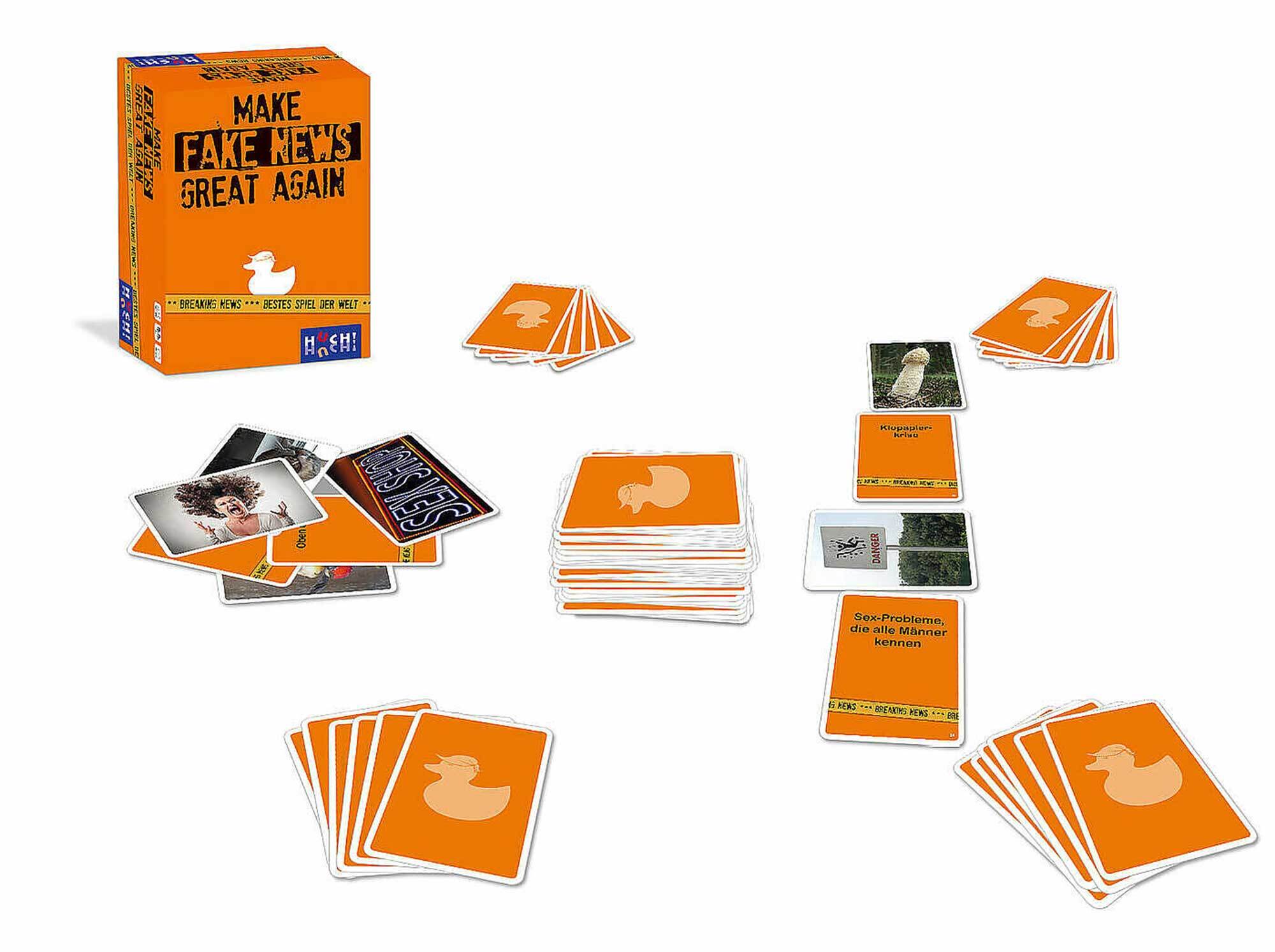
Disinformation is hard to escape these days. Huch knows this too and refers to it in the promotional text for “Make Fake News Great Again” as an “omnipresent topic”. Players are supposed to “open Pandora’s box and serve their fellow players the naked truth”. In this simple communication game, at least four people aged 16 and over come up with fake news. Each person at the table picks a card. A storyteller then invents fake news using the words and images on the cards. For more details on how it works, see my SpieLama video from second 45.

Huch raves about a “cheeky implementation” that “lightens any mood”. What’s cheeky about the game, however, is the way it destroys trust in the media and, by extension, in our democracy. The game makes light of a serious topic without reflection. That’s not funny; it also contributes to people seeing fake news as normal. But they’re not.
“With fake news, there are never any winners”
Anyone who doubts that a game can have a democracy-destroying effect should read the article on kulturexpresso.de. The self-described “German-language online culture magazine” reviews “Make Fake News Great Again” and, rather (in)appropriately, relies entirely on disinformation. Quote from the text: “The game ends when a player has five Loser cards in front of them. They have lost the game and must, at the end, weave the ultimate fake news story from all their Loser cards! This should be practised and delivered fluently, without a hint of shame, especially by the gap- and lying press. ‘Make Fake News Great Again’ must not be missing from ARD, ZDF and Deutschlandfunk, or from the media of the bourgeoisie.” A game review that tries to discredit serious media with slurs? That’s as unprecedented as a US president who lies non-stop.
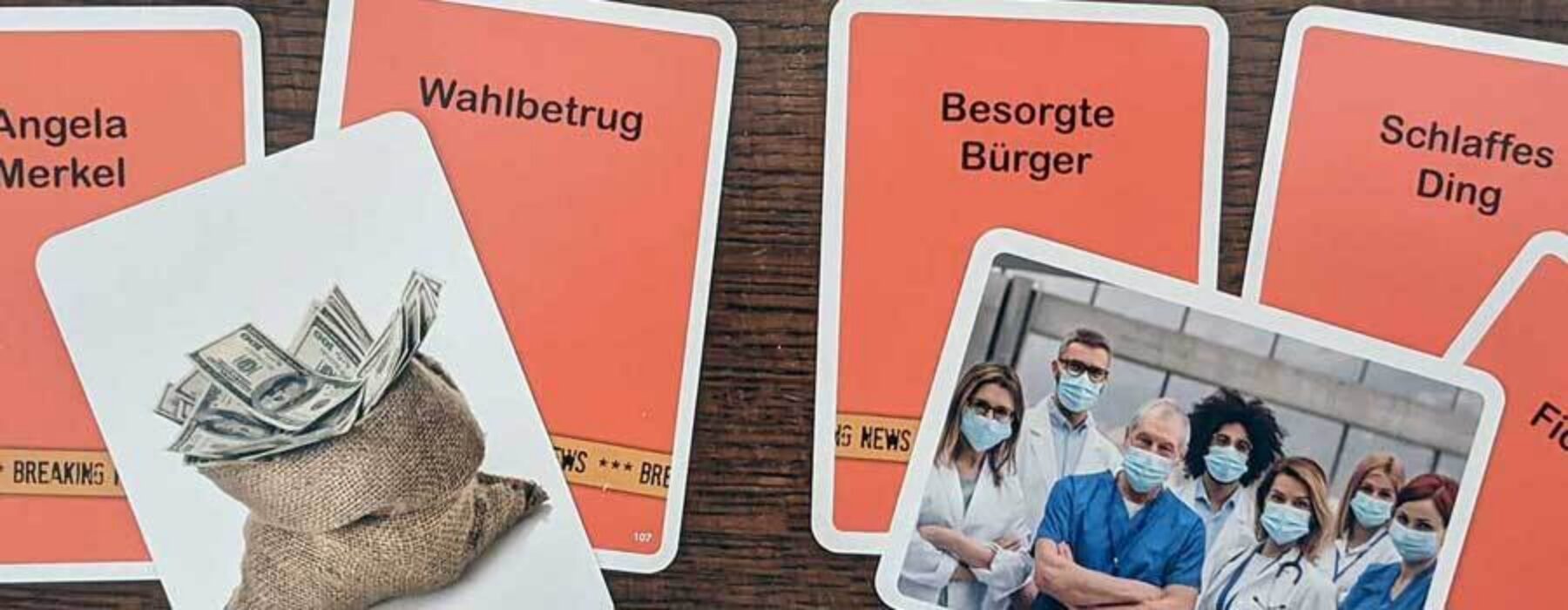
And it gets even worse: fake news leads to false memories. This is the conclusion reached by researchers from University College Cork and the University of California after an experiment they conducted in 2018. So what happens when players invent fake news using cards like “angry citizen”, “quarantine” and “election fraud”, which then become embedded in their brains?
It’s also cheeky that players don’t find any further information in the instructions for “Make Fake News Great Again”. There are no warnings about the dangers of fake news, nor tips on how to spot them. At least we don’t collect victory points, but loser cards. Whoever has the fewest cards wins. Quote from the instructions: “But let’s be honest: with fake news, there are never any winners. With fake news, there are only ever losers.” These sentences show: the publisher has recognised the problem, but still released the game. That’s reckless.
Discussions about relevant topics
Despite all the criticism, there is at least one thing that “Make Fake News Great Again” gets right, albeit probably unintentionally. It shows that games can also spark discussions about relevant topics. It doesn’t matter whether it’s about fake news, climate change or violence against children. How the latter can be done was shown by Pegasus with the violence prevention game “Sei stark, Sag nein”.
Authors and publishers don’t have to handle relevant topics in games in a sensitive or reflective way. But reviewers must critically question insensitive or unreflective implementations like “Make Fake News Great Again”. If publishers face up to this criticism, they are also facing an important, possibly uncomfortable discussion for them. These days, that’s already enough to act with more moral integrity than the President of the United States. Even Pinocchio would probably find that hard to believe, but unfortunately it’s true.
“We expect our customers to have common sense
Three questions for Andrea Stadler, Press Spokesperson for Huch! and Hutter Trade
How did “Make Fake News Great Again” come about?
In spring, we published the game “What Do You Meme?” and were completely overwhelmed by the demand. We then decided to add another party game to our range. So first, we had the idea of how the game should be structured. When it comes to researching the topic, our editorial team naturally also looks at current trends and quickly came across the topic of “fake news”. As the product developed further, we increasingly realised that the title was a perfect fit for the theme: throw together different terms and hey presto, you’ve got a headline. So we pursued this direction further. Making up stories and judging what’s false or funny is a lot of fun in this game. And it leads to a lot of communication among the players.
Fake news endanger democracy. Is a game that portrays fake news as something funny and normal also a threat to democracy?
The term “fake news” is unfortunately no longer an unusual term these days. However, we expect our customers to have common sense and assume that they will understand a game with this theme, especially with the further context of “Make … Great Again”, as satire and not as a trivialisation. Furthermore, we see the opportunity to playfully sharpen the awareness of how quickly a headline can be created. The game thrives on creativity and communication and also encourages players to critically question the topic.
In the instructions, there is the note: “With fake news, there are never any winners. With fake news, there are only ever losers.” Why are there no further hints about fake news?
Of course, we could have included further information on the topic. But then the question quickly arises: where do you start and where do you stop? For us, the main focus with our products is on the fun of playing, which is why we refrained from including information about the terminology.
“Fake news is a buzzword used by far-right groups, conspiracy theorists and tin-foil hat wearers”
Three questions for Hendrik Zörner, Press Spokesperson for the German Journalists’ Association (DJV)
Fake news endanger democracy. Is a game that portrays fake news as something funny and normal also a threat to democracy?
Whether such a game is immediately a threat to democracy cannot be judged from a theoretical perspective. But it is clear that fake news is a buzzword used by far-right groups, conspiracy theorists and tin-foil hat wearers. Many of them reject democracy.
In the game instructions, there is the note: “With fake news, there are never any winners. With fake news, there are only ever losers.” However, there are no further hints about fake news. Would the DJV like to see such hints?
Yes, definitely. Even the most competent media user doesn’t always immediately recognise whether a piece of news is trustworthy or a fake.
What is the DJV’s general stance on the terms “fake news” and “Lügenpresse”?
As I’ve already said: these are buzzwords used by fringe groups aiming to denigrate journalism and the media. Yet the coronavirus crisis has shown just how important journalistically researched news and reports are.