
Handbook Board Games: “Glory over Wealth”

In the “Handbuch Brettspiele”, experts explain how games are developed, produced and marketed. In an interview, editors Jürgen Karla and Christoph Post talk about their labour of love, the cultural asset of board games, and a company that took offence.
Handbuch Brettspiele
The Handbuch Brettspiele – Tätigkeiten und Akteure in der Brettspielbranche was published by Springer in 2024. The editors are Jürgen Karla and Christoph Post. In the book, 75 contributions by industry professionals shed light on the world of board games. The book costs 99 euros and is not only interesting for experts but also for fans who want to gain a deeper insight into the hobby. The free reading sample also includes the preface, in which the editors explain how the book came about.
In Handbuch Brettspiele there are 75 articles on different topics. Which is the most exciting?
It would be unfair to highlight individual contributions or authors. All the articles are too interesting for that. During editing, we found the articles on topics we don’t usually come into contact with particularly exciting – the knowledge gain was already huge on the first read.
What criteria did you use to select the topics?
We started with the idea of a value creation network. That’s an approach from business administration. In our Podcast Brettspielbar, in spring 2021, we explored the creation process of board games with Matthias Nagy. Over several episodes, we worked through the chronological and logical creation of a board game. We also used this as a basis for structuring the book. As the subtitle, Tätigkeiten und Akteure, makes clear, we approached the book by looking at the respective roles in the creation process and the associated tasks. That’s how we arrived at just under 35 contributions.
In the final book there are not 35 but 75 contributions: where did the additional texts come from?
Jürgen has been active in the industry with spielbar.com for 25 years. Christoph with brettspielbox.de for ten years. We have many contacts that we were able to use. During the acquisition phase, we contacted managing directors and publishing heads and asked if they had experts for certain topics. This led to many recommendations for people and topics, which we gratefully accepted. That’s how 35 contributions became 75.
Was it difficult to motivate the authors?
That was our biggest concern at the beginning. Writing a book contribution is a lot of work, which in most cases had to be done alongside their day jobs. And all on a voluntary basis. The authors’ reward is a printed copy of the book. We hope that the Handbuch Brettspiele will be bought and borrowed often. Then the authors can at least earn a small, albeit usually modest, income through the VG Wort payouts. In the end, we had open doors everywhere and received positive feedback from almost everyone. The idea of capturing the industry’s knowledge through experts convinced people.
The authors have expert knowledge, but they are not trained writers …
… which made us all the more delighted by the linguistic and substantive quality of the texts.
Which contributions didn’t make it into the book?
There were two topics we would have liked to include, but after the initial agreement we never heard back from the people involved, even after following up. With 75 contributions, that’s a good ratio. We had to reject one contribution. We had agreed with everyone involved that the texts should be factual and professional. In this one case, however, that was misunderstood and resulted in empty, promotional platitudes for the publisher’s products. We invested a lot in editing to salvage it. But the company briskly rejected our suggested changes. We no longer have any contact with them and are glad about that. When you put so much heart and free time into a project, you don’t need insulting emails.
You also wrote articles. Were these topics for which you couldn’t find experts? Or were these the topics in which you are experts?
The latter. Some of our contributions were based on interviews that we turned into text. For others, we had personal professional interests. When it came to the topic of money, no one in the industry wanted to give their name. So we did our research and drew a quintessence from many conversations. We also wrote some overarching contributions.
The editors
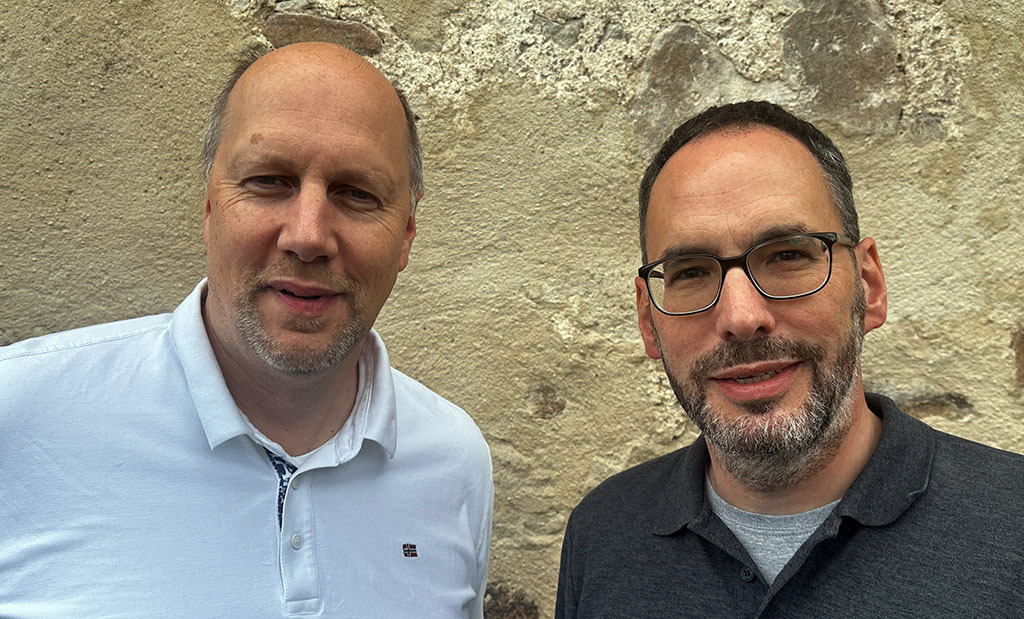
Professor Dr. habil. Jürgen Karla holds a professorship in Business Informatics at Niederrhein University of Applied Sciences. There he conducts research and teaches on social media, digital technologies and digital ethics. He has been passionate about board games since 1997. Since 2000, he has run the website spielbar.com. He also launched the podcast Brettspielradio there. Since 2018, he has additionally run the podcast Brettspielbar with Christoph Post. The idea for Handbuch Brettspiele emerged in this context. Karla is a member of the beeple Brettspiel-Blogger-Netzwerks and was a member of the jury for the innoSPIEL award.
Christoph Post has been working as a Business and Agile Coach with Fokus schärfen in Bonn for several years, supporting executives and self-employed professionals through coaching, mentoring and training. As part of his work in personality and competence development, he uses gamification approaches, among other things. Previously, he spent many years as a manager and CEO in a DAX-listed company. Since 2014, Post has run the website brettspielbox.de and the YouTube channel of the same name, featuring game reviews, news from the scene and trade show previews. He is a co-founder of the beeple Brettspiel-Blogger-Netzwerks. Together with Jürgen Karla, he runs the podcast Brettspielbar, from which the idea for Handbuch Brettspiele originated.
Were there any editorial or technical guidelines?
We would have liked concrete guidelines and templates from the publisher. We specifically asked about this in the initial discussions. Maybe we should have been more cautious when we were told: No problem. Just write everything in a document, the publisher will take care of the rest later. The requirements only came when 70 percent of the contributions were already finished. So everyone had to go back and revise their texts. Unfortunately, that was an inefficient process.
What did you focus on during the editing?
Alexandra Hurajt and Carina Brachter supported us with the editing. The work was a lot of fun because the contributions were already good when we received them. All contributions are double-peer-reviewed. That means each contribution was edited by two people. We paid attention to inclusive language, which wasn’t a problem and required little effort. We standardised technical terms (for example, Pöppel, Meeple, Spielfigur) and aligned the layout.
How did you come to work with Springer Nature?
It definitely had to be an academic publisher because, for us, the book was about positioning board games as a cultural asset. To position board games in this way, we need to publish scientifically. Jürgen had already published other books with Springer’s academic publishers, so the process was straightforward.
Was it difficult to convince the publisher of the book?
Springer Nature initially couldn’t categorise the Handbuch Brettspiele. It sits on the border between a non-fiction and an academic book. However, in the meeting with the editorial leads, we were able to impress with the topic and our commitment. It’s fantastic that the book made it into the ‘Reference Book’ series. The series has a good reputation.
What tasks did the publisher take on?
Springer Nature handled the typesetting and took care of formalities such as the ISBN number and distribution. Our main contacts were based in India, where Springer Nature manages all topics related to typesetting and project management.
The printed book will cost €99. Who set the price?
We had no influence on the price. All books in the ‘Reference Book’ series cost €99. If we had chosen a less prestigious series, a price of €79 might have been possible. But then the book would have had a lower priority in the publisher’s marketing concept.
What do you earn from the book?
Fame and glory, if everything goes well: you don’t get rich with books like this. Money was never an issue for us, as it’s a passion project and we wanted to put the content from the podcast series into writing.
What is the initial print run?
There is no fixed initial print run. The Handbuch Brettspiele, like almost all academic books, will be printed mainly on demand. The market has changed massively: Jürgen’s book ‘Grundkurs Mobilfunk’ sold three printed and 11,000 digital copies from autumn 2022 to early 2024. It’s great that the book is part of the ‘Reference Book’ series. This series is often purchased by booksellers as a complete package for display in stores.
Where can I get the book?
The book is available in local bookshops and online. It will be marketed in both printed and digital formats. The ISBN of the book is 978-3-662-68338-5, and the eBook’s ISBN is 978-3-662-68339-2.
What’s next? Are you already working on a Brettspielhandbuch II?
It will continue. Maybe in book form, but definitely in the form of the Brettspielbar podcast.