
Alex Randolph: Fragments from the Life of a Game Inventor

Alex Randolph is the inventor of the game inventor. His games were so popular that he convinced publishers to print his name on the box. This was unusual back then, but it’s standard today. Randolph invented Sagaland, decoded enemy codes as a secret agent during the Second World War, and became friends with Herbert Feuerstein. We’re publishing an excerpt from the book “Die Sonnenseite” about his life.
This excerpt is from the book Die Sonnenseite – Fragmente aus dem Leben eines Spieleerfinders. It was published in 2012 by Drei Hasen in der Abendsonne, has around 140 pages and cost just under twenty euros.
Discovery of the German games market
At that time [1972, editor’s note], there was no “games market” in either Italy or France, and in Germany its development was still in its early stages. During a stay in Salzburg, Alex discovered Ravensburger and, through them, met Erwin Glonnegger, who ran the games publisher. In turn, Glonnegger discovered Alex Randolph, and the two became good friends.
Also, in 1972, the German subsidiary of 3M had its first stand at the Nuremberg Toy Fair. There, it presented the German editions of the American games programme. At this stand, Alex discovered his TwixT and met Michel Matschoss for the first time, who was responsible for the games programme at 3M Germany.
In America, Alex had already gained initial recognition as a game author through the publication of three games in 3M’s Bookshelf Games series (TwixT, Oh-Wah-Ree, Breakthru), as well as several games with other American and Japanese publishers. From now on, however, the German market became the launchpad he had been looking for. For him, a fruitful, creative period began, which he almost exclusively dedicated to strategic games – the only ones that interested him at the time.
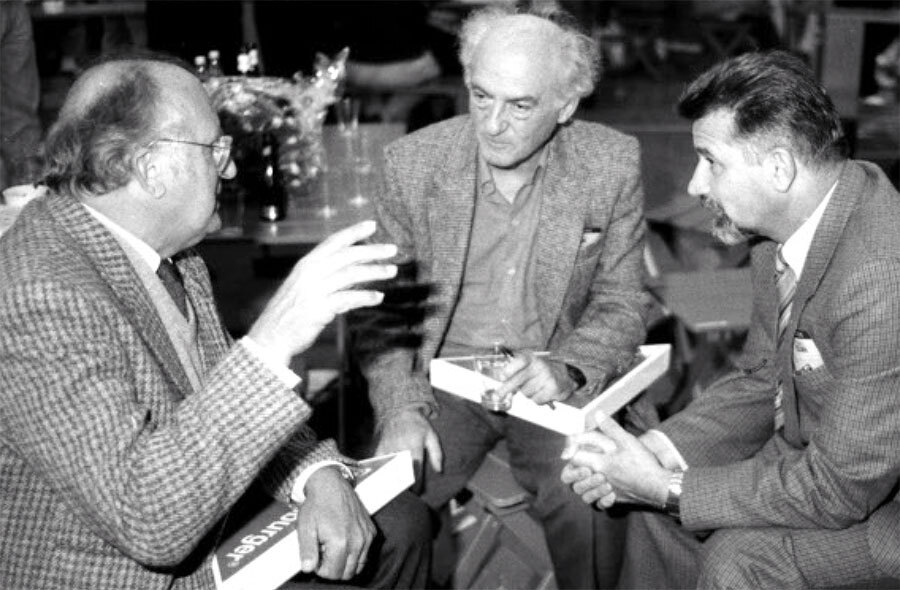
Gradually, what became known as the “games scene” emerged in Germany, made up of publishers, authors, organisers of public events, editors and enthusiastic players. This group of professionals, as well as passionate amateurs, increasingly succeeded in sparking and fostering a broad public interest in games.
The new and steadily growing market interest led to a decision in 1978 to establish a jury – mainly consisting of game-loving journalists – to award the “Spiel des Jahres” prize. The idea came from Jürgen Herz. On his way to the Nuremberg Toy Fair, he attended a meeting at Tom and Margot Werneck’s flat in Erlangen and presented his proposal. It was quickly put into action, so this award has been given annually in various categories since 1979. A groundbreaking distinction that almost immediately gained wide acceptance in the media and among the public.
Tabula rasa

In the same year, Alex Randolph had to cope with a serious loss when a fire in his studio destroyed his entire archive, personal notes and all his prototypes of new game ideas. Overnight, he had no games left in reserve to offer publishers. This event marked the beginning of a change, also in his approach to the games market.
The success
For Alex, the change began with a joint project with Michel Matschoss, whom he already knew from his collaboration with 3M Germany. When 3M discontinued its games programme, they decided to develop a game together to continue their professional collaboration on a private level. This initially rather vague project eventually led to the realisation of a game published by Ravensburger: Sagaland.
What was new about this game was that it wasn’t developed based on an author’s ideas, but with the aim of being enjoyed by German families. The special feature isn’t the game principle, but the way the theme is implemented, incorporating elements from stories and fairy tales that have long been part of German culture. Sagaland was named “Spiel des Jahres” in 1982 and became so popular that millions of copies were sold – and Alex received further recognition from the media and the public. You could even say that from this moment on, Alex pursued a new direction and was very successful with it, which also had a financial impact. Things took off.
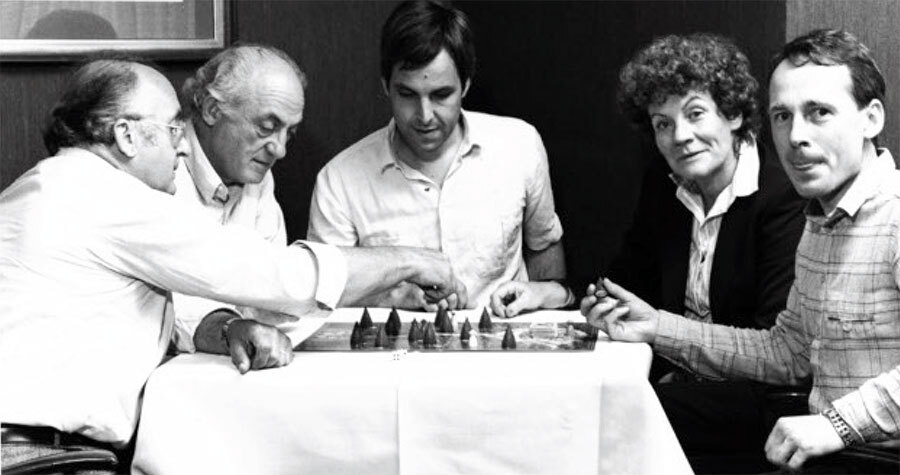
A new game was published by Ravensburger that became exceptionally successful: a snail race for children aged 3 to 4. Tempo, kleine Schnecke is surprisingly simple; even young children can easily understand the rules: roll a colour die and move the corresponding snail forward. The key lies in one rule that Alex particularly emphasised: there are two winners in the race. One who crosses the finish line first and one who crosses it last.
Alex, who always strongly defended competitive games over cooperative ones (“You have to learn to lose”), also stressed that for young children there should be games with almost no competition.
Playful authority
Alex made the decision to focus intensively on games – to dedicate his skills solely to them – after reading Huizinga, who describes play as the foundation of all human culture. During the rapid development of the German games market in the 1970s, Alex began developing games with the same principles he had applied to writing: expressing himself clearly and using as little material as possible, as it was very important to him to make the rules understandable to everyone.
He didn’t always achieve this goal, but he often succeeded in a convincing way.
Alex Randolph incorporated the observations described by Huizinga into his games. When he said that we seek justice in play that we cannot find in life, he was repeating the Dutch philosopher’s message for the public. But he also went further, casually defending games of chance as inherently fair because everyone has the same chances of winning. He put this insight into practice, for example, when he developed the “cake rule” for TwixT – 20 years after its first publication – which ensures equal opportunities at the start of a game: one player places the first stone, then the opponent decides whether to continue with that colour or choose the other.
When Huizinga posits that the human brain seeks order behind everything, Alex draws the inevitable conclusion that, at its core, the rule alone is the game. His ideal of creative purism makes a theme for a game redundant, as it only distracts from the dramatic tension.
Based on these principles, he wanted to try expressing himself in a stark minimalism, which may be the hardest thing of all: to build tension with nothing or almost nothing. This minimalism requires extreme concentration, yet with the simplest of materials, a surprising depth can still be achieved. All thanks to the rule! Fatal Error, for example – this game existed in a small, personal edition of around 100 copies: players must make do with 16 double-sided cards to lay out a circular path – consisting solely of a single black line. And they must interrupt the game as soon as a move prevents (Fatal Error!) this circular path from actually closing.
Another masterpiece from his Japan period, which isn’t really a game with rules but rather consists of construction material, is called Topolotoy, a cube perfectly divided into 8 Platonic solids.
Finally, after over 20 years of development with numerous improvements, Jekyll and Hyde became the game Geister, which for him also embodied simplicity: only one type of piece, only one possible move.
However, it must be said that there was no large market for such games, and Alex’s best games – like TwixT, Geister and a few others of this kind – never really achieved great success. Even the highly praised TwixT only sold modest quantities, a few thousand in its best years. So it was more of a critical success among connoisseurs and enthusiasts.
And yet, through these kinds of games, Alex Randolph became a recognised authority in the world of publishers and game designers. What’s more: his opinion carried weight and was well-founded. He knew how to present his perspective well, often adding a humorous twist to his arguments. In short, he used his eloquence to make things happen, whenever he could. It was less about the ‘speed of thought’ and more about arguments that were carefully considered, making his position almost irrefutable. A typical example was his response to militant anti-war game campaigners: “Anyone who condemns war games should start with football!”
Defending the status of ‘game designer’ was very important to him. Early in his career, it had hit him hard when he lost the rights to the intellectual property of TwixT and had to buy them back. That’s why he increasingly advocated for – and ultimately threw his full weight behind – persuading publishers to always print a designer’s name on the game box. Once he had achieved this for himself, he worked to ensure it for everyone else. He initiated discussion groups with other game inventors. One of these gatherings led to the founding of the SAZ (Spieleautorenzunft) in 1991 in Göttingen, at Karin and Reinhold Wittig’s, who set up an annual game designers’ meetup.