
Stefan Brück on alea, his resignation and working with his successor
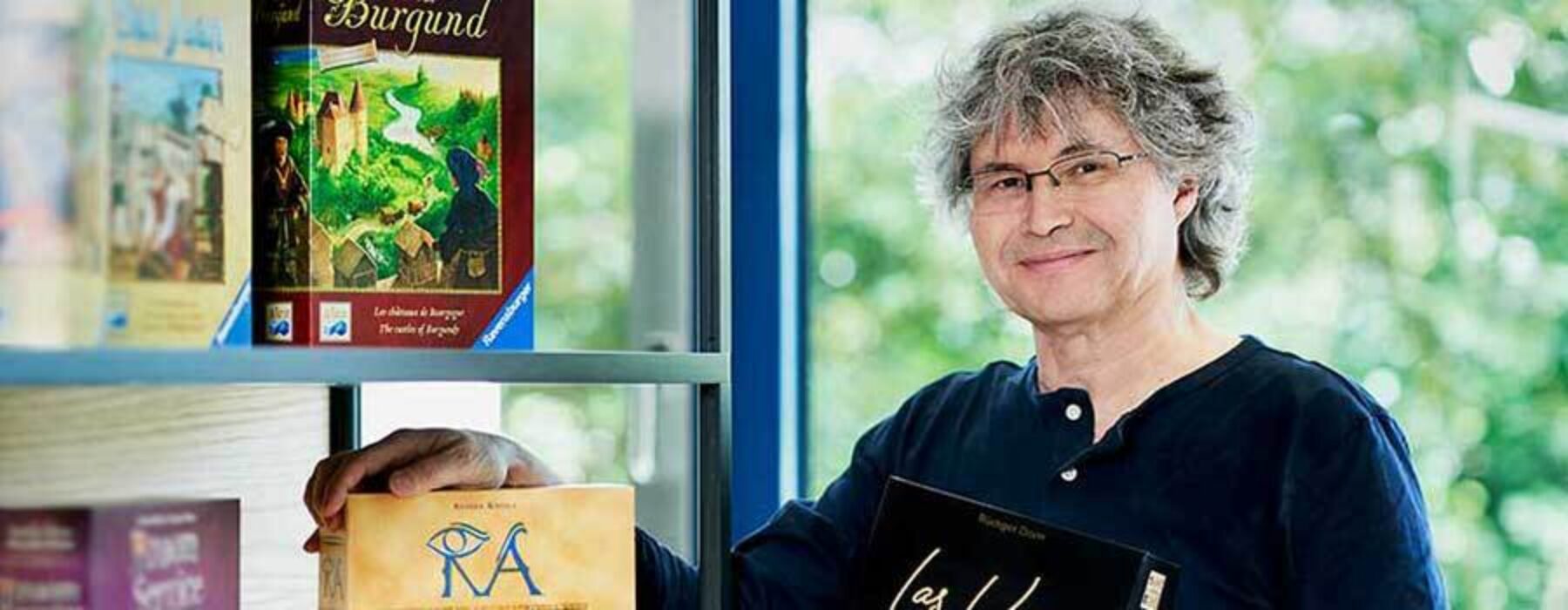
Stefan Brück was the face and driving force behind the Ravensburger brand alea. In summer 2020, he left the publisher. Since then, he had not spoken publicly until now. We spoke to Brück – about the reasons behind his resignation, his current work and Stefan Feld.
The interview is a summary of a one-hour conversation with Stefan Brück. You can listen to the full interview in the podcast Boardcast by Frederik Malsy.
You wanted to start your own publisher after leaving alea. What became of that?
The plan largely fell through. During the coronavirus pandemic, I had a lot of time to think. I realised that starting my own publisher would be too much for me as a one-man operation at this point in time.
What are you doing instead?
I work freelance for publishers, including Ravensburger, Game Factory and Deep Print.
What does that involve exactly?
My freelance work is very similar to what I did at alea. With one big difference: in the past, I mainly handled expert games, whereas now I focus more on family games. Sometimes I act like a game editor. I look at prototypes, test them and work on them. Sometimes I also work as a localiser, translating games from English into German.
You were very successful with alea. So why did you resign in 2020?
The reason was probably a kind of fatigue. I had a lot of freedom and a wide range of tasks, but after nearly 25 years, even such a great job becomes routine. There were also internal developments that I didn’t like. They led to me having less freedom. I had to get more decisions approved. After 25 years of successful work, this bothered me. I saw no advantage in it, only extra effort and a risk of dilution.
Why were there these changes?
The American market became more important, and the influence of Ravensburger North America grew. The Castles of Burgundy (BuBu) was and is alea’s most successful game in the USA. So questions arose about what else could be done around BuBu, for example a second game. These were understandable questions, but not from my perspective.
The way Americans approach games also differs from my approach. Generally speaking, American games tend to focus more on theme, materials and visuals. They rely a lot on the surrounding elements, merchandising and licences. That’s fine, but it’s not what defined alea. Nor is it what defined me at alea.
Before the changes, could you do whatever you wanted?
Yes, in fact. I had to make very few compromises. Sometimes alea games weren’t even shown or tested in conferences because there wasn’t time. Besides, they were special games that wouldn’t have appealed to every conference participant anyway. I am and was very grateful to Ravensburger for these freedoms. They don’t come along often. Maybe that was one reason for the success. At alea, everything came from one source. There was a dishwasher, cook and sous-chef all in one person – and not many cooks who could spoil the broth.
Were there financial constraints?
The calculations had to add up. At the end of the day, a game had to cost amount X so it could be sold for amount Y. I made some cuts here and there because of this, but nothing major.
So why was there criticism of the quality or components of alea games?
Some of the criticism was justified, some was exaggerated. As the person responsible for the brand, I myself suffered greatly from the erasable pens in Saint Malo. They were simply a disaster, but they didn’t contain the tiniest bit of alcohol. The fact that players’ hands were completely covered in ink after every game unfortunately bothered the head of quality control less. That was also an internal issue. Another example was the coloured tile backs in Carpe Diem. On screen, you could distinguish the shades of green wonderfully, but in reality, not so much.
You used to work with Stefan Feld a lot. Do you still keep in touch?
Yes, I still have contact with Stefan. It was partly his idea that I could start my own publisher. Over the past years, we’ve been working on a game for it. I’m happy that the game has now found a home with another publisher and that I can continue to be involved. I can’t say any more about it yet.
After you left alea, Puerto Rico was revised. The publisher responded to discussions about colonialism and racism. What do you think of the new version?
I only followed the work on the reissue from the sidelines and know few details about the approach and changes. Personally, I think political correctness is overdone in some games. The brown discs in Puerto Rico were never slaves. We researched the history of Puerto Rico. The result: after its ‘discovery’, Puerto Rico didn’t have enough workers. That’s why people were brought from the old country to the island as colonists, not as slaves. What happened later is a different story. But ‘our’ Puerto Rico never took place during the time of slavery.
If people, for example Puerto Ricans, see it differently, I wouldn’t presume to judge or condemn those opinions. At the end of the day, they’re just games that we produce or consume – not books, treatises or political statements.
Isn’t that devaluing the cultural asset of games compared to other cultural assets like books or films?
For me, games primarily have entertainment value, whereas films have a higher educational value. Depending on the subject, a film has to be more historically accurate than a game. Even a book, even fiction, in my view has a more profound impact than a game.

Even The Castles of Burgundy were revised. On Gamefound, the most expensive version of the reissue, including game mats and painted miniatures, costs 267 euros. What do you think of that?
I’m not sure if they haven’t gone a bit too far there. Visuals and materials are becoming increasingly important. Often, the mechanism gets lost in the process. That’s not the case with Castles of Burgundy, because the game itself hasn’t been changed. But with other games that come across so pompously, I sometimes wonder: what’s left when you set the components aside? Often not much more than hot air and a cool show. That’s a problem with many crowdfunding projects.
Do you have contact with your successor André Maack?
Yes, I have regular and very good contact with André, and for Ravensburger I primarily handle alea projects. That also shows that we parted on good terms.
What were your tasks with the past alea new releases?
For Dungeons, Dice and Danger, I worked closely with André and Thorsten Gimmler. The prototype was already on the alea editorial desk during my time there. But back then, a lot of things still weren’t quite right. With Council of Shadows, I was less involved. I struggled a bit with the game because the mechanism never really clicked with me. Later, though, I did finalise the rulebook.
Way back, you developed games yourself, for example in 1989 Tom & Jerry: Das große Rennen. When can we expect the next game from you?
After I resigned, I had a lot of free time and tried to develop and refine game ideas. I failed. If publishers approach me and ask for inspiration on a theme or licence, I can certainly come up with ideas. But I don’t develop a complete game. That’s basically always been the case. I was never an author, but always an editor.
Stefan Brück and alea
Stefan Brück was born in 1961. In the 1990s, he was responsible for the entire games programme at publisher F.X. Schmid. The era of alea began for him in 1997 when Ravensburger took over F.X. Schmid. Since the takeover, Brück has been solely responsible for alea – as editor, product manager and head of the brand. In 1998, alea was presented to the public for the first time at SPIEL Essen, with the production-ready prototype of Ra. The official launch then took place at the Spielwarenmesse in 1999. It started with the first two games: Ra by Reiner Knizia and Chinatown by Karsten Hartwig. Since then, alea games have received numerous awards and accolades. Brück left alea in the summer of 2020. His successor is André Maack.