
Landlord’s Game becomes Monopoly: Economy on the kitchen table
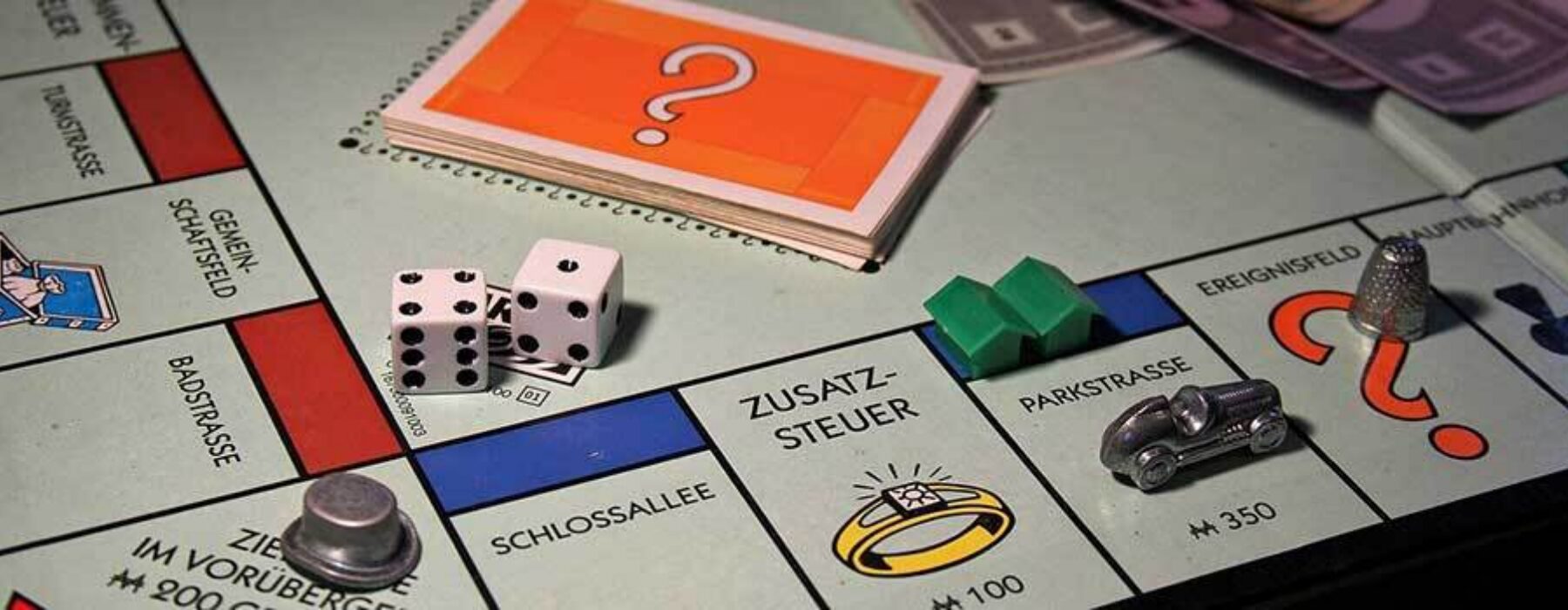
Conceived as a critique of monopoly capitalism, Monopoly developed into one of the greatest economic successes in gaming history. The game was and is a mirror of society and its economic systems.
Philadelphia, in the midst of the Great Depression: Charles Darrow sits at the kitchen table and invents a global success. The unemployed heating engineer carves little houses from wood scraps. He cuts up cardboard boxes and labels them with numbers. On a red oilcloth, he scribbles street names and colourful spaces. On top, he places a thimble, a spool of thread and a bracelet as playing pieces. This is roughly how one of the most famous board games of all time came to be: Monopoly. Even in the GDR, citizens haggled over streets and rents. No other social game was copied as often as Monopoly. Much to the displeasure of SED politicians and Stasi employees. For them, the struggle for houses, hotels and mortgages was an unwanted tribute to capitalism. So to speak, the devil in board game form. Yet Monopoly originally advocated for an economic system in which all people benefit from progress, not just large landowners.
First Landlord’s Game, then Monopoly
“Monopoly was a gift from heaven and a child of its time. It gave people the illusion that they could make a fortune in real life by buying and selling land,” said Robert Barton, the former president of Parker. But it was the game publisher that made the big money. In 1935, the company secured the rights from Darrow and sold over a million copies of Monopoly within a year – right in the middle of the Great Depression. Darrow, the father of the game, also became a millionaire through the licensing income. The mother of the game, however, earned only 500 US dollars from it.
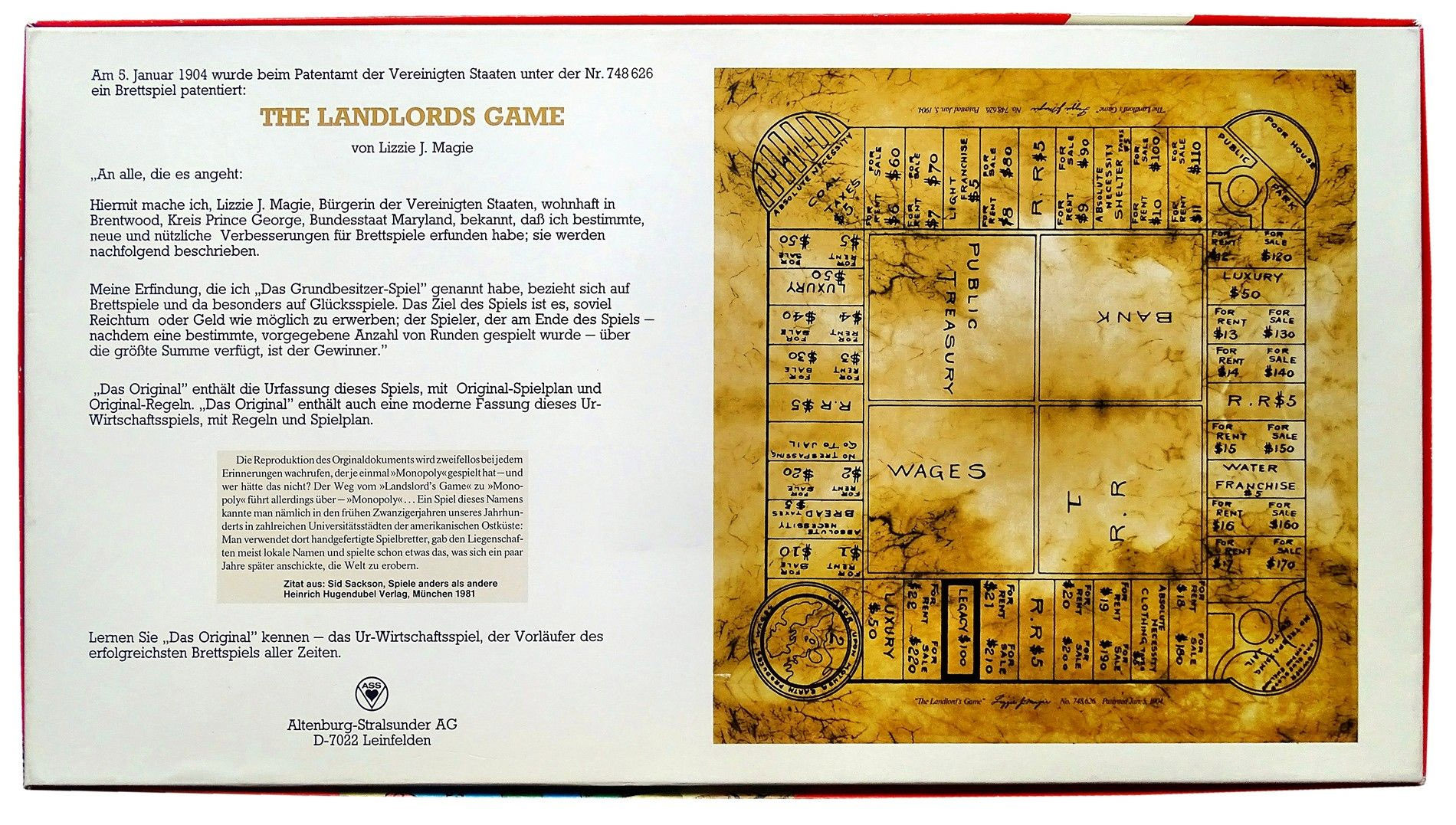
Elizabeth Magie, later Phillips, designed Landlord’s Game in 1904. It addresses the monopolistic capitalist tendencies of large landowners. The game board resembled the Monopoly layout. On each side, there were nine rectangular property spaces, along with a jail and a poorhouse. “Landlord’s Game was a critique of its time, unlike most games known at the time. It was complex, with unusually detailed rules. Magie had the game patented. In the early 1920s, she added houses and hotels when it became clear that buildings on land were often more valuable than large estates,” explains Peter Lemcke, founder of the German Games Museum in Chemnitz. Darrow knew Landlord’s Game and was inspired by it. This didn’t bother former Parker president Randolph Barton: “The fact is that Darrow put the pieces together. He brought the game to market and sold it to us. Back then, there were a lot of people dealing with property games. Darrow was the guy who came out with his game and made his fortune, in the best tradition of the American Dream.” Just to be safe, Parker still acquired the rights from Magie – for 500 US dollars. Later, these rights passed to Hasbro.
Single-Tax Theory: Monopoly without land speculation
According to Hasbro, Magie never regretted the deal. Her goal was not to make a lot of money, but to spread an idea. She wanted the game to keep the Single-Tax Theory in the conversation. She didn’t succeed. Hardly any Monopoly player knows the economic theory. It comes from the economist Henry George. In his book “Progress and Poverty”, written at the end of the 19th century, he stated: “The great cause of inequality in the distribution of wealth is inequality in land ownership. To eradicate poverty, we must replace individual land ownership with common ownership.” The economist did not call for expropriation, but for a tax on land, on property ownership. He wanted to abolish all other taxes. Magie liked the idea. With Landlord’s Game, she wanted to show that everyone could benefit from a Single Tax. In her game, there was a variant without land speculation. In this version, most players became increasingly wealthy.
With today’s rules, only one player wins. They must drive all competitors into ruin. Whether this principle celebrates or condemns capitalism depends on your perspective. “The key word is affirmation. Put simply: exaggerated approval. The affirmative effect of Monopoly arises when all players passionately fight each other to the bitter end and lose everything. Here, the principle of monopoly capitalism is taken to the extreme. Through this affirmative trial run, players experience Magie’s critique of monopoly capitalism, while simultaneously learning to assert themselves in society,” explains Lemcke.
After its success in the United States of America, Parker exported Monopoly to other countries. In Germany, Schmidt acquired the rights in 1936. The game was popular with the citizens, that much is certain. It is unclear why Monopoly disappeared from department store shelves in the Third Reich. Did Joseph Goebbels ban the game because of its allegedly “Jewish-speculative character”? Or did the Propaganda Minister dislike the German translation? The prominent district of Schwanenwerder, where Goebbels also resided, appeared on the game board with exorbitant rents. Was the public not supposed to know about the politician’s luxurious lifestyle? What is certain is that Monopoly last appeared in the Schmidt Spiele catalogue in 1938.
Copied: Monopoly copies in the GDR

In the Eastern Bloc, the game officially existed only from the late 1980s. Communists and socialists agreed: the game of rents, power and money fuelled greed. “Even Josef Stalin could and would not reconcile himself with Monopoly due to its alleged decadence. This was reason enough to ban the game from the capitalist abroad. No Monopoly was to reach the territory of the GDR. Copies hidden in Western packages were confiscated,” reports Hasbro.
The citizens of the GDR were not deterred. They eagerly copied Monopoly. Some of the replicas were exact plagiarisms, while others included autobiographical elements. On a Monopoly Chance card from Leipzig, a young girl scribbled: “Your child has broken their leg, go to Querstraße and pay.” At that address, there was indeed once the Leipzig children’s surgery. In a Monopoly copy from Hönow near Berlin, real and fictional economic life merged in a special way. The owner stacked the Monopoly money in a wooden box with several compartments. Above it, in printed letters: Rent, Insurance and Savings Book. Before the game money went into the box, the woman stored her household money there. The example shows: players in the GDR often had to improvise when copying the game: “We sawed the houses from square wooden strips and painted them. We drew the game board on coloured paper, glued it onto plywood and varnished it. We typed the Chance cards on a typewriter,” recalls a player from Wolfen, a small town between Dessau and Leipzig. Others repurposed materials from existing games. “Instead of Monopoly dollars, we used notes from the children’s shop game. We used red Lego bricks as houses, white ones as hotels. We first copied the cards and then glued them onto sturdy cardboard, which was included in the photo paper packaging at the time. So that Monopoly wouldn’t be too obvious in the cupboard, we chose the box of another game as the packaging,” remembers a woman from Dresden. One even more creative hiding place was found by a former soldier of the National People’s Army. The man and his comrades drew the Monopoly board on the back of a picture. In the evenings, the game was on the table; during the day, the artwork hung on the wall with the inconspicuous side facing forward.
With perestroika, the Monopoly ban in the East was relaxed. In 1988, the first Soviet Monopoly was released. Thanks to Mikhail Gorbachev’s glasnost policy, Russians have since been officially driving themselves into Monopoly bankruptcy. Due to the ban, the game had gained cult status in the former USSR and in the GDR. When the Wall fell in 1989, many citizens bought original Monopoly sets and disposed of their homemade copies. Today, the GDR is history, but Monopoly is still around. Alongside the few homemade versions, there are now city editions of Dresden, Leipzig or Rostock. Demand for these is high. In recent years, Hasbro has sold an average of around 750,000 Monopoly editions in Germany each year. The classic version costs about twenty euros.
Landowners who find that too cheap can opt for luxury versions. American Alfred Dunhill sold a version with silver houses and gold hotels for 25,000 US dollars. And Californian jeweller Sydney Mobell charged one million US dollars for his edition. The accompanying game board and pieces were made of pure gold. Jewels adorned the houses, and diamonds the golden dice. Mobell had no trouble finding a buyer. Welcome to capitalism.